Why iPad magazines aren’t selling well

Women’s Wear Daily reported recently that after an initial burst, iPad-based magazines aren’t selling well.

Well, duh. They were designed to meet the needs of publishers, not readers.

Hey, let’s charge $5 an issue for something that requires little work because we can just export from inDesign! Genius!

As a former online news guy, I view the iPad app craze as an attempt by publishers to try to turn back time.

Many executives in the business still believe in the “original sin” of not charging for content online when news sites first launched. (Conveniently ignoring the reality that many newspapers, including ours, tried and failed to charge for online content.)

I’ve spent time with apps from all of the leading newspaper companies. They remind me a bit of TimesFax, a digest of the New York Times that was delivered by fax to remote locations. The only one that was engaging was USA Today — and that was because of their great implementation of the crossword. The magazine apps are gigantic — consuming about 500MB per issue. There’s little interactivity.

The apps give publishers the illusion of control. They can push a package of identical content to people, just like they do in print. The only people these apps will appeal to are those few who liked the PDF-like versions that the industry kept pushing. Yes, those folks might be drawn into subscription models. As long as ABC keeps counting this as circulation, they could use this to move people over from print and reduce costs.

The apps ignore four fundamental, irreversible trends:

  • Real time. People want stuff fast. Waiting a week or a month for updates is more and more unacceptable. In reviewing some of the newspaper apps, it was obvious that they were struggling to walk the line between being a reasonable replica of the print edition and being fresher.
  • Personalization. Even the nichiest magazine is going to have a lot of content that a reader doesn’t want. Again, publishers and editors want the feeling of control that they used to have.
  • Social. Social networks are increasingly driving content consumption. Most magazine and newspaper apps don’t work well within that environment.
  • Free. Except for very specific content areas, paywalls haven’t worked in the 15+ years publishers have been trying them. Not only are iPad magazines not free, they’re generally very expensive. You can get Wired in print for as little as $4 a year. They want that much for a single issue on the iPad.

They would all do better to skip the proprietary apps and work with someone like Flipboard, who understands all of this.

As I mentioned, ABC is allowing publishers to count these digital copies as circulation toward their print ad rates as long as they are reasonable replicas of the print product and contain the same advertising.

This is a joke. (Guess who pays ABC.) Advertisers aren’t stupid — they are going to begin demanding that they get metrics just as they do with online advertising

Posted in ipad, journalism, media | 3 Comments

Junk journalism: media flaming fear and irrationality

The Daily Beast’s Howard Kurtz recently took the media to task for spending too much time covering the TSA’s new procedures, referring to it as a “‘junk’ journalism epidemic.”

I’ve about had it with media types who insist on turning this into a junk story.

A government agency with more than a $7 billon budget that touches 2 million people a day (now sometimes literally) with little accountability? That’s exactly the kind of story that the media should be focused on.

Unfortunately, Howie is right in that while they’ve stayed on the story, the handling has largely been junk.

There are two biases in today’s media: laziness and sensationalism. They lazily do the standup at the airport with the grandma who says she’s happy to fly naked if it makes her safer. (Portland TV stations sent their reporters to Portland International Airport, even though the new procedures aren’t in place there.) They don’t bother to question whether it actually makes her safer.

They lazily interview John Pistole with his pat answers that admonish people that it’s all for their own good and to remember 9/11. Deference to official sources is just as strong as it was during the lead up to the Iraq war. Tough questions are few and far between. Official statements are treated as gospel. Even in Howie’s piece, he quotes Pistole as saying “Very few people actually get the pat-down at all … it’s a very, very small number.” That “very, very small number” is about 60,000 people a day.

They also interview security consultants, who have either worked for these same agencies or make their money by working for the companies that make the scanners or both. Former Homeland Security chief Michael Chertoff’s company worked on behalf of Rapiscan, one of the two suppliers of the devices.

They lazily quote polls from other news organizations without any understanding of what the poll asked or what the answer meant. The widely quoted CBS News poll was garbage.

For the most part, they don’t ask about whether the new procedures are effective or whether they can be worked around. They can — just insert the explosives into the rectum or vagina. That’s right, we have government employees fondling law-abiding citizens without cause, even though a terrorist can easily work around it. Even the companies that make the new imaging devices are uncertain whether they would have detected the underwear bomber.

They don’t bother to ask about all of the risks the TSA ignores while it puts on a show at the security checkpoint.

There’s also a bias to sensationalize. Some people are afraid to fly as it. The bogeyman of the Muslim terrorist plays well. We fear dying in a plane bombing because incidents that involve aircraft get a disproportionate amount of media attention. The media have a financial incentive to sensationalize: scared people watch TV to hear the “experts” talk about how to stay safe.

What the media don’t talk about is that flying is incredibly safe. 2 million people a day fly in the U.S. That’s more than 700 million people a year. In the last 9 years, there have been:

  • More than 300,000 deaths in car crashes.
  • More than 130,000 people murdered.
  • Exactly zero fatalities from aviation terrorism in the U.S.  6.6 billion passengers and zero fatalities.

Everything we do in life has a risk to it. Taking a shower, walking down the street, going to the mall.

I travel between 50,000 and 100,000 miles a year most years. I also travel on larger planes and to and from foreign countries. My risk of dying in a terrorism-related plane crash is much greater than that of the average American. (16% of Americans have never flown; another 37% fly less than once a year.) But I’m not worried because I know the risk is so unbelievably tiny it’s not worth worrying about. The TSA’s new procedures don’t reduce that already insignificant risk.

The Cinnabon at the airport food court is a bigger threat to your health and well being than a terrorist is. And, by the way, what the TSA doesn’t want you to know is that the guy working behind the counter at the Cinnabon didn’t have to go through security.

Posted in journalism, media, newspapers | 5 Comments

Asking meaningless questions: CBS’ faulty poll on TSA screening

Daryl Cagle, MSNBC cartoonist

Daryl Cagle, MSNBC cartoonist

In defending its actions in screening passengers, the TSA continually points to a CBS News Poll which claims that 80% of Americans support the scan. What does that really mean?

Let’s take a look at the actual question that was asked:

Some airports are now using “full-body” digital x-ray machines to electronically screen passengers in airport security lines. Do you think these new x-ray machines should or should not be used at airports?

Nowhere in the question is the technology explained. No mention of the fact that the scanners see through clothing and generate images that provide anatomical detail. No mention that the efficacy of the scanners has been questioned by security experts. No mention of the potential health effects of the x-rays. The frame of reference that most people have for x-rays is what they see at the doctor’s office when they break a bone. People are being asked a question without the background to understand what it really means.

The poll also surveyed the general population. It does not reflect the population that actually flies, even sporadically. (Much less those who are on planes several times a month.) According to Bureau of Transportation Statistics survey data, only about 40% of the population had taken even one trip by commercial aircraft in the previous 12 months.

For this poll to really have meaning, the question should be asked of people who are affected and who understand what is being asked. Question wording has a huge impact on results. Most journalists don’t bother to look at what was actually asked before making assumptions about what the results say.

CBS might want to consider this variation for their next poll:

Some airports are using enhanced screening techniques in airport security lines. Do you think 13-year-old children should or should not have their genitals touched by government agents without probable cause?

I’d bet that the results are the mirror opposite.

Update: ABC News did its own poll on TSA screening that addressed both of the issues above (wording bias and sample bias). It’s results were very different.

Specifically, ABC asked:

The Transportation Security Administration is increasing its use of so-called ‘full-body’ digital x-ray machines to screen passengers in airport security lines. (Supporters say these machines improve the ability to spot hidden weapons and explosives, and reduce the need for physical searches.) (Opponents say these machines invade privacy by producing x-ray images of a passenger’s naked body that security officials can see, and don’t provide enough added security to justify this.) Which comes closer to your own view – do you support or oppose using these scanners in airport security lines?

Among people who fly at least once a year, 58% support the machines and 37% oppose. Opposition rises among people who fly more frequently, although that sample size was small.

Posted in metrics, research, travel | 3 Comments

Netflix throws away the disc in the US

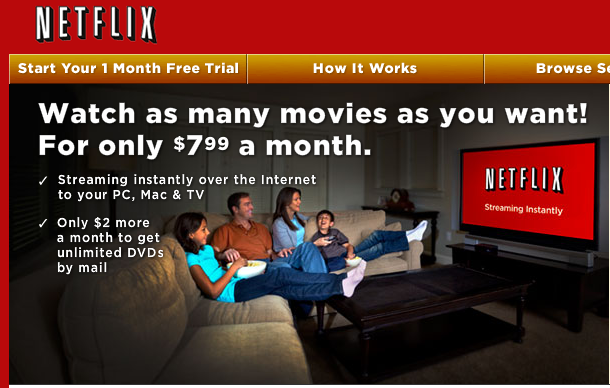
Netflix is edging a step closer to its name with a test of streaming only service in the United States. The new offering allows users to purchase a net-only subscription for $7.99 a month. Adding DVD rentals is an option for an additional $2.00. This represents a $1.00 price increase from recent offers of $8.99 for unlimited streaming and unlimited DVD rentals with 1 DVD out at a time.

The online selection still lags its DVD catalog. That’s unlikely to change in the near future.

Netflix has been de-emphasizing DVDs lately. For good reason: streaming is much cheaper than postage. It costs roughly 5 cents to stream a movie vs. close to $1 per DVD rental. It has put a substantial emphasis on streaming, with Netflix capabilities embedded into dozens of devices, including Apple TV, Google TV, blu-ray players, iPads, iPhones, TVs and game consoles.

The company also recently entered the Canadian market with a CDN$7.99 streaming only plan with no option for DVDs.

H/T: Andrew Cooke on Quora

Netflix streaming only offer

Netflix streaming only offer

Posted in netflix, television | 2 Comments

Apple and Google make their big push to TV screen

This year has seen the biggest push yet to bring the Internet (or parts of it) to the biggest screen in the house. The newly revamped Apple TV started arriving in stores and homes last week. Logitech is announcing the details of its Revue Google TV box tomorrow. The boxee box is due in November. Roku has revamped its product line. TiVo is planning enhancements to its Premiere boxes. Prices are all over the map, from $60 for the cheapest Roku box to $500 + subscription fees for the most expensive TiVo. Capabilities vary dramatically.

It should be quite the battle at retail this holiday season.

Regardless of who sells the most boxes, these are the likely winners and losers in the overall entertainment ecosystem.

Winners:

  1. Netflix. Apple TV, Google TV, roku, Boxee, blu-ray and DVD players, networked TVs… Netflix is everywhere. In the last year, its stock is up 250%, compared with 51% for Apple and 8% for Google. Netflix recently reported that 61% of its customers had watched 15 minutes or more of streaming video online in the last month. Not only does that reduce distribution costs (the company spends $600 million a year on postage), it gives Netflix more leverage to negotiate distribution deals with studios. Netflix is already the number 3 video content distributor, beating out all but Comcast and DirecTV. With all of this additional distribution, I wouldn’t be surprised to see Netflix be the top video distributor in a few years.
  2. hulu. It could be a big beneficiary, but its ownership could keep this from happening. hulu’s network owners (NBC/Fox/Disney) seem conflicted on whether they want hulu to succeed. hulu integration is planned for roku and TiVo, but hulu has repeatedly blocked boxee. It will be interesting to see if hulu chooses to block Google TV’s browser.
  3. YouTube. As YouTube pushes more into longer videos and higher quality videos, it becomes more compelling to watch them on a big screen. A good 10′ interface would drive additional consumption.

Losers:

  1. Traditional media buyers. Ads today are sold by show, which serve as a proxy for demographics. e.g. ads on Grey’s Anatomy are targeted at young females. These will become more algorithmic and bought by individuals.
  2. Lesser cable channels. Some cable channels today only get distribution as part of bigger deals. For example, Disney may say if you want ESPN you have to carry the Ocho.
  3. Traditional pay-TV providers. Pressure to unbundle channels will increase. Making Web content easier to access will steal share of audience from traditional premium programming. On the plus side, it should drive additional demand for faster tiers of broadband.
Posted in apple, apple tv, google, hulu, television | 3 Comments

Facebook Places is at the beginning of a long road

Facebook Places on the iPhone

Facebook Places on the iPhone

Facebook’s much awaited Places product finally launched this week. It’s the first step toward bringing friend finding to the masses.

People have been using Facebook to do this for years; posting their location in freeform status updates that their friends can read and comment on. (e.g. “heading to Cambridge for dinner.”) By turning that freeform text into structured location data, Facebook can make that data more useful.

From an iPhone or HTML5-capable mobile device, you can check in to a place, such as a restaurant, bar, movie theater, airport. You can also leave a message with the check in. The check in is posted to your wall and may appears in friends’ news feeds. On the mobile side, you can see a list of your friends and where they’ve checked in. Clicking on a place will show you details of the place, including a map and who has checked in.

The initial release is fairly simple. In fact, it’s not that much more useful than the freeform status updates.

Facebook is entering a very crowded space with competitors such as foursquare, Gowalla, Loopt, Google Latitude, Whrrl and Twitter. Many of those products are much more robust. Facebook’s key advantage is the size of its social graph: within the past 24 hours, 18 of my friends have checked in.

There are many opportunities for improvement to Facebook Places:

  • Basic UI. Check ins are sorted by time, not distance. A friend checking in 2,000 miles away 2 minutes ago is less relevant than someone checking in 2 miles away 5 minutes ago. This problem is exacerbated by the fact that the city isn’t shown. Considering that many people use Facebook to keep track of friends all around the world, this is a significant issue. Foursquare has a separate bucket of “Friends in other cities.” Update: Facebook now has a separate grouping of nearby friends.
  • Map view. Often, visualizing your friends on a map is much easier than scanning a list. Foursquare already offers this.
  • Visiting friends. Out of town friends who are in town aren’t indicated. One of the big potential values of social friend finding is discovering when friends are in town. If a friend from far away is visiting, I’m more inclined to want to get together than someone who lives in town.
  • Pictures. There is no way to associate a picture with a check in. Given the difficulty in typing on mobile devices, often a picture gives a lot more information. These pictures could also be used to build a much more robust Place page.
  • Pushing location. Sending people your location via SMS is tedious. You have to address the message, type out where you are. If they don’t know where it is, they have to pull up a map or text you back for directions. With Places, it would be easy to push a notification to friends with where you are, complete with map. This could be sent as a push notification on iPhones or as an SMS with a URL for other phones.

As with most Facebook product launches, questions of privacy come up. In general, I think Facebook has done a good job with the default privacy settings on Places. You must explicitly check in; there is no background tracking.

Only your friends can see where you’ve checked in. Unfortunately, my social graph on Facebook wasn’t designed with location in mind. When I decided whether or not to accept friend requests on foursquare, I used a tighter filter than on Facebook. Now, I’ll have to go back through Facebook friends and create a list of who should have access to location. (See Post technology columnist Rob Pegoraro’s piece on how he classifies his friends.) Yes, old high school friends have been known to burgle homes based on Facebook updates. If that worries you, watch Rob’s video on how to adjust your privacy settings for Places.

The one big complaint I have with the privacy defaults is that your friends can check you into a location without your permission.

See also:

Posted in facebook, foursquare, geotagging, lbs, maps, mobile, twitter, wireless | Tagged | 6 Comments

Heading toward the Facebook recommendation engine

Image representing Facebook as depicted in Cru...

Image via CrunchBase

There’s an interesting thread over at Mike Blumenthal’s blog on the effect of Facebook Places on the local reviews space.

My view is that reviews and updates will coexist, much as blogs and Twitter coexist. People who were less committed to reviews will migrate their activity to Facebook Places updates. But Places could lead toward the ultimate recommendation engine.

In the local space, there’s really only one review site that matters: Yelp. They’ve got a strong set of tools and an active and engaged community. New restaurants and bars, which are often of the most interest, will have a dozen reviews on Yelp a year before they even show up on many Yellow Pages sites.

There are three big challenges with Yelp:

  • It’s been too successful. Many restaurants have hundreds of reviews. Although Yelp provides great tools for analyzing the data, it can still feel overwhelming. It also discourages participation from more casual users. In the early days of Yelp, I was an active reviewer. That’s tapered off substantially — what’s the marginal benefit of me writing the 426th review of a place?
  • These aren’t my real friends. I don’t know how compatible their tastes are with mine. It also affects the propensity to write reviews. People are more likely to do something that helps their friends than something that helps a generic audience.
  • Skewed demographics. Yelp primarily caters to a young, urban demographic. If you’re a mom in the suburbs, its value is more limited.

Facebook Places lowers the bar to participation and ties it into real-life social networks. Instead of writing out a long review, a few clicks is all it takes. Combine that with Facebook’s large user base on mobile devices — its monthly uniques on mobile devices is 4x Yelp’s monthly uniques on the Web — and we’ll see a tsunami of local data. (For more on importance of massive amounts of data, watch Google’s Peter Norvig’s talk.)

While each blip may not be as rich as the data in Yelp, you could build a recommendation engine to infer a lot from that data.

If I see that a place I am considering visiting is regularly frequented by my friends with families, I can infer that it is good for kids. Positive reviews can be inferred by friends going back to a place regularly. There are some friends who I have negative taste relationships with. If I know that they’re regulars somewhere, I know not to go there. Facebook can also make recommendations based on places I’ve visited and the overlaps with places my friends have visited. Facebook also has real demographic information which could be used to tailor recommendations.

Status updates in the social network also prompt discussions. Even if the original poster doesn’t write a review, it may be followed up by “hey, I was thinking of going there. what did you think of it?” Facebook could also close the loop by prompting people to add star ratings, Like or add comments a few days after a check in.

When it comes to restaurant reviews and recommendations, most people are looking for “good enough”. While you could spend hours reading every Yelp review of several restaurants and possibly get a better answer, a recommendation based on your friends’ activity is probably nearly as good. Facebook has done really well with good enough; Facebook Photos dominates online photo sharing, despite many functional weaknesses when compared with flickr.

I built a prototype of this when I was at AOL Search and even with a few users in the system, it worked really well.

More on: Facebook, local search, Yelp

See also:

Posted in facebook, lbs, local search, maps, yellow pages, yelp | Tagged | 15 Comments

Groupon personalizes the daily deal

Groupon announced a shift from its approach of the same deal for all email subscribers in a market to personalized deals in select cities. CEO Andrew Mason says that there is a backlog of 35,000 businesses waiting to be featured on Groupon and that 7 businesses are turned away for each that is featured.

Offering more deals makes sense for Groupon, for consumers and for businesses. It will lead to higher engagement among consumers, more revenue for Groupon and better results for businesses:

  • Higher engagement. As the novelty of the daily deal wears off, email open rates will decline. In my own usage, I’ve found that many businesses featured are outside the area that I’m willing to travel. If I know that deals are more local and more relevant, I’ll be more likely to open the email.
  • More revenue. Having multiple deals allows Groupon to capture revenue from more people because deals will be more relevant. The user data collected will also help with getting businesses on board — sales people will be able to say we have X thousand customers within a few miles of your business.
  • Better results for businesses. One of the concerns that small businesses have with offering big deals is attracting only deal chasers. The ideal customer is someone who will convert into a regular and pay full price. Someone who is willing to drive 30 miles to save $10 will likely have a low or negative lifetime value.

Mason says the first cut of personalization will be dumb, using limited data such as ZIP code, gender and age. While location is important, it does come with a couple of caveats:

  • Location is often directional. People living in Manhattan are much less likely to go to New Jersey for a deal than the reverse.
  • Its importance varies by business. People will travel farther to go skydiving than for a restaurant or bakery.

I’m not as convinced on using gender, age or other factors to target deals. Many of the deals have wide appeal and part of the value of products like Groupon is their serendipity.

Posted in advertising, local search, marketing | 1 Comment

Why small businesses are snapping up the daily deal

A sample daily deal from Living Social.

In recent months, we’ve seen daily deal sites like Groupon and Living Social grow like crazy. Groupon is valued at $1.35 billion. That’s more than 4x the valuation of the McClatchy Company, one of the country’s largest newspaper publishers. It also ekes out The New York Times Company. Others are scrambling to get into the business, including DealPop in Seattle and CrowdCut in Minneapolis. Yelp is also testing its own entry in Sacramento.

A while back, I wrote about why small businesses were reluctant to get online. So what changed?

Well, the daily deal providers addressed most of the challenges I laid out.

  • No one was asking them to get online; now they are. Groupon, Living Social and others are rapidly building up local sales forces to approach small businesses.
  • It’s a lot simpler. Bidding on keywords is beyond the experience level and time commitment most small businesses can afford. Putting together a special offer is much simpler and the daily deal sites are doing a lot of hand holding. Even Google has realized this, with simplified pricing for its Google Tags product aimed at small businesses.
  • There’s no upfront commitment required. Unlike most advertising products, businesses don’t have to spend hundreds or thousands of dollars on an ad and pray that it works. Instead, they get paid for the deals sold before they’re actually redeemed.
  • Results are evident and compelling. Businesses can clearly see how many people are buying their deals in real time. They can also see customers as they walk through the door with the coupons. It’s a lot more trackable than other forms of advertising.

On the consumer side, the daily deal sites have turned coupons from something that were looked down on to a fun, social thing. Friends who wouldn’t use coupons in the past are touting the great deals they’ve found online.

A big challenge for providers will be providing enough new businesses to keep the deals interesting. Many of the deals I see these days are too far to drive to; a metro area is too large a geography. As the novelty of the daily deal wears off, deals will have to be more targeted based on location to avoid becoming perceived as spam.

See also:

Posted in advertising, google, local search, marketing, yelp | 3 Comments

United’s mobile check in not ready for takeoff

On my last trip, I had the opportunity to try United’s mobile check-in and mobile boarding passes. The promise is paper-free check in. It sounds really great, but it’s not quite there. Partly it’s due to United’s horrible user interface, partly the newness that gate agents aren’t accustomed to it.

The user interface rarely misses an opportunity to add extra steps.

  • When online check-in opens up, United sends you an email reminding you to check in. But clicking on the link in the email takes you to the full browser version. (It should automatically redirect you to the corresponding page on the mobile site if you’re on a mobile browser.)
  • When you go to http://mobile.united.com, you have to enter your confirmation number (who remembers these?), e-ticket number (ditto), Mileage Plus number (I don’t remember it despite being a top tier flier for years) or email address (long to type). There’s no way to just cookie your email address or MP number for all future check ins.
  • You’re presented with upsells, including the ridiculously overpriced Award Accelerator. (No way to say “I never ever want this.”)
  • After you finally check in, you’d think you get a boarding pass. But now you have to enter an email address to send the boarding pass to. (Never mind that you just logged into your account with an email address; it’s not prepopulated.)
  • You’d think, “OK, now, I’ll get an email with the boarding pass.” Nope. You get an email for each segment. Neither of which contains a boarding pass, but a link to a boarding pass.
  • Instead of using one link tied to your record, there is a link for each flight. If you click on the email for the wrong flight, you can’t just flip to the other flight. You have to go back and open a different email.
  • When you finally get to the boarding pass, you see a 2D bar code read by the scanner, along with your flight and seat information in text.

After doing all of this, I went to the airport without any paper. First step: security. The TSA agent looks at my ID and phone to compare names. He then has me hold my phone over a reader. It beeps and lights up in green. Good to go. At the gate, I hold my phone over the reader. Beep. Green. Board.

At the gate for my connection in Denver, I get paged because the agent wanted me to swap seats with someone else. She asks for my boarding pass. When I say I’ve got a mobile one, she prints out a boarding pass with a new seat assignment. Being a geek, I refresh the screen and see that it shows the new seat and ditch the paper. Unfortunately it doesn’t scan and she has to board me manually.

Leaving SFO, I had to standby for an earlier flight because of weather. Although the boarding pass initially showed my standby status, somewhere along the way that disappeared. (Causing me to panic and race to the big screens in the gate area to verify that I was still on the list.) When I cleared standby, the agent called me up and issued a paper boarding pass. The link I had showed no boarding pass.

In a future ideal world, my phone would beep when I cleared the standby list, I’d click to accept and the screen would show the updated boarding pass. It would free up the mob around the gate, let me get a drink or food and get the plane out faster.

In Denver, my original mobile boarding pass was still valid. It took some fiddling to get it to scan. I thought 2-D bar codes could be held in any direction, but that didn’t seem to be the case.

Note that although the boarding pass is generated dynamically, the information is static. If your flight is delayed, you won’t see that reflected. You’ll have to go back to http://mobile.united.com and enter your flight information. It also self destructs after a flight, so if you need documentation for business purposes or making sure you get your frequent flier miles, you might want to stick with paper. (In theory, it shouldn’t be needed for miles purposes, but I don’t like to rely on theory when it comes to airlines.)

More on: airlines

This slideshow requires JavaScript.

Posted in advertising, airlines, customer service, mobile, ui, wireless | Tagged | 6 Comments
