Dash begins taking preorders

Dash connected GPSDash is now taking preorders for its next-generation navigation system. It’s one of the biggest breakthroughs in navigation technology and points to a time when we’ll all be connected as we drive down the road at 65 mph.

Unlike typical GPS devices, Dash is connected to the Internet via either a GPRS cellular connection or WiFi. (Some high end TomToms, like my new TomTom 920, can be paired with Bluetooth cell phones and use their data connections.)

Among the features this two-way connectivity enables:

  • More up-to-date content. You don’t have to worry about updating map and point of interest data; it happens automatically. Dash uses Yahoo! Search to find points of interest.
  • Additional content types. Want to see where the best Christmas lights are or what’s happening around town? The real-time connectivity allows you to search for the latest information. In theory, you’d be able to pull up images of your destination from flickr or Google’s Street View. Want to know how much that home you just drove by goes for? Pull up Zillow. Dash will offer support for GeoRSS and KML, making it easy for third-parties to provide content.
  • Live traffic. Dash uses other Dash units to help you determine what your commute will be like. Each Dash out there serves as a traffic probe.
  • Send-to-car. Send destinations to your car from your PC. I was driving the other day to meet my brother and he called to say he had moved since I last talked to him. I had to pull over to re-program the GPS. With Dash, he could have sent a new destination to my car.
  • See where your friends are. Although I don’t see this in the specs, a connected GPS could be used to show you where your friends are. (TomTom offers a similar feature.)

One way to think of Dash is as a location-enabled, mobile-optimized Web browser.

The biggest challenge Dash faces is pricing. All of these features and connectivity don’t come cheap. Prices on basic GPS units have almost fallen into the stocking stuffer category, with many units at $150 to $200.

Dash seems to be missing many of the features found in high-end ($400-$600) PNDs: Bluetooth hands-free calling, MP3 player, voice recognition and a picture viewer.

Dash retails for $600. In order to use the advanced features described above, you have to pay a monthly fee of $12.99. It’s $9.99/month if you prepay for two years, making the cost about $840. You won’t see that in many stockings.

More on: gps, satellite navigation

Posted in dash, gps, lbs, local search, maps, mashups, satellite navigation | 3 Comments

Sign of the times

I went to the E-Trade site this morning and this is the first thing that greeted me:

E-Trade investor protection

It’s a sign of the times. E-Trade has had more than its share of troubles lately. Suffering from the mortgage meltdown, it recently took a $2.5 billion capital infusion from Citadel Investment Group.

In a letter to investors, the acting CEO of E-Trade writes:

From this point forward our customers can be assured that E*TRADE FINANCIAL has no exposure to securities such as CDOs, Alt-A or second lien asset-backed securities.

One of the banks I did business with folded in September and was taken over by the FDIC. Fortunately for most savers FDIC protection is seamless.

Posted in random | Comments Off on Sign of the times

Bad user interface design at Dulles

Bad user interface design

If the city you’re going to begins with P-Z, move the giant stocking out of the way.

Posted in fun, random, rocky's travel, travel | 4 Comments

Weekly reader – December 15, 2007

Interesting reads from this week:

  • Owen Thomas freely licensed pictureWhy Lane Hartwell Popped the ‘Bubble’ Video (WIRED) – The hilarious video by the Richter Scales parodying the Web 2.0 bubble to the tune of “We Didn’t Start the Fire” disappeared from the Web after photographer Lane Hartwell filed a takedown request with YouTube. A picture she took of Valleywag’s Owen Thomas was used for a fraction of a second in the parody video. Although she’s gotten a lot of flack for it, it’s hard to fault her for protecting her rights as a photographer.

    The issue also brings up the challenge that the Web and amateurs pose for people like Hartwell. It’s easy to steal commercial content and it’s easy to find freely usable “good enough” amateur content. When flickr makes it so easy to find pictures that you are free to use, why go through the hassle of improperly using a commercial image? (The picture in this post is a Creative Commons image from Telstar Logistics.)
  • Amazon Ordered to End Free Delivery on Books in France (IDG News Service) – The French high court rules that Amazon is selling books too cheaply because free shipping constitutes an illegal discount. Under French law, booksellers can’t discount a book by more than 5% off the list price. (Discounts of 50% on bestsellers aren’t uncommon in the United States.) via Dave Smith
  • Search: 2010 – A Review (WebProNews) – A look at the future of search with Marissa Mayer from Google, Larry Cornett from Yahoo!, Justin Osmer from Microsoft and Daniel Read from Ask. More of the usual stuff. Usability consultant Jakob Nielsen speaks of moving from “relevance” to “usefulness” to evaluate search. Good luck measuring that. via Jim Simmons
  • Dodd Challenges Google to Provide Leadership in the Digital World (WIRED) – Presidential Noshot Chris Dodd speaks at the Google campus about providing leadership in the new information driven economy. He chastens Google for their approach to China and encourages them to stand up to governments (including our own) when they seek to trample the rights of their citizens.
Posted in flickr, intellectual property, privacy, search, weekly reader | Comments Off on Weekly reader – December 15, 2007

Yahoo! Local gets Yelpy

Yahoo! Local has rolled out some new features to increase the Web 2.0-ness of its local search product:

  • RSS feeds. You can subscribe to feeds of all reviews near you. If you find a reviewer you like, you can stay up-to-date on his or her reviews.
  • A “first reviewed by” designation to highlight contributors who are the first to review a place.
  • Attribute drill down. You can narrow your search using filters such as “family friendly,” “casual” or “elegant.”

It’s been a few months since I last checked in on Yahoo! Local. Overall, it’s a huge improvement. It has a ways to go before catching category leader Yelp. (The metric being by my subjective opinion of product quality.)

Yelp has had the first two features for at least a year.

Among the local players, Yelp has had the best incentive system for contributors. Its “First to Review” designation is one of many things that Yelp does to encourage frequent participation. An “Elite” system rewards frequent contributors with a badge on their profile and invitations to parties. The front page of the site highlights a review of the day. Featured Yelpers also appear on the home page.

It may sound corny, but such incentives are important to keeping people engaged. Most social systems have some sort of perk system, including ODP’s edit-alls and metas and the Wikipedia cabal.

Although Yahoo’s design is more visually appealing than it used to be, it’s still cluttered.

Unlike Yelp, the map scrolls off the search results page, making it hard to see where results 3-10 are located unless you have a very large screen.

Getting reviews is more work than it should be. Yahoo! breaks its 69 reviews for The Italian Store across 29 pages, 3 at a time. Yelp shows all 42 of its reviews on one page, making it very easy to scan.

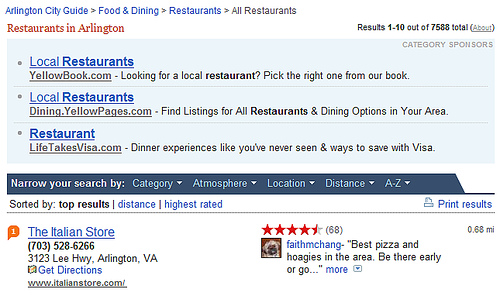
Then there’s the ads. I’m all for ads — I work in the Web space and like to get paid — when they’re relevant. The ads on Yahoo! Local are anything but. Here is an example of the ads that appeared above the listings for restaurants:

Irrelevant ads on Yahoo! Local

The top two ads are for services that compete with Yahoo! Local. Ads on the side (not shown) pitched “Watch mouth-watering videos of Oklahoma’s best restaurants” and one from Target offered “Find restaurant online. Shop & Save at Target.com Today.” (I’ll admit to clicking through on the Oklahoma ad just to see what would constitute a mouth-watering video of Okahoma restaurants. Unfortunately, they linked it to a video of a bad rendition of Rudolph the Red-Nosed Reindeer.)

I understand that local advertisers are scarce, especially outside the Bay Area. But Yelp takes the right approach.

More on: local search, yahoo, yelp

Disclosure: I used to work on local products for AOL.

Posted in advertising, city guides, local search, search, web 2, web 2.0, yahoo, yelp | 1 Comment

Google My Maps gets bloggy

Google is continuing its efforts to turn its My Maps personal mapmaking tools into a geographic blogging platform. Back in October, they added profile pages for map creators. I wrote at the time that it would be nice to have user comments on the maps to introduce flickr-like incentives for map creators.

Today’s release allows viewers to rate maps and leave comments. You can also see statistics on maps, including the number of views and the top referring links to the map.

More on: google, maps, Web 2.0

Posted in google, local search, maps, mashups, web 2, web 2.0 | 1 Comment

Searching for a search engine that understands deep dish pizza

Update: If you’re looking for deep dish pizza near O’Hare, see my step-by-step guide to Gino’s East on Higgins.

Having gone to school in Chicago, I love deep dish pizza. Unfortunately, there’s no Carmen’s or Giordano’s in the D.C. area. The last time I had good Chicago-style pizza was when my friend Jason flew in a few Giordano’s pies for his Super Bowl party. (The Colts were are also represented with tenderloins.)

Jason with Giordano’s pizza

I was connecting through O’Hare today and wanted to get some deep dish at the airport. I asked Google for “deep dish pizza at o’hare”. No luck.

This is a really difficult query for search engines. It seems simple, but it has a lot of components that make it tricky. But it’s exactly the kind of query that search engines should be able to handle.

Breaking apart the components of the query, we have:

“deep dish pizza” is a distinct concept. It’s different from “New York pizza,” “Sicilian pizza,” and “Indiana pizza”. (I don’t know what that is, but my friend Wanita swears there’s such a thing.) I could restrict my query using quotation marks around the phrase “deep dish pizza” but I shouldn’t have to do that. On the other hand, “deep dish pizza” is close enough to “Chicago-style pizza” that those results should be included.

The second part of my query was “at”. Search engines typically treat words like “at” “and” “near” and “or” either as filler and ignore them, or they use them as Boolean operators. There’s a big difference between the query “deep dish pizza at o’hare” and “deep dish pizza near o’hare”. With 90 minutes between flights, “near” doesn’t work.

“O’Hare” is also tricky. It’s a known place with a physical address. But Google and other search engines know it as ORD or 10000 Bessie Coleman Dr, Chicago, IL 60666. Compare the results for “deep dish pizza o’hare” with those for “deep dish pizza ORD“. Frequent travelers might shortcut to ORD, but again, that’s not a burden users should have to bear.

The answer, in theory, lies in natural language search. I’ve written before about how search engines force people to think like computers. Natural language search tries to teach computers to think like people. The most talked about company in the space is Powerset. I saw a controlled demonstration of their technology in August, but the promised fall public beta has yet to materialize.

Keyword-based search engines fake some of this by using tricks like stemming, synonyms and anchor text. With the uptake of sites like Yahoo! Answers and the sheer volume of information on the Web, there’s a decent chance that someone has phrased the question the same way. In the search results page for my original query, one of the results was a Frommer’s Q&A.

In addition to the structural challenges of queries like this, there’s also the challenge of how data is gathered. Data providers do a terrible job of gathering information about a place that’s really a collection of places — such as malls and airports. In some cases, information is simply not collected. In others, the information that is collected isn’t sufficiently descriptive. The physical addresses of these businesses aren’t meaningful to users. “Terminal 1, Gate C3” makes sense; 10000 Bessie Coleman Dr, Chicago, IL 60666 does not.

OK, how many geeks are pulling out their laptops and doing searches like this you ask? Not a lot. And in search from the Web, it’s relatively easy to re-do the query and keep tweaking it until you get an answer.

Getting better answers faster becomes increasingly important as search moves to mobile devices and with voice-based search from the likes of Tellme and Google’s GOOG-411. In those environments, the penalty for failure is much higher. Users can’t easily tweak queries. They can’t browse endless Web sites to try to get the answer. They need the algorithms to do the work for them.

I was finally able to find out about pizza options at O’Hare by going to the O’Hare Web site and looking at a PDF map of Terminal 1. There isn’t a deep dish pizza place in Terminal 1, though there are Pizzeria Unos in other terminals.

The pyschic search engine would know that Pizzeria Uno is not an answer that works for me.

More on: local search, search, wireless

Posted in local search, mobile, mobile search, search, wireless | 2 Comments

Online subscriptions and dumb criminals

A couple of interesting stories from the media this week:

  • Success Without Ads – The New York Times looks at the success of Consumer Reports, online and offline. The all-subscription and no ad products have been remarkably successful. The magazine has 4.5 million subscribers and the Web site has 3 million subscribers. Consumer Reports is one of the rare successes in getting people to pay for content online. It’s a good thing they don’t need advertising: their readers aren’t prime targets of advertisers. Online readers average 50 years old, which is youthful compared with the 60 year old average for print subscribers.
  • Cheese! Uh-Oh … Cellphone Photos Prove Perps’ Guilt – The Wall Street Journal looks at master criminals who take pictures of themselves committing crimes. “By and large, however, the cellphone photo trend is welcomed by police and prosecutors. ‘We pray for those kinds of cases,’ says Debra Collins, an assistant state attorney in New Britain, Conn. Last spring, Ms. Collins obtained guilty pleas from two young men who had used a friend’s camera phone to record one of them igniting a car by tossing fireworks into an open window.”
Posted in reader | Comments Off on Online subscriptions and dumb criminals

Buying physical space for online products

PhotoStamps kits at Costco

This time of year, there’s always a lot of talk about driving clicks to bricks: how online affects offline purchases. Whether it’s an actual purchase that is picked up in store or just online research that influences store purchases, the Web has undoubtedly had an effect on in store shopping.

What is less talked about is the increasing trend in the other direction. Online retailers are putting their products on store shelves. For a few years, you’ve been able to find iTunes gift cards and Rhapsody subscriptions at electronics retailers like Best Buy.

I was at Costco the other day and ran into the boxes of PhotoStamps pictured above. Each unit gets you three boxes, each of which can be redeemed online for a sheet of 20 personalized stamps that are sent by mail.

From a marketing standpoint, it’s brilliant. You get to put a cute baby in front of thousands of gift shoppers and drive impulse purchases.

From an environmental standpoint, it’s highly wasteful. It’s mostly packaging. Each box is mostly air; there’s a cardboard insert to keep its shape. Inside there’s a one page pamphlet explaining what PhotoStamps are and a CD. (You don’t even need the CD, you can just go to the Web site.) On the CD sleeve is the redemption code. The 13-digit code is all you need to get your stamps.

It could just as easily be sent as email. In fact, you can get an email gift certificate from the PhotoStamps site. But email doesn’t look as good under the tree. And without the Costco discount, you’ll pay more buying direct.

Posted in fun, marketing, random | Comments Off on Buying physical space for online products

Google Chat and AIM, together at last + free SMS

Google has integrated AIM into its chat in Gmail, delivering what Google and AOL announced nearly two years ago when they renewed their search deal and Google invested $1 billion in AOL.

AIM integration into Google ChatThe integration is not true interoperability, like what exists between Yahoo! and MSN’s IM products. Google/AIM works like a multi-headed client, such as Trillian or Pidgin. In order to chat with someone on AIM, you must have an AIM account. You provide your AIM account information and Google logs you into AIM and displays your AIM Buddy List integrated with your Google buddies. (AIM buddies have the AOL running man icon next to them.)

The integration worked reasonably well. I could see and chat with my buddies. Just as with Google buddies, chats were automatically stored in my Gmail account. Unfortunately, the indexing is less than optimal. If a user’s screenname is “jsmith2000923” but displays as “John Smith,” you can only search by “jsmith2000923.”

Another flaw is that AIM’s mobile indicators don’t show up reliably. You might think that someone is available, when they’re really just available on their mobile phones.

A bonus with the addition of AIM integration is that you can use AIM to send SMS messages from within Gmail. Just add the phone number as an AIM buddy.

The AIM integration isn’t yet incorporated into Google’s downloadable client, Google Talk. Without carpet bombing the United States 100x over with CDs, it seems Google Talk hasn’t gotten a lot of traction. Given that Google was very late to the IM party, I suspect that many of the people likely to download Google Talk use Trillian or Pidgin instead.

That’s OK, because integrating chat into Gmail was a genius move. It drew many Gmail users into Google’s chat and I know a few people who went from just Google Talk users to Gmail users. In the two years since the announcement, I’ve seen many of my non-AOL friends become Google chat users.

I already run Pidgin at startup on my computers, so this integration isn’t critical for me. But it will be useful when using someone else’s computer. Now I can just log into Gmail and have access to my Google and AIM buddies. This poses a threat to Web-based IM providers such as Meebo. (Meebo does a whole lot more, but this might be “good enough” for many people.)

That still leaves out my Yahoo! and Microsoft buddies. Sadly, this is one of the few areas where the Web companies have trailed the wireless carriers. Wireless operators in the United States have had true interoperability for several years now. But they had a financial incentive to do it: they charge for each message sent and received.

Disclosure: I worked at AOL Search.

See also:

More on: AOL, Google, SMS

Posted in aol, google, im, instant messaging, sms, wireless | 6 Comments