Take my picture, please

I’ve been testing out a couple of relatively new social networking sites lately — FriendFeed and brightkite. Both reminded me of a pet peeve I have about social networking sites: they all want your picture, but they don’t make it easy for you.

They want you to upload a jpg from your computer. I’m not so vain that I keep a jpg of my mug on my desktop ready for easy uploading. And I’m too lazy to go digging around for it every time I want to test out a site. A good chunk — 40% of my friends on FriendFeed — are lazy, too. As a result, they all get the same icon, decreasing the usability of the site.

My profile pictureHere’s a simple idea: steal my Facebook picture, or my flickr picture, or my twitter picture. (I’m in blue, for those who are wondering.) Easy enough to do. FriendFeed already synchronizes my friends list with Facebook.

Yes, I know not everyone uses twitter or flickr. But their primary audience right now is the Great Silicon Valley Echo Chamber. They do. And Facebook only has a 100 million or so users.

An alternative, which WordPress uses for commenters, is to generate a custom icon for each user. It won’t remind people what I look like, but it will help distinguish one user from another.

Posted in facebook, social networking, web 2, web 2.0 | 2 Comments

Occasional reader – Gas prices, trashing hotels, brain chemistry, hunger cafes

Some interesting reads from the past few weeks:

  • Top Car Dealer Says High Gas Prices Are Good for the U.S. Auto Industry (WSJ) — The CEO of AutoNation views high gas prices as just what we need to spur innovation on new technologies. After decades of convincing Americans that they should pay for size and power, he’s now trying to convince them that they should value fuel efficiency. That argument is made easier by $4 gas.
  • Hotels upgrade their ‘no-stay’ lists (MSNBC) — Every frequent business traveler has hotels they’d never stay at again. I hated the Hyatt Rickey’s (now gone) and likely won’t be back to Sheraton Gateway Suites O’Hare. But hotels are also keeping a list of people they don’t want to see again. They’re using chainwide databases to blacklist problem customers who trash hotel rooms or constantly complain about service and ask for comps. I hope my complaint about $80 in erroneous minibar charges from the Westin Bellevue doesn’t land me on the list. It’s a great hotel otherwise.
  • Exploring the neurochemistry of fairness (Ars Technica) — “It’s not fair!” is a common refrain from childhood. Apparently, as a species we have an innate sense of fairness. We do things against our own interests for a “fair” outcome. Participants were asked to play the Ultimatum Game, in which they were offered a percentage of a pool of money by another participant. If they agreed to take it, they’d get that percentage. If they didn’t agree, neither party got anything. The economically rational thing to do is take any percentage offered. Even 1% is better than nothing. That’s not how it played out. And the results could be changed by manipulating serotonin levels.
  • In a Restaurant Row, Drive-Through Charity (New York Times) — One of the toughest things about visiting India is seeing the staggering amount of poverty throughout the country. The Times reports on “restaurants” where homeless sit in rows outside waiting for people to drive by and offer some money that can be used to purchase food. If someone comes the group goes inside and eats. via Chamath Palihapitiya
  • $5+ premium gas in San Francisco

Posted in reader, travel, weekly reader | Comments Off on Occasional reader – Gas prices, trashing hotels, brain chemistry, hunger cafes

The first first draft of history

In journalism school, you’re taught that newspapers are the first draft of history. Today it’s common for news outlets to scoop themselves on their Web sites. But even that may not be fast enough when news breaks. Lost Remote reports that news of Tim Russert’s death broke not on NBC or by a news site, but on Wikipedia.

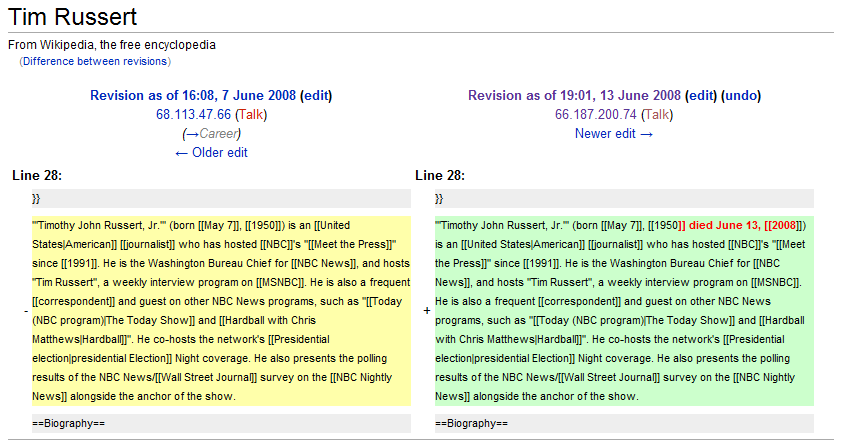
In the screenshot below, you can see the change made at 3:01 E.T., adding simply “died June 13, 2008”.

Wikipedia screenshot of Russert\'s entry

This was more than 30 minutes before Tom Brokaw announced the news. You can even see the incredulity, as a Wikipedia editor, fearing vandalism, reverts Russert’s page to bring him back to life. (Wikipedia also shows the uglier side of humanity with insertions such as “Liberal piece of crap finally died.”)

The 24-hour news networks delayed reporting the news to give NBC the opportunity to break it, according to CNN’s David Bohrman:

I sent a note out internally in CNN in Washington to hold off. This is a story we’re not going to report first. And at the same time, the Fox bureau chief in Washington, Brian Wilson, and I had a quick communication. And we both sort of quickly said we’re not going to go first on this story.

We’re going to wait for NBC to go on the air. We’re going to let Brian or Tom or whoever it was make the announcement, and then we would be ready to follow in.

Not all of the media played along; the New York Times Web site reported the death before NBC. In fact, the Wikipedia contributions may have come from a journalist looking to get the word out. The original edit originated from an IP address belonging to a company that hosts Web sites for local TV stations.

We’ll see more of this as publishing becomes easier and a wider audience becomes used to it. We’re just as likely to see news broken by a text message to twitter or a picture uploaded to flickr from a cell phone.

Whether we believe it, or we like what we see is another matter entirely.

See also:

Posted in flickr, journalism, media, newspapers, television, twitter, wikipedia | 2 Comments

More Americans get their news from… Facebook?

I found out about Tim Russert’s death today through Facebook. One of my friends had updated his status to say he was “shocked by Tim Russert’s death.” I glanced over at my Google Talk contacts and noticed that two other friends had updated their status to reflect Russert’s death.

It’s a little ironic that I found out about the death of a veteran television newsman through a social network. But it’s not unusual.

Increasingly, I’m finding out about things through social networks. I was alerted to last year’s 35W bridge collapse in Minnesota by a friend who IMed me.

Shortly after I updated my own Facebook status to indicate that I’d found about Russert through Facebook, another friend emailed to say that’s how he heard about it, too. It’s not that my friends are all geeks. The two friends who had updated their Google status are well outside the Silicon Valley echo chamber and aren’t highly political.

What does this mean?

  • I spend too much time on Facebook. Sure, yes. But Facebook is a destination site whereas news sites aren’t. I read a lot more news than I ever have and across a much wider range of sources. I usually find stories to read based on email and IM from friends and colleagues, as well as whatever catches my eye on feed readers. Checking out CNN.com, nytimes.com, etc. isn’t on my daily to-do list. News has a way of finding me.
  • Everyone can have an immediate worldwide megaphone. While my status updates and IMs don’t have anywhere near the reach of CNN or The Washington Post, I can easily reach hundreds of people, who can each reach hundreds of people. News spreads faster than ever because we’re more connected than ever. The ease of such communication makes it much more prevalent; I wouldn’t have picked up the phone to tell some the news.
  • Facebook, Twitter, blogs and other user-generated sites are reflections of our collective conscience. Twitter search engine Summize shows on its home page that “Tim Russert” and “Russert” are the trending terms for today. There are more than 100 pages of tweets with “Tim Russert” in them. (Summize cuts off at 100 pages.) We’re getting unprecedented, unedited and immediate reaction to news in a way that letters to the editor and man-on-the-street interviews just can’t touch.
  • Major brands still matter. After seeing the Facebook status update, I went straight to CNN.com. I didn’t even think to go to Google to search for “tim russert”, I knew where to go and got what I was expecting: CNN offered a live feed discussing Russert’s death and a video of Tom Brokaw’s announcement.
Posted in facebook, im, instant messaging, journalism, media, newspapers, publishing, social networking, twitter, web 2, web 2.0 | 3 Comments

Google offers fresh perspectives on travel photography

Google’s Panoramio has launched one of the most exciting advances in online pictures since flickr added geotagging. A new “Look around” feature shows you when pictures are available from other angles.

In the screenshot below, you can see the dome of the Taj Mahal highlighted. Clicking on that takes you to a picture of the dome. (Shown in red on the right.)

The UI is a bit confusing. For example, in the screenshot there is a blank image in the middle. I assume that means something, but I haven’t been able to figure out what. The same goes for the overall arrangement of thumbnails. Regardless, it’s a lot of fun to play with.

The feature is only available for sites with lots of pictures. Try the Brooklyn Bridge, Eiffel Tower, Statue of Liberty, Tower of London and the Ponte Rialto. I had an easier time finding places to explore in Europe than in the United States. (This could reflect the fact that Panoramio is based in Spain.)

Microsoft’s Live Labs has been demoing similar technology called Photosynth for more than a year, using images of the Basilica di San Marco. Photosynth offers a spectacular 3D overview. I’d love to see it out of the labs.

Until then, I’ll be playing with Panoramio. Check out their take on the Basilica.

Read more on Panoramio’s blog.

Disclosure: I work for a Microsoft subsidiary.

Posted in flickr, fun, geotagging, google, microsoft, photography, travel, web 2.0 | 1 Comment

Occasional reader – Saying no to Google, popcorn prices popping, economics and height, Pringles

Posted in fun, google, maps, movies, privacy, random, reader, street view, weekly reader | 1 Comment

Occasional reader – Airport security, future of journalism, working with Yahoo!

Some interesting reads from the past couple of weeks:

  • The Airport Security Follies (New York Times blog) – Pilot Patrick Smith takes a look at the idiocy of our airport screening processes. Smith argues (and I fully agree) that airport security is a charade designed to persuade people that the government is doing something, when in reality most of those measures have zero impact on safety. Part of the reason we tolerate this is that those who are most impacted by this idiocy are a small fraction of the population: pilots, flight attendants and very frequent fliers. Even the media largely ignore it, despite the billions in lost productivity. (This piece didn’t run in the paper.)
    When they do cover it, it’s for the theatrics: It never fails that when an idiotic measure is announced that the local TV news has a grandma who flies twice a year talking about how she’s willing to fly naked if that would improve security. The media love scare stories because they get people to watch. A CNN promo running this weekend intones “What if a hurricane hits, gas skyrockets to $10 a gallon and everything collapses?”
    Comment #3 to the entry, from another pilot, is also worth reading. via Adam Lasnik
  • So far, so good for Midway Airport’s new screening system (Chicago Tribune) – I was stuck in the metal detector line at SFO last week behind a guy who tried to go through wearing a bulky sweatshirt, a backpack and a baby. I’ve long wondered why airports don’t offer beginner, advanced and expert lanes. Chicago’s Midway now has security screening lines that uses ski resort-style lane designations to sort travelers. In theory, it would also benefit inexperienced travelers and families: “Shannon Spicer, who was traveling with her 2-year-old son, Liam, said she liked being able to take her time without other travelers breathing down her neck.” Marketplace’s Kai Ryssdal reports similar signs at Cincinnati’s airport aren’t working well: “The TSA agent at the checkpoint said the signs look nice but they don’t help much. Everybody, she said, thinks they’re experts.” At least there are still the elite security lines at hub airports.
  • The Future (We Hope) of Journalism (Poynter Online) – Former Los Angeles Times editor John Carroll offers his take on the transition from lucrative virtual monopolies to rapidly shrinking competitors. Like many in the old media, Carroll takes potshots at bloggers: “Although blogs have contributed much to the national discussion, they offer only a rare flash of original reporting. For fresh information, the blogs remain deeply dependent on the old media, which they simultaneously deplore and utilize extensively.” Never mind that bloggers were instrumental in holding the old guard accountable in cases like Dan Rather’s erroneous National Guard story and the L.A. Times’ very similar fiasco about an assault on Tupac Shakur. Or that journalists frequently fill air time and ink by interviewing bloggers like Michelle Leder of footnoted.org. Or that the old media are “deeply dependent” on press releases and political operatives.
  • Doing Business with the Semi-Permeable Corporation (Greg Cohn’s blog) – Blogs and social networks have made it much easier to reach out to key decision makers in large corporations. But they haven’t erased the rules of business. Yahoo’s Greg Cohn provides a look at the good and the bad of openness in a large public corporation.
Posted in airlines, journalism, media, newspapers, reader, social networking, travel, web 2, web 2.0, weekly reader, yahoo | Comments Off on Occasional reader – Airport security, future of journalism, working with Yahoo!

Old and new

Typewriter and Vista

Saw this odd juxtaposition of a Corona manual typewriter and Windows Vista Home Premium at a Noe Valley sidewalk sale today.

Posted in fun, random | 1 Comment

From chits to bits

I was meeting some colleagues and partners last night for the Pistons playoff game. As we sat down for drinks, we realized that we’d left the tickets at our hotel – more than an hour away from the Palace. Six small pieces of paper were tucked in a blue backpack and there was no way to get there and back without missing most of the game.

We could get the hotel staff to find the tickets and send them to us by cab, but that would take at least an hour and we’d have to count on the cab driver not taking off with the prized tickets. (Which were worth a lot more than the $100 cab fare.)

A quick call to the box office and we found a solution: if we could fax the tickets to the box office, they would reprint them. A fax glitch later, we had three of our tickets. (Only one page went through.) Fortunately, I had a digital image of the fax in my email account and the Palace box office also does email.

As this experience illustrates, sports and entertainment venues are rapidly coming into the digital world. Being able to handle situations like this dramatically improves the guest experience and reduces costs for the venue:

  • Tickets purchased directly from the venue can often be reprinted with just a credit card.
  • Print-at-home ticketing eliminates mailing costs and reduces the number of people needed to staff will call windows. (Note that this doesn’t mean reduced costs for you, because the ticketing companies charge for this service.)
  • The San Francisco Giants Ticket Relay allows you to transfer tickets electronically to someone else. If you decide at the last minute that you can’t go to a game, you can transfer the tickets by email and your friend can pick them up at a kiosk.
  • The Washington Nationals are experimenting with mobile phone ticketing that sends a scannable 2-D bar code to your phone.The current technology is too kludgy to be useful, but it will get better.

Digital ticketing also allows venues to generate additional revenue. At the Boston Symphony, season subscribers can electronically return tickets for a tax deduction. Those tickets are then resold.

Major League Baseball’s deal with StubHub allows ticket resales even on the day of the game. (For StubHub tickets that can’t be transferred digitally the market dries up based on FedEx’s schedule.) And, of course, MLB gets a cut. Those extra butts in seats also help to pad concession revenues.

There’s an additional benefit to the venues: digital ticketing increases the risk of buying tickets from scalpers. An “authentic” ticket could have been invalidated electronically.

I expect that we’ll also see more last minute deals offered by email and mobile phone to fill seats at underperforming events.

Pistons Ticket

Pistons vs. Magic, Game 5

Posted in customer service, wireless | Comments Off on From chits to bits

The Internet’s perpetual motion machine

In my comment on Clay Shirky’s speech on the cognitive surplus, I mentioned the effect of increased content production on consumption patterns. I didn’t mention the Internet’s perpetual motion machine.

I was reminded of that when I reviewed the post and saw a new WordPress addition: the “Possibly related posts: (automatically generated)”. This section uses technology from Sphere (recently acquired by AOL) to recommend other items that the reader might be interested in.

The suggestions include posts from this blog (in bold), other WordPress blogs and items from across the Web.

It’s too soon to provide a definitive verdict, but some of the initial results I’ve seen have been impressive. I was thinking “media fragmentation” as I wrote that post, and sure enough, Sphere generated a link to my earlier post, Living in a fragmented media world.

TV, radio and other media have long run promos, but none have been as effective in driving consumption as Internet links. With TV and radio, it’s too easy to forget about the program that was promoed before it airs. Network Web sites do a terrible job of cross promoting, even when they’re simultaneously available on the site.

Creative Commons image from flickr user Brian Bennett.

Posted in media, publishing, web 2.0 | Comments Off on The Internet’s perpetual motion machine