A wow experience from United Airlines. Wow.

It’s rare these days that a company impresses with customer service. It’s even rarer when that company is an airline, especially an American airline. That’s the experience I had last week when I was flying home from New Orleans on United Airlines.

It started out pretty awful. A few hours before my flight I received a text message that my flight was delayed. Then another. By the time I arrived at the airport, my originating flight had been delayed more than two hours, ensuring that I’d miss my connecting flight in Denver. As it got close to the new departure time, we were told that there was a mechanical issue. After a string of “we’re waiting for an update” announcements, we finally boarded three hours later when a new plane arrived.

Based on experience, I was braced for the worst when I arrived in Denver: a 90 minute wait for a harried customer service rep who would look for every excuse to not put me up for the night. Before leaving New Orleans, I’d tweeted “United already knows who will misconnect. What are the odds they’ll be proactive and have hotel vouchers waiting?” I would’ve placed them at 1000:1, best case.

But that’s exactly what happened. After we landed the gate agent came on board and announced that they had prepared packets with hotel and meal vouchers for everyone who was stranded. Three people were staffing the desk, despite the fact that we arrived around 2 a.m. They were polite and directed us to the hotel shuttles.

Within 20 minutes of landing in San Francisco the next day, there was an apology in my email box for the inconvenience. A link in the email invited me to select from a list of appreciation items, including a $250 travel certificate.

The immediacy and the proactive nature of the response made a very positive impression. It’s great to see companies using IT in this way.

Posted in airlines, customer service, travel | 15 Comments

How the AP blew it

In the most recent round of AP getting in a huff about search engines and aggregators stealing traffic that they feel rightly belongs to them, there’s a fundamental problem they’re ignoring: AP chose not be in the online news business. More than a decade ago, AP made two crucial decisions: to not create a destination site and to license its content to news portals. Either of these decisions on their own would have been damaging, but the combination of the two has been nearly deadly.

Screenshot of AP's iPhone app

Screenshot of AP's iPhone app

As a member-owned cooperative, the AP has catered to its members, which includes newspapers, radio stations and other media outlets. Even now, if you go to AP.org, news is a footnote. Contrast that with the front page of Reuters. Instead of displaying AP content on the AP-branded site, you get AP content in obscure brands like the Lake County Record-Bee, High Desert Daily Press, Citizen-Times.com and GazetteXtra.com. AP is still hosting the content, but the strong national AP brand is subsumed by a large number of brands that have no meaning outside their region.

This might have worked if newspapers had assumed the role of the default home page and people sought out their local brands. Some papers, including the Washington Post and New York Times tried to create all purpose portals; those efforts have been abandoned.

AP also decided to license content to online media outlets. Yahoo! was an early licensee; Google struck a deal with AP more recently. Yahoo! was able to take the AP content and create a leading news destination site without employing hundreds of journalists.

Not only do Yahoo! and Google license AP content, they are doing a better job presenting it than AP. Compare this story on the AP’s site (branded oanow.com) with the same story on Yahoo! News. The Yahoo! story loads a lot faster and the layout is cleaner. On AP-hosted pages, I sometimes get pop up ads. It’s a much worse experience than Google or Yahoo! News.

The fact that AP doesn’t have a destination site presents another big problem in today’s PageRank driven environment: because the same story can be presented at hundreds of different URLs, they don’t rank highly in search results.

It’s not impossible for AP to get back in the game. But they have to play the game as it exists today, instead of trying to reset the calendar to 1995. They’ll need to focus on the things that any Web business needs to focus on today: simplicity, performance, community, analytics and search engine optimization. And they must do it under the AP brand.

One hopeful sign is AP’s Mobile News iPhone application. The app provides a solid user experience, incorporates photos and videos effectively, has acceptable levels of advertising and looks like it was designed this decade. You can even send in news tips. My only real complaint is that the AP brand is buried in favor of a generic “Mobile News Network” brand. (Probably to placate member companies.)

AP has a lot of assets that even now aren’t fully exploited by Google or Yahoo! With some creative thinking and Web-focused talent, they could use those assets to build a killer destination site. It won’t be anyone’s home page, but it can be successful nonetheless.

More on: newspapers.

Posted in google, iphone, journalism, media, newspapers, yahoo | 9 Comments

9 ways to improve the Facebook news feed

As any designer knows, making a big change to a site with as many users as Facebook has is going to cause a lot of complaining. With that in mind, I’ve tried to get used to the new feed over the last few weeks — and I still hate it.

The new news feed is like watching CNN during a breaking news event: you can watch for hours and hours and only get two or three bits of interesting information amid the endless blather.

It’s a giant step backward and as more people get on Facebook and become more active it’s going to become worse.

Among the issues I have with it:

  • Feed items from frequent users drown out feed items from infrequent users.
  • Friends seem to be treated equally.
  • It rewards spammy applications, such as the quiz applications that seem to pop up every day and apps like PicDoodle.
  • It doesn’t eliminate duplicate items. If 10 people post the same item, it’ll be inserted multiple times. As much as I love the Twitter parody by current.tv, I don’t need to see it anymore. This is made worse by the use of URL shorteners that obfuscate the item you’re clicking on.

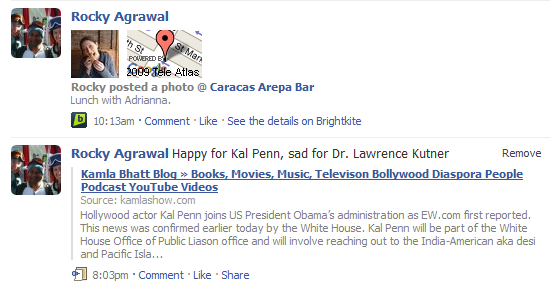
Snippet of Rocky's Facebook feedOne of my design philosophies is that you shouldn’t make users do work that computers can do better. Filtering and priortizing is high on that list. The old Facebook news feed algorithm and the current highlights section provided some level of this.

Here are some of the factors to consider when prioritizing:

  • Degree of interaction. Items from people I interact with regularly should be prioritized higher.
  • Number of friends involved. The greater the number of friends involved, the higher the priority.
  • Number of times shared. The more of my friends that have shared it, the more likely it is to be of interest.
  • Location. I’m more interested in things happening near me than on the other side of the country. Facebook will need to become aware of locations that are being embedded by applications such as Brightkite.
  • Posting frequency. If someone rarely posts on Facebook, the odds are good that when they do post, it’s something important.
  • Application usage. If I use the same app, I’m more likely to be interested in the content that the app generates.
  • Topic similarity. If the item is about a topic that I frequently post about, it should get a boost.
  • Been there, done that. If I’ve seen it already, it should be downweighted.

The ideal feed would adapt to visit frequency. Someone who visits every five minutes would see a feed very similar to today’s feed. Someone who visits once a week, would see a “best of” from the week.

Some of these things are harder to do than others, but any sort of this filtering is better than what I see today.Any algorithm will undoubtedly miss something that I care about, but the current endless river of unfiltered content ensures that.

Besides, there’s a trick I use when I want to bring someone’s attention to something: instead of hoping that they see it on my feed, I message them directly.

More on: Facebook

Posted in facebook, search, social networking | 3 Comments

Anyone can be a journalist

In conversations with people in the news business, I regularly hear about the need for “professional journalists.” Ask them what makes a professional journalist and the answers get wishy-washy. Is it someone who is on staff at a newspaper? What about TV anchors? What about commentators? Do you have to have a fancy degree from a top-flight journalism school? Do you have to be able to write eloquently or briefly? (I know people who work for newspapers that can’t do either.)

Unlike medicine, law or plumbing, there is no officially recognized training program, licensing or accreditation process. Actors’ Equity has more stringent requirements for membership than the Society of Professional Journalists.

My answer is none of the above. A journalist is anyone who can report a story.

Just like the best camera is the one you have on you at the time something happens, the best journalist is the person who is there when news happens. At the same time that we have newspapers across the country drastically cutting their staffs, we have an increasing number of people with the tools to do original reporting quickly and easily. (See my earlier post on flickr vs. The Washington Post.) The cameraphone is replacing the reporters’ notebook and the printing press. Not only can it record notes, it can instantly disseminate that information across the globe.

Janis Krums was a journalist on January 15 when US Airways flight 1549 landed in the Hudson River. His tweet “There’s a plane in the Hudson. I’m on the ferry going to pick up the people. Crazy.” and picture were among the lasting memories of the day. The picture has been seen more than 442,000 times on TwitPic, which is greater than the circulation of all but 20 newspapers in the country. That number would be much, much higher if you were able to include the views on sites (including mainstream media sites) that hosted the pictures on their own servers.

If he were employed by a newspaper or wire service, he’d have a decent shot at a Pulitzer for breaking news photography. A key part of winning is being in the right place at the right time.

I used to wonder what I’d do if I found myself in the middle of a big news event to get the story out. Would I call someone I know at the New York Times? Now I know what I’d do: I’d upload a picture from my cameraphone to my flickr, Facebook and Twitter accounts.

Hard-hitting investigative journalism represents a small fraction of the resources spent by news organizations.

Even there, the “professional journalists” have competition. Last week, I attended a Web 2.0 Expo session by Sunlight Labs where technologists gathered to bring more openness and accountability to government. Their mission is to get access to government data that is locked up in ancient computer systems and expose it in ways that the average citizen can consume it. Their tools are XML, parsers and databases. They are journalists, too.

More on: newspapers

Disclosure: I have a fancy degree from a top-flight journalism school. I try to write briefly (on Twitter) and more eloquently here. I used to be on staff at startribune.com and washingtonpost.com. I try to commit journalism for fun.

Posted in facebook, flickr, journalism, media, mobile, newspapers, publishing, social networking, twitter | 7 Comments

Newspaper companies can’t unring the bell

American newspapers are in trouble. So far this year, the Rocky Mountain News and the Seattle Post-Intelligencer have shuttered their presses. Tribune is in bankruptcy. My first employer, the Star Tribune in Minneapolis, is also there. Publishers have threatened to close the San Francisco Chronicle and the Boston Globe. Much of the blame has been pointed at two things: not charging for content online and the rise of craigslist.

While those have undoubtedly had an impact, there have been structural changes that go well beyond that:

  • Consolidation among key advertisers. There used to be three or four different department stores in each major city, all of whom advertised in the paper. Now they’re nearly all Macy’s, reducing the number of potential ad buyers. The same has happened in the banking industry where many regional banks have been gobbled up. Many of the ad buying decisions that were previously made at a local level are now consolidated as well.
  • Demand for trackability. Advertisers and their agencies increasingly want to know how their ads are performing and newspapers don’t provide the level of tracking that online sites do. The key classified verticals — homes, autos and jobs — all have trackable online options.
  • Rise of information technology. Businesses can get to know their customers much better due to advances in computer technology. The airlines, banks, hotels, department stores and grocery stores I do business with know my buying habits. They can use that data to create targeted offers that will appeal to me. Harris Teeter, a regional grocery store chain, sends out an e-circular that highlights the items customers have bought in the past. These personalized offers can be delivered for little cost.
  • Competition from their own suppliers. Newspapers have long been aggregators. They get a lot of their content from other providers. Instead of relying on a newspaper for Dilbert, I can get it in my email every morning from the syndicate that distributes it. And because color is free online, I get full color seven days a week.
  • Rise of user-generated content. Anyone can be a publisher these days. Twitter is stealing mindshare 140 characters at a time from newspapers. It’s not just Twitter, of course. Many of the same experts that newspapers rely on to provide the content for their stories are bloggers as well. Although the average quality of news in newspapers is likely higher than the average quality of an article in the blogosphere, there are more experts in the blogosphere than there are in newsrooms. As Fred Wilson writes, the tools for discovering this excellent content are getting better and better.
  • Increasing cost of commodities. Producing and distributing a newspaper is very expensive. Subscriptions don’t cover the cost of newsprint and fuel. While these prices fluctuate, the general trend line is up. To cope with these increasing costs, newspapers have raised their subscription rates, further depressing the circulation that advertisers count on.
  • Increasing environmental consciousness. Consumers are increasingly going green and newspapers are no friend of the environment. Trees are cut down, turned into giant rolls of newsprint, shipped across country where massive energy guzzling presses print on them and are then distributed every morning by trucks. Then they have to be disposed of. (See my earlier post on hotels going green and requiring opt-in to newspapers.)
  • Decreasing density of newspaper subscribers. As a kid, I used to drag a pile of newspapers around in my red Radio Flyer wagon, going door-to-door delivering the paper to people’s doorsteps. With the decline in subscriptions, you really can’t do that anymore. The unit cost of distribution goes up as there are fewer subscribers. It also makes the paper less convenient: rather than getting it at your doorstep, it might be in a box at the curb. Getting to your laptop doesn’t require getting dressed and going outside.
  • Inability to develop national scale. Most of the newspaper companies’ competitors can play at a national scale. This includes both online and offline media such as Google and TV networks. This makes it easier to spread out costs and easier to generate revenue. At startribune.com, we built out online yellow pages, entertainment guides, classifieds, etc. well before the vertical players existed. But because we were a regional paper, we couldn’t generate sufficient revenue to compete with the focused vertical players. The fragmentation also makes it harder for advertisers who want to buy reach. (See my related post on How the AP blew it.)

More on: newspapers

Posted in journalism, media, newspapers, publishing, twitter, web 2, web 2.0 | 3 Comments

15 people I’d want to have dinner with

Posted in random | Comments Off on 15 people I’d want to have dinner with

Facebook drives 6MM people to Friendster!

That headline is kinda, sorta true. If you buy shoddy analysis from misinterpreted data.

Like a recent piece from Henry Blodget, mass inflator of the Web 1.0 bubble. He is at it again with a piece on Facebook being a Google Killer. He points to RBC Capital Markets analyst Ross Sandler’s “analysis” of Facebook’s incredible growth and comScore data on entries and exits.

This is the kind of incessant hyping that inflated the housing bubble we’re all suffering through now — assuming that extreme rates of growth will continue.

The 1427% growth cited for Facebook starts from an insignificant base. With Google’s 468MM uniques in 2006, the only way for Google to have grown 1427% would be to reach every man, woman and child on earth. And it certainly couldn’t sustain that growth into the future, even if a lot of couples got really busy really fast.

Blodget also points to comScore’s entry/exit data to bolster his case. Here, he falsely equates correlation with causation. comScore’s entry/exit report doesn’t necessarily mean that site A drove traffic to site B. It just means that after someone went to site A, they went to site B.

If you go from Facebook to Google, it counts as an exit from Facebook and an entry to Google. It doesn’t matter whether you clicked on a link in Facebook to go to Google or not. You just happend to do those two things. Given that a lot of people use both Google and Facebook, any big site will show up on both entry/exit reports for any site.

Blodget says:

Fully 19% of Google sessions now come from Facebook, up from 9% a year ago.  At the very least, this will likely give Facebook the leverage to negotiate a sweet referral deal at some point.

Nope. Those people are going to Google anyway, without any prodding from Facebook. Google would be stupid to pay for that traffic.

comScore’s entry/exit report is one of the most useless reports they generate and really difficult to interpret. The only real curiosity in the Facebook data is this: 6MM people go to Friendster after they go to Facebook?

Yet another issue with RBC’s graph is that it doesn’t take into account duplicated reach. The combination of Google and Facebook is not 99% of worldwide uniques, because there is a high degree of overlap between the two sites. RBC analysts evidently don’t know how to use the unduplicated reach feature of comScore’s reporting tools.

That’s three huge flaws in one report. Sadly, that’s not uncommon. Analysts and journalists frequently ignore methodology while chasing killer headlines.

Thanks to @carolalene for the pointer on the comic.

Posted in facebook, google, search, social networking, statistics | 1 Comment

More bad news for newspapers: hotels going green

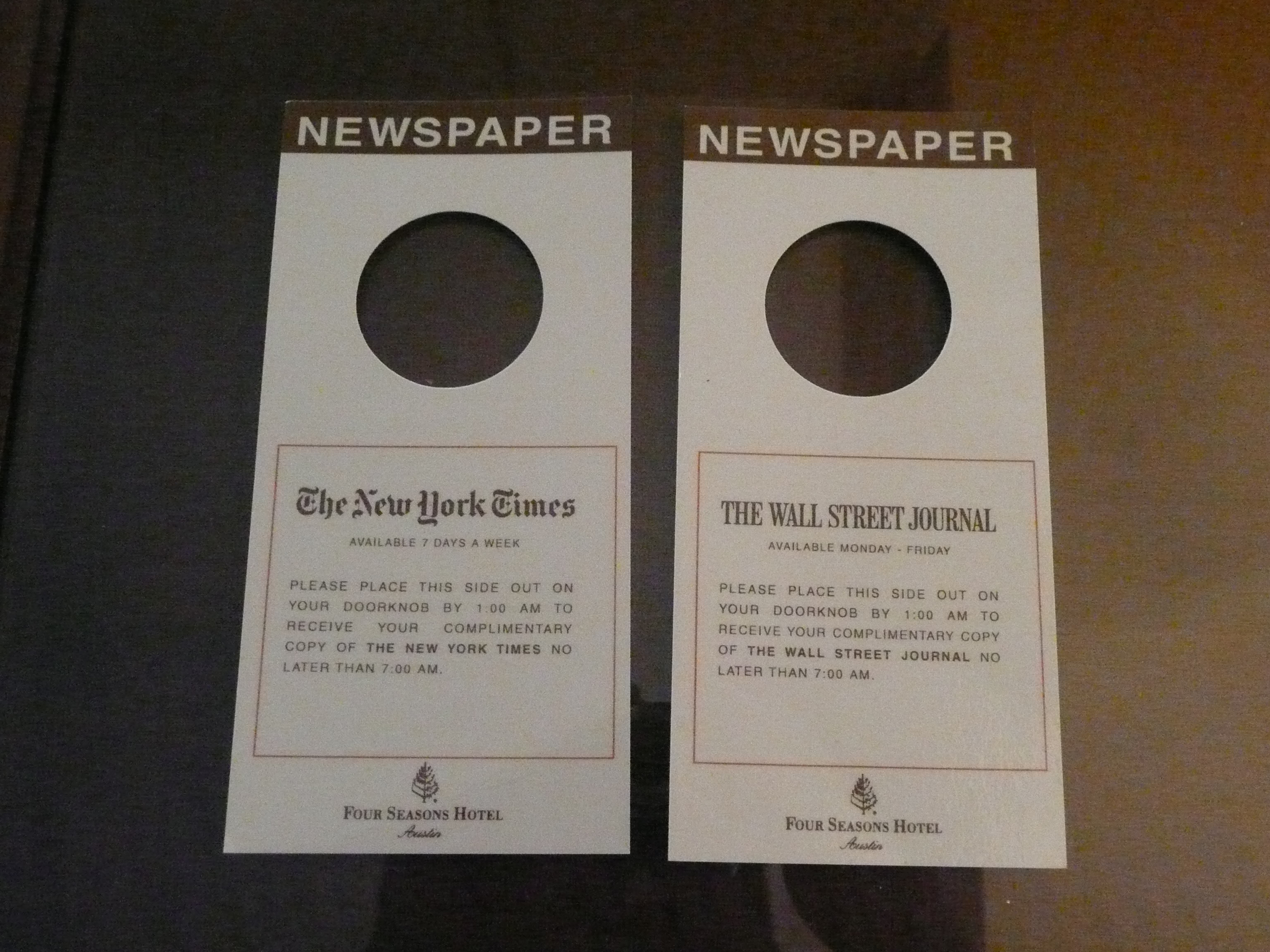
The Four Seasons in Austin requires guests to opt-in for newspapers.

The Four Seasons in Austin requires guests to opt-in for newspapers.

This picture should send shivers down the spines of executives at USA Today headquarters in McLean, Va.

For at least as long as I’ve been traveling for business (13 years and counting), a USA Today in front of the hotel room door in the morning has been a given. It just shows up. There’s fine print in the check in folder that says that USA Today will be delivered and if I don’t want it, I can tell the front desk and get a credit of 75 cents a day. Because I do what most people do — nothing — USA Today gets to count me as paid circulation.

At least 60% of the time, the only people who see that USA Today are the person who drops it off in front of my room and the maid who throws it away. I’ve already gotten my news from my laptop and from the TV that was showing CNN while I was getting ready.

I’m surely not the only one, and hotels are catching on.

Hotels have been steadily greening their practices while cutting costs: changing sheets only between guests, changing towels only when guests leave them on the floor, providing new toiletries only when guests have used up the previous batch.

Cutting back on newspaper delivery is the next step. This year I’ve started encountering hotels that ask me at check in whether I want a newspaper. The Four Seasons in Austin has gone a step further: if you want a newspaper, you have to put a hang tag on your door before 1 a.m. And you have to remember to do this every night of your stay.

As with Web defaults, you can guess what happens. Most people do what I do: nothing. On my floor early Sunday morning, I saw three newspaper hang tags (out of about 40 rooms). Not even a free copy of the Sunday New York Times enticed people. They were easily outnumbered by the “do not disturb” hang tags.

There are a number of unknowns: how many rooms were occupied, do the hotel’s demographics shift considerably during SXSW, etc.

But the fact that an increasing number of hotels no longer consider newspapers an essential part of their service is bad news for the newspaper industry.

See also: Who needs newspapers?

More on: newspapers.

Posted in hotels, journalism, media, newspapers, travel | 3 Comments

Who needs newspapers?

I read two thought-provoking pieces this week on the decline of newspapers from voices outside the newspaper business and one Really Dumb Idea from a voice on the inside.

Author Clay Shirky, Newspapers and Thinking the Unthinkable:

When someone demands to know how we are going to replace newspapers, they are really demanding to be told that we are not living through a revolution. They are demanding to be told that old systems won’t break before new systems are in place. They are demanding to be told that ancient social bargains aren’t in peril, that core institutions will be spared, that new methods of spreading information will improve previous practice rather than upending it. They are demanding to be lied to.

Society doesn’t need newspapers. What we need is journalism. For a century, the imperatives to strengthen journalism and to strengthen newspapers have been so tightly wound as to be indistinguishable. That’s been a fine accident to have, but when that accident stops, as it is stopping before our eyes, we’re going to need lots of other ways to strengthen journalism instead.

When we shift our attention from ’save newspapers’ to ’save society’, the imperative changes from ‘preserve the current institutions’ to ‘do whatever works.’ And what works today isn’t the same as what used to work.

ODP/DMOZ creator and veteran geek, Rich Skrenta, The news medium has a message: “Goodbye”:

Every so often there’s a story about about a technophobe executive so out of touch a secretary has to print out their email every morning so they can read it on paper and dictate replies.

That’s what the print newspaper is, of course. Why on earth would you print all that stuff out? Over a hundred pages, most of which you’re not going to read, with the crease down the middle of the front page photo, story jumps everywhere, a carbon-footprint disaster to produce, distribute and recycle. It’s absurd.

I once worked out some rough back-of-napkin estimates on the number of text bytes in the paper. It was only delivered once during the day, but if you average the bytes across the entire 24 hour period it came out to be about the rate of a 300 baud modem. The newspaper was the internet.

Both make essentially the same point: the newspaper is an accident of history whose time is just about up. Rather than try to figure out how to “fix” the newspaper problem, we should focus on what’s next.

A lot of the players in the news ecosystem have already done that. I’ve written before about how most newspapers are just repackagers of information.

Newspapers have long played to the middle, and not in a political sense. They put out essentially one product and hope that the average person finds enough of value in to subscribe. The cost of print means that you really can’t go into a lot of depth on a lot of topics. You can’t cover things that are extremely important to a few hundred people.

That worked when getting that depth was a difficult thing for readers. Now, infinite depth on just about any topic is a click away. For sports, finance and politics junkies, sites like ESPN.com, morningstar.com and huffingtonpost.com are much better ways to quench their appetites.

In the meantime, the diehards in the newspaper business will come up with stupider and stupider ideas. Consider this story (via Blake Williams) about a personalized print-at-home newspaper:

MediaNews has been working with a technology company — Mr. Vandevanter would not say which one — to develop a proprietary printer for a reader’s home. It would receive and print a subscriber’s customized newspaper — with targeted advertising.

You have to have a new printer to help cut their printing and delivery costs! Maybe you’ll even have to buy special paper and ink so you can get that full broadsheet experience and can get that genuine newspaper experience of having ink rub off on your fingers. For real authenticity, the registration will be off every once in a while so that the pictures don’t look right.

And maybe, just maybe, you’ll be able to scan a link on the printed page with your CueCat to go to a Web site you find interesting.

Posted in journalism, media, newspapers, web 2, web 2.0 | 5 Comments

Realtime Twitter search is not a Google killer, part 2

In the first part, I wrote about the fallacy of using people with thousands of followers to illustrate how you can get great results if you ask questions on Twitter.

In this part, I’ll focus on why the conversational nature of Twitter makes searching it effectively a hard problem.

Consider this exchange:

@CherylHaas: Celebrating my newly purchased iPhone. w00t!!! No longer a Luddite. App suggestions, please?
@rakeshlobster: yelp and shazam and Facebook

This is how people interact on Twitter. Partly because we’re lazy, partly because a lot of the interaction is done from mobile devices where typing is hard and partly because of the 140 character limit on tweets.

Between these two tweets, we have an answer to the query “iPhone app”. But Twitter Search treats these tweets independently. As a result, if you search for “iPhone app”, you’d get Cheryl’s question. Not very helpful.

If you search for “shazam,” you’ll get back my response. But there’s no context for it. The meaning of my response is lost without the context of Cheryl’s question. The question could have been “what apps are causing your iPhone to crash?” This happens in ordinary conversation on Twitter; when people are slow at responding and I get a “@rakeshlobster yes,” I’ll sometimes have forgotten the context.

This problem could be alleviated if Twitter presented threaded conversations. But then Google could just as easily index the conversation, as it does with Yahoo! Answers.

Another issue is that people don’t write for Twitter the way they write for search engines. Compare my tweet above with this post I wrote on my favorite iPhone applications. That was written with searchability in mind. There’s also a lot of shorthand on Twitter. @maryvale shortened “Nikon D80” to “D80” in her tweet discussing my last blog post.

That may change if searching Twitter takes off, but it would also change the nature of Twitter. I’ve been experimenting with adding more keywords in my tweets. For example, when I dropped my laptop, I originally wrote:

“laptop hinge broken. argh. it’s pretty, sleek and light. and extremely delicate.”

But then I added in the “toshiba portege r500 is”. It’s more searchable, but it makes the conversation sound stilted and robotic.

Another challenge with searching Twitter for information is that a lot of the value in Twitter is not in the tweets, but in what the tweets point too. With the extensive of URL shorteners like TinyURL and bit.ly, even the minimal keywords are lost.

Beyond the content difficulties in search, there are the related issues of search order and authority.

The results that you get back are sorted chronologically and are highly dependent on when you search. Although the “best” answer for a search can fluctuate over time (one of my criticisms of Google is that its algorithms don’t do enough to counter the effects of Web rot), for most searches it doesn’t vary dramatically over the course of a day or a week. A notable exception would be queries like “what’s a good party at SXSW right now?”

As with asking questions of the Twitterverse, searching Twitter doesn’t provide any guidance as to whose answers are better than others. Searching Twitter is in someways like stepping back 15 years in search technology, before search engines widely used off-page clues and link authority to rank results.

Some suggestions have revolved around developing authority rankings based on number of followers, number of tweets, etc. The problem with that is that no one person is an authority on everything. A search result from Om Malik (@Om) on telecom should be ranked much higher than a result from Om on migration patterns of birds in Africa. Review sites like Amazon and Yelp have devoted a lot of energy to helping people determine which results are valuable. Twitter will have to develop something similar.

Despite today’s issues, the immense amount of data that Twitter and Facebook are collecting could be used to build a better, more spam-resistant search engine. The marriage of search and social networks has the potential to get us better and more credible answers, while also increasing our connections to our friends.

More on: Twitter, Google

Disclosure: I worked with several members of Twitter’s search team at AOL Search. While I don’t believe in the current hype in the blogosphere about Twitter as a Google killer with the current technology, the guys I know are very smart and I look forward to seeing what they do next.


Posted in facebook, google, search, seo, twitter | 3 Comments