The ad is a lie

While watching the Olympics, I was struck by a gorgeous animated ad. A lobster conducts an orchestra of other sea creatures playing Gershwin. As soon as I recognized Rhapsody in Blue, I knew it had to be a United Airlines commercial.

The beautiful ad is in stark contrast with the product being advertised. We all expect exaggeration in advertising, but for the most part the product doesn’t even exist. I’m not talking about cramped seats or the fees for everything but using the toilet; the ad is one of several new commercials for United’s new international first and business class.

United’s premium products have significantly lagged their competitors, especially when compared with foreign competitors. Virgin’s and British’s business classes are much nicer than United’s first. United’s new product is a significant step forward.

The problem is that most of United’s international fleet hasn’t been reconfigured for the new product. If you buy the advertised product, chances are you’ll get the older, vastly inferior product. According to the FlyerGuide Wiki, only 11% of the fleet has been reconfigured:

Completed aircraft: 11 out of 96
Completed B747-400s: 4 out of 29
Completed B767-300s: 7 out of 21
Completed B777-200s: 0 out of 46

Good luck getting the 180-degree flat bed seats they talk about in the Butterfly and Moondust ads. There is no way to ensure that you’ll get the new product. Veteran frequent fliers play guessing games on FlyerTalk’s United forums. While you can improve your odds based on picking the routes or studying United.com seatmaps you’ll only know for sure when you step on the plane. There is a way to ensure that you don’t get the new product: buy a business class seat on a 777. None of those have been converted.

United deserves credit for making the ads easily available online, something more companies should do. The clip of the Heart commercial includes a “making of” commentary by Dennis Cary, United’s SVP of Marketing and behind the scenes interviews with the artists.

As art, the ads are some of the most creative and visually engaging ads I’ve seen; they’re downright stunning when viewed in HD. If they do their job and gets people on United’s planes, there’s a really good chance they won’t be crossing the oceans on United again.

Desi shoutout: According to United’s description, Moondust was animated by an Indian. “Ishu Patel, an Indian-born and Canadian-based animator, used his world-renowned back-lit technique in which a thin layer of plastic modeling clay is applied to a glass plate that has a 1000-watt light positioned beneath it and an animation camera above it.”

See also:

Posted in advertising, airlines, travel | 2 Comments

The Russians are coming! The Russians are coming!

I’ve long advocated that news organizations geotag the news. But I’ve been skeptical of automated systems for doing this. Google News recently provided a terrific example of what can happen when you use entity extraction for such a task:

Where in the world is Georgia?

Where in the world is Georgia?

In this case, reported by Valleywag, Google is comically wrong. But even when Google is roughly right, the map is often there just for the sake of having a map. The location information is often not very precise or isn’t really relevant.

For example, this story about a Yankees game puts Yankee Stadium somewhere near City Hall. Stories about national issues are often datelined New York or Washington because the reporter happens to be sitting in one of those two cities.

For individual story pages, an inaccurate map isn’t the worst thing in the world. But when you plot many of these stories on a map, they become worthless. In Google Earth, you can get a layer that provides geotagged news from The New York Times. I’ve seen pointless geotagging such as a story titled “U.S. Moves Toward International Accounting Rule” geotagged as being in the “USA”. (Which Google Earth plots in Oklahoma.)

There are many cases where geocoding makes sense and provides users a real service:

  • Restaurant reviews
  • Crime stories
  • Event listings
  • Travel stories

In each of these cases, the location is a critical part of the story. The minimal extra effort involved in geotagging these stories would significantly increase their shelf life and usability.

Posted in geotagging, google, journalism, local search, maps, media, newspapers, web 2.0 | 4 Comments

All the news that’s fit to tweet

On board CalTrain 369 possible fatality near San Bruno

Local, local, local. It’s the new mantra for news. I was reminded of this last week after the train I was riding in struck a pedestrian. The event was insignificant to all but a few hundred, maybe a couple of thousand, people.

There were lots of questions from the people on the train: What happened? Did we kill someone? How long are we going to be delayed? There were also a key question for others who use CalTrain: should I get on the train or find another way home?

Given the small number of people affected, this isn’t the type of thing that makes the local TV news. The Bay Area, being what it is, has a new answer: Twitter. An unofficial CalTrain account allows citizen journalists to share information about what’s going on. Readers can get the news on the Web or by text message.

This kind of real-time journalism has its challenges — initial reports can be wrong. In my own account, I relayed what we heard from the conductor: On cal train that hit someone. Possible fatal.” The first report on the CalTrain account asks, Can someone confirm fatality at milbray?” Another report from the field (presumably from someone at the station), said the opposite of what the conductor was telling us: “ambulance is now gone. man is ALIVE. police+firemen still here.”

But these kind of errors occur in mainstream media as well, such as the erroneous reports that most of the Sago mine workers were still alive.

People use Twitter to write about mundane news items: power outages, fires, etc. While they might not be Newsworthy, that are incredibly important to the relatively few people that are affected by them.

Twitter could become the police scanner of our times. As Twitter becomes location aware, it would be possible to detect where something happened by looking for unusal spikes in activity around a location. Even without that, the Chicago Tribune has used Twitter to break news.

Twitter is also getting attention from mainstream journalists. The Washington Post’s media critic, Howard Kurtz, writes about Twitter use by journalists such as Slate’s John Dickerson at the Democratic convention.

Posted in journalism, media, newspapers, social networking, twitter, web 2, web 2.0 | 3 Comments

How’s the weather out there?

One of the things that takes getting used to living in the Bay Area is the many microclimates. Temperatures and conditions can vary dramatically within a few miles.

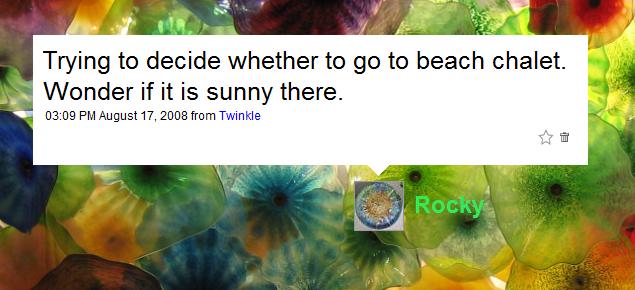
I was deciding whether to head out to the Beach Chalet, a microbrewery and restaurant on the Pacific Ocean, on Sunday. They’ve got a great back yard with Adirondack chairs and live music. It’s a gorgeous place — on a sunny day. Unfortunately, it’s located in one of the foggiest parts of San Francisco.

Before trekking all the way to the other side of the city I wanted to know whether it was sunny there. Could social networking help?

I decided to post the question — to noone in particular — on Twitter:

Wonder if it is sunny there. My question posed on Twitter.

Within 10 minutes, I had my answer:

Its Not.

Of course, this particular experiment is likely only to work this well this quickly in the Bay Area, where it’s easier to find a Twitter user than a newspaper reader.

How else could I find the answer? Google now has geo-coded Webcams in Google Earth. Find where you want to be and check to see if there’s a camera. Click and you’ll get your answer. In the case of the Beach Chalet, it’s often this:

No, I didn't just paste in a white image. This is a view from a webcam near Ocean Beach.

No, I didn't take a picture of a white wall. This is a view from the Cliff House webcam near Ocean Beach.

Posted in geotagging, google, maps, social networking, twitter, web 2.0 | 1 Comment

NYT pays tribute to the best fake political team in television

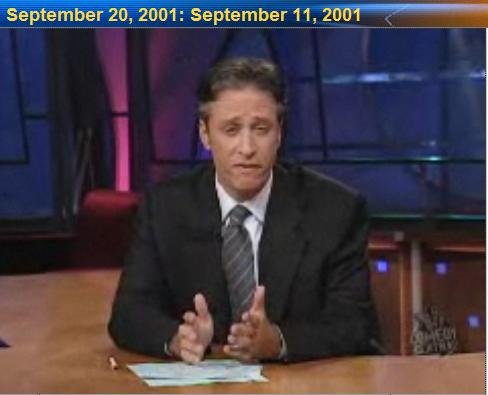
Jon Stewart on his first post-9/11 broadcast

Jon Stewart on his first post-9/11 broadcast

The New York Times ran a great profile of fake news purveyor Jon Stewart this weekend. According to a 2007 Pew poll, Stewart was tied with real newsmen Brian Williams, Tom Brokaw, Andersen Cooper and Dan Rather for #4 as the journalist they most admired.

The Daily Show is my go to source for television news. Stewart and his crew do a much better job than “real” journalists on calling politicians on their hypocrisy. The Times profile barely touches on Stewart’s agenda-setting effect; it isn’t uncommon to see hypocrisy exposed on his show get called out later in more traditional news shows.

Stewart is as tough, if not tougher, on journalists. His media criticism is often sharper than that of Washington Post media critic Howard Kurtz. (Kurtz frequently uses clips from The Daily Show on his CNN program Reliable Sources.)

The show has also changed my expectations of the late night talk show. I find that I’m disappointed when the interview segment is an actor, instead of an author or politician.

The Daily Show and The Colbert Report are ahead of many in the old media when it comes to presenting video content on the Web. After a slow start, this year’s upgrades to the Web site show that they really get the new world of audience interaction and content delivery. Full episodes of each show are available the day after broadcast. You can scroll back through previous episodes. Videos can be embedded on Web sites. Want to see that clip everyone is talking about? The search feature lets you easily find it. You can even find shows going back years. Unfortunately, there’s no way to get video from a specific date years ago.

The Times could learn from them. The nearly 3,000 word story includes two pictures and not a single video. The author describes a few segments, including an extended description of Stewart’s first post 9/11 broadcast, which scream for video. (The video is available on thedailyshow.com.)

Posted in journalism, media, video, YouTube | Comments Off on NYT pays tribute to the best fake political team in television

Congratulations to Twitter and Summize

A big congratulations to former AOL Search colleagues Abdur, Greg and Jay on the acquisition of Summize by Twitter.

They’ve done a terrific job capturing the pulse of Twitter. Summize is a great tool for marketers and others looking to drink from the firehouse of information being generated by Twitter users. (One of my favorite Summize-based applications is Twistori.)

More on the Twitter blog and on the blog of former AOL Search head Gerry Campbell.

Posted in twitter | Comments Off on Congratulations to Twitter and Summize

Technology moves on, language doesn’t

Screen grab of Rotary Dial app for iPhone

Screen grab of Rotary Dial app for iPhone

One of my favorite iPhone apps is Rotary Dialer. There’s just something fun about making the latest and greatest device act like something from the 60s. Rotary Dialer isn’t like the “classic” phones from Pottery Barn, where the buttons are just laid out like a rotary phone. You have to make a circular motion from the number you want to the metal thing at the end. (Anyone know what that’s called?) And just like on real rotary phones, if you slip you have to start all over. It took me 1 minute and 2 seconds (and three tries) to dial my own number.

“Dial” is one of those words that still hangs in there, despite a lot of changes in technology. Most people haven’t “dialed” phones in this country in two decades. When I was in Minnesota, the local phone company made it impossible. It was costing them too much to maintain the equipment to detect the pulses, so they forced everyone to Touch Tone.

Some other words and phrases that are hanging in there:

  • Film, rolls. We film events, even though a lot of that is actually on DV tape or recorded on an SD card. Hollywood still makes actual films, but many of those are now going digital. Apple refers to the recent pictures on the iPhone as the “Camera Roll”.
  • Tape. My TiVo tapes House every week. OK, it’s not really a TiVo, but a Comcast DVR. (Thanks, Clint.)
  • Rewind. Back in the day, the VCR had to physically rewind the tape to show a scene you missed. Now you hit rewind, but you’re probably just going back through a buffer.
  • Albums. Vinyl has all but disappeared, but album art is still with us. Even the compilation aspect of the album is rapidly disappearing as people can pick and choose tracks they want to buy.
  • Washboard stomach. I think I might have seen a washboard in a museum, but I can’t be sure. At least we still have six packs.
  • Slides. I can’t remember the last time I was in a business presentation that used actual slides. Possibly never. But I’ve sat through endless presenters drone on to stills on a screen.
  • Ship. When you send something by FedEx, it’s most likely going by plane or truck. At least we don’t call planes flying boats anymore.
  • Turn off the the TV. With no more knobs to turn, we’re actually pushing it off. With Kinect, we may soon be waving it off or flipping it off.
Posted in apple, fun, iphone | 4 Comments

Unlocking the creativity of the masses

With the launch of the iPhone last year (and the millions of dollars in ad spend around it), Apple did more for wireless data adoption than wireless carriers had in the last 10 years. With Thursday’s launch of the App Store, they’re doing it again by unlocking the creativity of the masses.

Wireless carriers had long held on to core cellphone features with an iron grip. Want access to the camera, GPS, microphone or address book? Good luck. It usually involved spending a year or more negotiating with a carrier and then writing and (rewriting) your app to work on dozens of phone models. And when you were all done, you brought it to a market with little distribution support at a price few people would pay.

In the last couple of days, I’ve downloaded more apps than I had in my entire history of cell phone usage (dating back to 1996). There’s one big reason: once developers had access to features like GPS and the camera, they created compelling applications.

The most compelling apps have come from independent developers or startups. Some have used public APIs for other products; although there isn’t an official flickr app, there are several apps that interact with flickr. AOL is the lone exception among large companies, with apps for AIM and AOL Radio.

Here are some of the apps that caught my eye. With the exception of iMilk, all are free. That’s another refreshing change: Apple is making it easy for application developers who want to distribute free applications. Even paid apps can be relatively cheap, with a one time price of $3-$10 being common. (Versus the previous $3-$5 per month.)

All is not perfect in app land, of course. Much like when Facebook launched their app platform, some developers are having a hard time keeping up with the demand. I’ve also had my phone reboot at least half a dozen times when using various apps.

The functionality in some of these apps is limited compared with their other incarnations. For example, in Jott, you can’t send Jotts to others. As these apps are revved, they’ll become even more compelling.

Jott

Jott allows you to record a voice “note to self”. The note is then transcribed and put in your Jott account, which is available by phone or Web. It isn’t as robust as Jott’s

Where

A mobile social network that lets you plot friends on a map, look for restaurant reviews, find and reserve Zipcars and even look at a map of the night sky where you are with the constellations plotted. (Video of the app.)

There are a number of players looking to create mobile social networks. Whrrl, Loopt and Limbo offer somewhat similar apps. Where offers a range of features beyond social, while Limbo is the most social.

(Disclosure: I did some consulting for Where last year.)

Facebook

Facebook took an early lead with the iPhone 1.0 by having one of the best iPhone optimized sites. The lead developer released a toolkit that was used by other developers. The application version adds the ability to upload photos and IM, but lacks some of the features found in the browser version.

AirMe

Upload pictures to flickr (or an AirMe account). The pictures are automatically geotagged with your location. AirMe also tags you pictures with the current weather conditions.

NearMe

See pictures from Panoramio of places around where you are.

Twittelator

See and update Twitter. Post pictures and location updates. Twitterific has less functionality and also has ads.

Urbanspoon

Kind of like a Magic 8 ball to decide where to eat. Uses GPS to find where you are. Shake your iPhone and it will select a place for you.

iMilk  ($2.99)

“Drink” virtual milk. Uses the iPhone’s accelerometer to empty the glass. If you prefer, you can pour it into a glass before drinking.

Remote

Control your Apple TV or iTunes. Play songs, see album art and search your iTunes library. Works over Wifi, so you don’t have to be in line of sight. Much better than the flimsy remote that ships with Apple TV.

Pandora

The world’s greatest music discovery service now streams to iPhone. The app is beautifully simple. Add in an aux in jack or FM transmitter for your car and say goodbye to the $14 a month you’re paying to XM or Sirius.

Yelp

Why settle for the hand-picked (usually glowing) reviews displayed in the restaurant window? Pull out your iPhone and check Yelp. My favorite feature is a filter that limits the search to restaurants that are open now. Very helpful for those midnight cravings.

Posted in apple, apple tv, facebook, flickr, geotagging, gps, iphone, ipod, lbs, local search, mobile, mobile search, photography, social networking, twitter, where, wireless, wireless data, yelp | 3 Comments

Colgate squeezes out a product for a niche market

Terrorist-approved toothpaste

Kudos to Colgate-Palmolive for responding to a market need: three ounce tubes of toothpaste that fit into baggies that you can get take through airport security. I was pleasantly surprised to find this at Target before a recent trip. (I got tired of buying tube after tube of trial sizes at $1 a pop.)

It must be a fairly new product. The screener at SFO pulled it out to verify the size printed on the tube.

If the TSA were half as responsive to the needs of travelers, the idiocy of the liquid/gel limitations would go away.

More jeers for the TSA for a stupid plan for special laptop cases that may or may not require you to take your laptop out of your bag when going through security. Manufacturers can make bags that may or not meet the guidelines. Bags with zippers, buckles or pockets that can hold things like cables or power adapters likely won’t. As near as I can tell, a laptop condom is the only thing that will for sure meet the guidelines. The only way to know for sure is to send your new laptop bag through the X-Ray machine and see if the screener makes you take the laptop out.

Posted in random, terrorism, travel | 1 Comment

Copy editors going the way of the dodo

Washington Post columnist Gene Weingarten has a hilarious piece making the case for copy editors, who are rapidly becoming an endangered species in newsrooms across the country.

Here’s how newsrooms have typically worked:

  • A reporter writes a story. Presumably, they read it, too. (In my experience as a copy editor, that’s not always the case.)
  • An assigning editor reads it, looking primarily for major holes in content or structure.
  • A copy editor reads the story also looking for the same errors as the assigning editor. The copy editor also looks for spelling, punctuation and grammatical errors.
  • A second, more senior, copy editor (called a “slot”) reads it again.
  • Front page or controversial stories get an additional read or two.

A large chunk of Post copy editors have left in recent weeks. The Post is testing eliminating one of these layers of review.

Weingarten makes the point that a lack of copy editors will mean more errors in stories. That’s undoubtedly true. His deliberately exaggerated column has 60 errors in it. But his column proves that the work of copy editors adds little value.

Here is the unedited list of errors in the first paragraph:

  • Opening line should begin “if you are like me,” not “like I.”
  • No hyphen in “financially troubled.”
  • “Downsizing” should be lower case.
  • “Budget-cutting” should have a hyphen.
  • Syntax requires moving “desperation” after “budget-cutting.”
  • “200-decibel” should have a hyphen.

These errors don’t detract from a reader’s understanding of the story. Most readers don’t care about such nits or even know that they’re errors. Some of the errors that copy editors correct are so widely accepted that the fixes can come across as elitist or errors themselves. In college, a friend came up to me with a copy of The Daily Northwestern, complaining that the paper had left the “n” out of restaurateur.

Sure, there are professional scolds who will write, call or email about these errors. But I’m surprised that those people haven’t keeled over from heart attacks watching what text messaging is doing to our language.

It’s not the job of a newspaper to be the guardian of the English language. Newspapers are correct to focus their increasingly dwindling resources on areas that add value. They should spend more time on the big picture and less time picking nits.

Wiengarten writes “it doesn’t make sense for us to weep for copyeditors anymore than it makes sense for us to lament the replacement of bank tellers with automated ATM machines.” I’ve talked to a bank teller maybe twice in the last 10 years. And both times they added very little value.

See also:

Posted in journalism, media, newspapers | 4 Comments