Slice, dice, repackage and resell

The newspaper business has missed out on a lot of opportunities over the years. Here’s one they shouldn’t miss: repackaging content for niches.

Most major markets have an industry specialization or two. In Detroit it’s the auto industry. Minneapolis has retail and medical devices. Charlotte has banking. Each of those industries has a number of companies in it.

Because I work on automotive products, I frequently end up on the Detroit Free Press’ site. Usually it’s because someone sent me a link or I found the story through an aggregator. Freep.com has a business front page, but often those stories there aren’t relevant to me. There should be an easier way: I should be able to subscribe to feeds about the auto industry and the companies I follow. A halfway decent publishing system should make this a very simple process.

A few newspapers are doing this already. The Seattle Times has feeds for Boeing and Microsoft. The Houston Chronicle has a feed for the energy industry.

But they don’t seem to be capitalizing on the advertising opportunity. Having a highly targeted business audience makes that traffic much more valuable. A conference that is targeting decisionmakers in the auto industry can spend a lot more than the spam ad inventory that is classmates.com. (Which is what currently appears on the Freep page.)

Newspapers can also serve other niches depending on the local market. The most obvious is out-of-town fans of local sports teams.

Posted in advertising, journalism, media, newspapers | Comments Off on Slice, dice, repackage and resell

Tellme where you want to go today

I’ve written a few times about Dash Express, the next-generation navigation device from Dash Navigation. It’s the world’s first two-way connected navigation system. That connectivity allows for some amazing features.

We launched one of those today at Tellme. Dash users who call 1-800-555-TELL or 1-800-CALL-411 and do a business search will have the business listing sent automatically to their Dash device. The listing arrives almost instantaneously. It looks something like this when it arrives:

The Dash screen showing a new address sent from Tellme

The Dash screen showing a new address sent from Tellme.

A few clicks and your Dash will give you turn-by-turn directions to the business you selected. This solves a real need: using the power of speech to make entering businesses much easier.

We’re doing lots of exciting things in the automotive space. I’ll share them as they launch.

More about this on the Dash blog.

Posted in dash, gps, launchpad, satellite navigation, search | 1 Comment

You too can be Rand McNally

How long does it take to get from Pike Place Market to Mount Rainier National Park? According to Google Maps, it’s a 5 minute walk; less than 1/3 of a mile. Pretty easy, huh?

Mount Rainier looks an awful lot like an office tower to me.

Mount Rainier looks an awful lot like an office tower to me. That'll be one steep climb!

In reality it’s a 2 1/2 hour drive.

This error is the result of a fundamental challenge in how data is collected for online navigation and local search products: all of the major services use data that weren’t originally collected for navigation. The typical source is phone books listings, which were originally compiled by companies like InfoUSA to sell mailing lists. In this particular case, the national park likely has a business office in Downtown Seattle.

Einstein monumentThe data have a distinct bias: toward places with phone numbers. While you can get exact driving directions to a local ball bearing distributor, look for a park, landmark or trailhead and you’ll often get erroneous data or no results at all. Occasionally, you’ll luck out and there will be business names nearby that incorporate the place name.

Just for fun, try finding the Albert Einstein statue in Washington, DC using an online mapping service. (If you can’t find it, click on the image to see the answer.)

On Sunday, I was looking for Hippie Hill in Golden Gate Park. Yahoo! Maps struck out entirely. Mapquest delivered a bunch of unrelated results.

An answer lies in another Yahoo! property: flickr’s database of geotagged photos. Although flickr’s search tools aren’t optimized for local search, it’s content is a great data source. The first search result in Google Maps for Hippie Hill is spot on; it came from Google indexing flickr’s geodata. The commercial results on the same map (the red markers) are mostly garbage.

Flickr is just one tool. As more people adopt GPS-enabled phones like the iPhone, we’ll see more and more user generated data. Enabling mobile data collection is reason enough to build an iPhone app.

Developing countries have the potential to leapfrog the developed world in data quality. Google’s Map Maker allows anyone to populate data in countries without large commercial data providers. You can pull up a satellite view and trace roads. Zoom into buildings and add local businesses. Find a park and add in key features. Because the content is user generated, the places that people look for the most will be added first, as opposed to the local ball bearing distributor. Places with colloquial names will become findable.

User-generated content has its challenges, of course. In the initial stages, tools like Map Maker will attract the community organizers who are passionate about their neighborhoods. Once the data start getting even modest usage, spammers will attack. But many of the standard spam fighting techniques can be used to deter them.

OpenStreetMap and Wikimapia offer similar functionality. OpenStreetMap is focused on creating and editing roads; Wikimapia is focused on places of interest.

Google Map Maker’s user interface is more intuitive than OpenStreetMap and Wikimapia. Unfortunately, Google is being hypocritical in how it treats the data. While Google Maps combines data from other sources, such as indexing geodata from flickr,  it is keeping content generated by Map Maker users locked up. Users can’t even download the data they create.

More on: geotagging, local search, maps

Posted in city guides, flickr, geotagging, google, gps, iphone, lbs, local search, maps, satellite navigation | 6 Comments

I am here, where is everyone else?

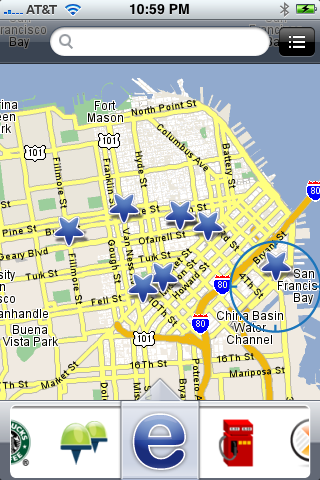
Since the iPhone app store came online, I’ve been playing with a number of mobile social networks. There’s no shortage of them: Limbo, Loopt, Where and Whrrl are all attempting to play in the space.

The central idea of mobile social networks is to connect you with your friends while you’re out and about. Unfortunately, they all require you to rebuild your friend list. Early versions of the Loopt app went so far as to spam people in your iPhone’s address book with text messages.

Local events on Where

Local events on Where

Here are some of the keys to success in mobile social networks:

  • It’s the network, stupid. Getting people to create Yet Another Network won’t work. I’ve already created my network. Use it. My only friend on the iPhone version of Loopt is 2,500 miles away — hardly someone I can run into when I’m out in San Francisco on the weekend. Loopt and Where have Facebook apps, but their iPhone versions don’t seem to tie into them.
  • Let me control when I update my location. Location is very personal. Don’t automatically update my location just because I’ve launched your application. I may just want to check something.
  • Let me publish beyond your app. Early adopters who try your app are willing to accept that there is a ramp up period, but they aren’t going to do work for zero return. If I my update my status and no one is there to see it, have I updated my status? Let me automatically publish the information I collect using your app to Facebook, Twitter and my blog. Not only does it give me a reason to use your app, it becomes a distribution vehicle for you, providing exposure to my friends who just might say “How’d he do that?” I taught a lot of my friends about Facebook mobile simply by updating my status from my phone. (Facebook puts a mobile phone icon next to such updates.)
  • Seed your app with other content sources. If I don’t have friends, at least give me other content that makes your app worth using. Where does a good job of this, pulling in content from Yelp, eventful and Zipcar. If you can, get ego bloggers like Scoble to use your app.
  • 128 King St is not a place. Pete’s Tavern is. Whenever posting information, it should include a human understandable version. You’d never post a location of 37.778911, -122.391223; a street address is marginally more helpful. With the margin of error built into GPS and density of urban areas, place names are critical.
  • Let me take pictures. For a long time, mobile developers haven’t had access to cell phone cameras. With the iPhone, they do. The ability to take and send a picture makes it easier to communicate a lot of information quickly. And it adds life to your application. (Bonus points for dropping a copy of the picture in my flickr account.)
  • Tie into IM and SMS. Loopt claims that the most commonly asked question via SMS is “Where are you?” That claim is probably made up marketing b.s. without any hard data. Nevertheless, it is a frequent question. Make it easy for me to answer it. Let me send an SMS or IM that includes where I’m at (Pete’s Tavern, 128 King St.). To anyone. Include a URL with a map and optionally a picture.
  • Don’t spam my friends. What you do with my friends’ contact information reflects on me. If you spam my friends, I will never use your application again. And I will tell everyone you’re a spammer.

Tying into the various APIs I mentioned may seem like a lot of work — and it is. But the alternative is spending a lot of money on distribution and marketing.

See also:

Posted in apple, facebook, flickr, gps, im, instant messaging, iphone, lbs, mobile, social networking, twitter, where, yelp | 9 Comments

Old gnews is bad gnews for United Airlines

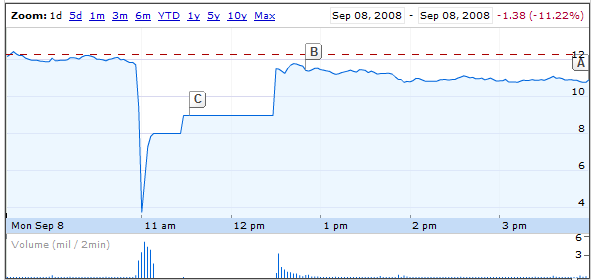
An amusing story today about a cascade of errors. Amusing, that is, if you weren’t a United Airlines shareholder. United’s stock plummeted more than 75% in Monday’s trading after an erroneous report on the company’s bankruptcy.

The report came from a December 2002 story on the Sun-Sentinel’s Web site. The story found its way from the Sun-Sentinel to Google News to an investment research firm to the Bloomberg terminals which sit atop many traders’ desks. The Tribune company, publisher of the Sun-Sentinel, claims that the story was clearly labeled as an archive story. Google and Tribune are pointing fingers at each other.

I’m not sure that I buy the Sun-Sentinel’s claims. It’s archives aren’t indexed by Google in the same way that archives of papers like The New York Times are. Archive pages are very clearly differentiated. It’s also unlikely that an archive story would make the “Most viewed” promotional box. Google’s account of the incident is more believable.

I do have to question a reporter who would republish such a major story without any attempt to verify it. It’s one thing for an algorithm to make such mistakes; entirely another for a reporter to do so.

Ironically, this occured on the same day that Google announced that it is digitizing the archives of newspapers in a blog post titled “Bringing history online, one newspaper at a time.” 

(Yes, that’s an ’80s cultural reference in the headline.)

More on: Google, journalism

Disclosure: I interned at the Sun-Sentinel in college. If you search their archives, you can find the stories I wrote. These stories aren’t in Google’s index. I don’t think I wrote any market-moving stories.

Posted in google, journalism, media, newspapers | Comments Off on Old gnews is bad gnews for United Airlines

Bad UX at Sea-Tac airport

Bad UX at Sea-Tac airport

See those black spots toward the top of the picture, about 30 feet above the ground? Those are flight arrival and departure displays. Really. It’s not just the height that’s a problem; the displays face a large glass wall. When the sun is shining it washes out the LEDs.

That’s a worse user experience than one I saw last Christmas at Dulles. And at least that was temporary.

Posted in rocky's travel, travel, ui | Comments Off on Bad UX at Sea-Tac airport

Sea-Tac arming grungy terrorists

South Lake Union, Sep 4, 2008

Seen post security at Sea-Tac. Someone call the TSA and have their metal knives confiscated!

Posted in random, travel | Comments Off on Sea-Tac arming grungy terrorists

Your customers are Twits

Last year, I blogged about how local businesses could use Twitter to reach their customers. In that hypothetical example, a street vendor would let regulars know whether he was working or not.

A number of large companies, including Zappos, Comcast and jetBlue are already using Twitter to engage with their customers. As Twitter’s popularity grows, it will cease to be a tenable channel for customer service.

But for local businesses, it’ll be a great opportunity. Witness this exchange between Twitter developer Alex Payne and 21st Amendment Brewery.

Twitter exchange between Alex Payne and 21st Amendment brewery

Twitter exchange between Alex Payne and 21st Amendment brewery

Three of the big challenges in getting local business online are that it’s too expensive, too complicated and too hard to prove the return. A Twitter presence can address all three:

  • It’s free.
  • It’s easy. You don’t have to create a Web site to reach your customers. If you don’t have one, your Web presence can be your Twitter page. Not ideal, but better than nothing — at least it’ll get you into search engines. If you do have one, you can autoflow Twitter updates to your Web page making it easy to keep your Web presence fresh.
  • It’s easier to prove return on investment. Twitter can improve both the “R” and the “I”. You can see who’s following your business, showing return. Because there is no cost and the effort is lower, the investment is lower.

There are a number of ways businesses can use Twitter:

  • Specials of the day. “Soup of the day: tomato basil”
  • Special events. “Windsor Cooley book signing Friday night” “Closed for private party”
  • New products. “Transcontinental IPA on tap at the 21A”
  • Problems. “Closed due to broken water pipe”

The immediacy of Twitter also offers a way to do real-time inventory management. Have an especially slow night and food going to waste? Send out a tweet with a special discount.

More on: Twitter

Posted in advertising, customer service, lbs, local search, marketing, social networking, twitter | 4 Comments

Why don’t local businesses use the Internet?

John makes a burrito with his goose sauce

John makes a burrito with his goose sauce

Back in the mid 90s, I frequented The Weinery, a total dive of a hot dog place in the Cedar/Riverside area of Minneapolis. Jerry, the then owner, collected email addresses and would occasionally send out specials. Say the password when you placed your order and you got a discount.

The other day, I received an email from John at Pedro & Vinny’s. John ran a burrito cart in downtown DC. (I wrote about John’s honor system earlier.) He moved away a while back. Friday’s email announced that his burritos will be hitting the DC streets soon.

But John and Jerry are rare among small business owners. In the last 13 years, Internet use has exploded and tools have gotten easier and easier. Yet few local businesses do a good job of communicating with their existing customers and reaching out to new customers.

To be fair, they haven’t been in the habit of advertising. Before the Internet, the key local outlets were newspapers, television, radio and the yellow pages. You essentially had to buy the entire DMA for thousands of dollars. Direct mail (Valpak etc.) and Entertainment coupon books were among the few options that made economic sense.

The Internet has drastically changed the economics. Publishers can slice and dice virtually infinite inventory into smaller and smaller buckets and make advertising affordable for small businesses.

So why aren’t small businesses advertising online?

  • No one is asking them.  Publishers (by and large) haven’t changed their compensation systems for sales reps. If I were a sales rep, I’d much rather work on selling the full page ad for $10,000 than an online presence for $100.
  • It’s too complicated. Search advertising seems like a prime opportunity for local businesses because it can be highly targeted. But the interfaces and the structures are well beyond the skills or interests of small business owners. They’re too busy running their businesses to run keyword campaigns.
  • They’ve been burned. Most restaurant sites look like they were built solely to show off the Flash skills of the design firm. The restaurateur spent hundreds or thousands of dollars for a site that doesn’t drive any foot traffic because it’s unusable and doesn’t show up in search results (because everything is Flash or an image).
  • It’s hard to see the return. Online advertising is a slam dunk for businesses that can complete the transaction online. They can see what they’re getting for their money. It’s harder to show that value to businesses that rely on foot traffic.
  • No need #1. In a town of 500 people, there’s no need to advertise. Everyone knows who you are.
  • No need #2. If you’re the hot new restaurant in town and there’s always a wait to get a table, why spend money on ads?
Posted in advertising, lbs, local search, marketing, newspapers, yellow pages | 9 Comments

Taking the “dead” out of the dead tree media

Last week we saw that Steve Jobs died. The week before, we learned that Barack Obama chose Chet Edwards to be his running mate.

Both were the results of slips by news organizations. Bloomberg prematurely put Jobs’ obituary across the wire, apparently after someone had just finished updating it. The Los Angeles Times released various versions of a story about Obama’s vice presidential pick featuring likely candidates and a couple of long shots. (I wonder if they had a version ready for McCain picking Palin.)

News organizations routinely prepare and update profiles on famous people to be ready to go when something big happens. In one odd case, the author of The Washington Post’s obituary of Gerald Ford died 11 months before Ford.

The big mistake isn’t that news organizations accidentally release the work like they have in the last few weeks; it’s that they don’t keep that work online to begin with. All of this time and effort goes into maintaing these stories and they only see the light of day when someone dies or otherwise makes news. The profiles of Chet Edwards, Kathleen Sebelius, Evan Bayh and others written by the Los Angeles Times are valuable, even though they weren’t selected to be Obama’s running mate.

Think about the people pages you could create with such profiles. They could be linked to from within news stories to provide users context or serve as a standalone reference. Think of the Google juice!

One thing that computers suck at and humans excel at is analyzing and synthesizing information. Compare the Post’s automatically generated page on DC mayor Adrian Fenty with the Adrian Fenty page on Wikipedia. For someone looking for a summary of Fenty, the Wikipedia page is the clear winner. The Post page requires the reader to read and synthesize many stories. (This page, incidentally, is the page that washingtonpost.com automatically links to on Fenty stories.)

The Post surely has an obit ready to go in its system with a profile similar to the Wikipedia page. But that more helpful page won’t be available until Fenty dies.

To be sure, that information isn’t updated as often as Wikipedia. But the edited profiles along with automatically generated recent stories would be a big improvement over what exists today. It would be even better if significant stories were highlighted versus run of the mill daily stories.

Even the list of people for the reporter to call for quotes at the top of the Jobs’ obituary is valuable to readers who are trying to understand a subject. The list includes Steve Wozniak, Heidi Roizen, Bob Iger, Al Gore and John Lassiter. Think of the page views!

The problem is old line thinking in newsrooms that revolves around traditional media. The assembly line mentality needs to go.

See also:

Posted in journalism, media, newspapers, wikipedia | 2 Comments