Googling all the news that’s fit to correct

The New York Times public editor writes this week about an increasing problem: incorrect information from the Times that lives forever in search engines. The Times has started surfacing its archived content in a way that search engines can crawl. This presents problems for people who were treated unfairly.

The Times tells the story of Allen Kraus, a deputy commissioner for the New York City Human Resources Administration. The Times reported that he resigned under pressure because of an investigation. If you Google “Allen Kraus” today, the second link is for the Times archive with stories titled “6 Held in Welfare Fraud Scheme; Inquiry Uncovered Worker Bribes” and “A Welfare Official Denies He Resigned Because of Inquiry“.

That’s not the best impression to make on a prospective employer or client.

People are coming forward at the rate of roughly one a day to complain that they are being embarrassed, are worried about losing or not getting jobs, or may be losing customers because of the sudden prominence of old news articles that contain errors or were never followed up. … Kraus is hardly alone in claiming real or potential harm. A person arrested years ago on charges of fondling a child said the accusation was false and the charges were dropped. The Times reported the arrest but not the disposition of the case.

The Times says that if they worked to correct errors, that’s all they would be doing:

But what can they do? The choices all seem fraught with pitfalls. You can’t accept someone’s word that an old article was wrong. What if that person who was charged with abusing a child really was guilty? Re-report every story challenged by someone? Impossible, said Jonathan Landman, the deputy managing editor in charge of the newsroom’s online operation: there’d be time for nothing else.

Although Wikipedia is often slammed for having inaccurate information, at least with Wikipedia, you’ve got a more than fair chance of getting an error corrected. Bloggers are generally more than willing to fix genuine errors — and they are much more approachable than the Times to point them out in the first place.

A big part of the problem is that many newspapers consider their archives to be a permanent record of what was in print. Newspapers view themselves as the first draft of history.

Removing anything from the historical record would be, in the words of Craig Whitney, the assistant managing editor in charge of maintaining Times standards, “like airbrushing Trotsky out of the Kremlin picture.”

In newsrooms, the archives are called “the morgue.” Now that the Times is bringing those dead stories to life, a different approach is needed. In the past, finding old newspaper articles required you to search through microfilm, dusty newspapers or expensive commercial databases made it clear that you were looking at something old. With one-click Googlability, ancient articles look as fresh as something published minutes ago.

Some news outlets still show the incorrect version of a story with a footnote at the bottom showing the correction. That is absolutely wrong. If you make an error and you know it, fix it where the error was made, not someplace people might not get to. (Especially if they’re just seeing an excerpt on a search results page.) The first thing someone should come across online is the best version the newspaper can offer.

Bloggers do this all the time. When an error is pointed out, they correct the main blog entry and usually indicate that a previous version contained incorrect information. If the error was pointed out in the comments, they usually point readers at the comment.

For newspapers worried about the “permanent historical record”, that can be maintained as a separate link off the current page with a prominent disclosure that shows that the article has been superseded.

The archives of the Times presents another problem: you have to pay to see the archived story. The free headline and excerpt might say “John Smith arrested in connection with fondling neighbor’s child”. But someone would have to pay $4.95 to see the update that says “The Times incorrectly reported the name, it was Justin Smith.”


Posted in journalism, media, newspapers, research, search | 1 Comment

Mooving beyond the boring business card

After leaving AOL, I decided to get some personal cards printed. Instead of going the conventional route, I went with Moo. It’s a great little company out of the UK that lets you print cards with full-color pictures on the back.

The cards are printed on high quality stock and the overall ordering experience is as pleasant as I’ve seen. You can pull in your pictures from many of the leading photo sites. Each order is 100 cards and costs $25; every card can have a different picture on it.

The cards are a great conversation starter. People love to guess where the pictures were taken. A friend was in town on Sunday and managed to guess 3 of 4. (I didn’t have the third card shown here on me.) See how you do. Click through to flickr to see the location.

card1.jpg

card2.jpg

card3.jpg

card4.jpg

card5.jpg

Posted in flickr, fun, photography | 1 Comment

How satisified are you with…?

I find that increasingly companies are asking me to answer surveys after speaking to their call center agents. Whether it’s a credit card company, insurance company or travel provider, they want to know how satisfied I am.

Many times, I can’t answer the question because they haven’t fully addressed the issue. They’ve told me that they will, but until I see the credit on my credit card statement or they pay my health insurance claim I don’t know if I’m satisfied.

I called Bank of America and the agent promised me a credit for an erroneous finance charge. About all I could comment on after the initial call was whether I had to wait on hold excessively or the agent was polite. The credit never showed up. I am not satisified.

The best thing they can do to increase my satisfaction (aside from applying the credit immediately and letting me see it online), is to send me clear information about what they did. AOL’s internal employee help desk was great at this. After each call, I’d receive a summary of our call and any pending next steps. If something went awry, I had an easy reference.

Most of the companies I deal with already have my email on file. If they sent me an email automatically with a case number, time of the call and who I spoke with, it would increase my satisfaction. Even better if they could inform me that my issue was resolved successfully.

When I call American Express customer service, I soon get an email:

You recently called American Express with questions about your XXXXXXXX account. Did you know that as a Cardmember registered to Manage Your Card Account online all you have to do is log in to access your account information?

Never mind that I wouldn’t have called if I could actually have solved my problem online.

Posted in customer service | Comments Off on How satisified are you with…?

Cutting the cord on the home phone

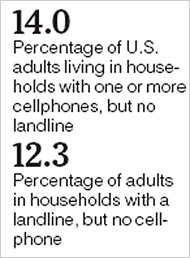
Cutting the cordThe Times reports today that the percentage of homes with cell phones and no landline now exceeds the percentage of homes that have a landline and no cell phones.

It’s been about four years since I paid a landline phone bill. (And for the previous three years, I only had a landline so my DVR could call for program listings.)

I’d love to know what the landline sign up rate in dorm rooms is these days. With the proliferation of cell phones, I suspect that it won’t be long before it’s not worth the expense of maintaining campus phone networks.

This stat from the University of Virginia provides a little insight:

In the 1997-98 academic year, students spent more than 5 million minutes making long-distance calls. That rate fell to 600,000 minutes [in 2004], bringing in only $30,000.

With free long distance, unlimited nights and weekends on most plans and unlimited in-network calling on many wireless plans, it certainly doesn’t make sense to make long distance calls on a dorm phone.

Posted in statistics, wireless | 2 Comments

Let Google Maps do the walking

Matt Cutts points out a great mashup for apartment hunters: Walk Score. One of the most important criteria I have when looking for a place to live is whether I can walk to (or stumble back from) places. Walk Score provides an easy way to answer that question. You specify an address and it calculates a walkability score. The score takes into account things like the proximity of grocery stores, restaurants and bars.

More than that, it also auto-generates a great little neighborhood guide. Most local search tools require you to search for a business name or category. Walk Score makes it easy to get a feel for a neighborhood by showing the nearest bars, restaurants, grocery stores, movie theaters, libraries and schools.

Here’s a Walk Score map of my neighborhood:

Walk Score map of Clarendon

Walk Score doesnt’ take into account hills, so those looking for housing in San Francisco may want to consult a topographic map.

Posted in city guides, google, local search, maps, mashups | 2 Comments

The strategy of the Feud

One of my guilty pleasures is watching the Family Feud.

Those who know the show can skip the rest of this paragraph. The Family Feud is an American TV show that pits two families (in teams of five) against each other to answer questions based on surveys. For each question, 100 people are surveyed and the goal is for your family to guess the answer that the most people said. A sample question would be “Other than love, what’s a reason a woman would marry a man?”  (money, sex, fame, looks). Each round beings with a “face off” where one member of each team answers the question. The person with the more popular answer can decide between two options:

  • Play – By choosing to play, the family must guess all of the remaining answers on the board. In each round, there are typically between four and eight answers. Each person must answer individually. If they get all the answers on the board before they get three wrong, they win the round.  If not, the other team gets a chance to steal.
  • Pass – If the winning team chooses to pass, the other team must get all the answers before they get three wrong. In the meantime, the winning team can talk amongst themselves and decide on one answer to steal the round.

Almost always, the team that wins the faceoff chooses to play. But it’s incredibly rare that a team gets all of the answers on the board; the vast majority of the time, they strike out and the other team gets a chance.

I’ve never understood why the teams that win the face off don’t pass. I’d pass every time. It’s much easier to guess one answer as a team than it is to individually guess 3 to 7 answers. Maybe it’s the desire to be on TV longer or the feeling of being in control of your own destiny.

Or maybe it’s the families they get. This is one of my favorite clips from the show. It’s worth watching all the way to the end.

Posted in fun, random | Comments Off on The strategy of the Feud

NY Times launches My Times

The New York Times has opened its My Times customized home page to the public. (via Techcrunch) Anyone who has used My Yahoo!, Pageflakes, Netvibes or iGoogle will find the look and feel very familiar. The default modules include Journalist’s Picks, stories from the NYT Home Page, NYT most emailed articles, Yahoo! News, BBC News, Bookmarks, Weather, Movie Showtimes, Flickr and Stock Quotes. You can add and delete modules, including content from the Times, outside sources and any RSS feed. (The Times seems to be using its own RSS feeds under the hood.)

It’s the best execution of The Daily Me that I’ve seen from a news company. But it’s at least two years too late. Aside from serious Times junkies, I don’t see many people using this page. The Times, like many news sites, gets most of its traffic horizontally. Of all the people who visit nytimes.com in a month, only 18% (1.4 million) visit the home page. By contrast, My Yahoo! gets 22.3 million unique visitors and iGoogle gets 6.8 million.

My Times journalist picksThe most interesting part of My Times is that you can pick from modules selected by Times journalists. Want to know what David Pogue is reading? You can click to see that he recommends Engadget, AppleInsider, Slashdot, Gizmodo and his own stuff. (Unfortunately, I can’t link to this page.) These pages are good resources that would be even more useful if they provided direct links to the RSS feeds so that you could subscribe with your preferred personal home page or news reader.

More on: journalism, newspapers

See also:

Posted in journalism, media, newspapers, rss, web 2, web 2.0 | Comments Off on NY Times launches My Times

iPhone as your social network

I had a chance earlier this week to try the new Facebook application for iPhone. The app, developed by Joe Hewitt, is a version of Facebook optimized for the iPhone. Many of the core features of Facebook are available on the iPhone, including your profile page, messages, pictures, status messages and your friend’s contact information.

It’s a very well done app that shows off the capabilities of the iPhone as well Facebook. (If you have an iPhone, go to http://iphone.facebook.com to try it out; you can also go to that URL in a Web browser to see the functionality.) A video demonstration is at the bottom of this post.

Currently all of this is done within the phone’s Safari browser; it’s not integrated into the phone’s contacts, pictures or other capabilities.

As much as I love my computer, my phone is where the most important “social networking” happens. The social network needs to be embedded deeply into the phone.

Here are some of the possibilities:

  • Pick up a new phone and enter your account information. Your contacts are automatically populated, complete with pictures of your friends. No need to fiddle with re-entering all your data.
  • Check the status of your friends before you make a call. If you see that your friend is on the phone, you can call later or send a text message. (Similar to presence on IM.)
  • When a contact changes their phone number, the new information is automatically updated. You don’t have to worry about outdated phone numbers.
  • Pull up a map of where your friends are when you’re trying to meet up.
  • Take pictures and videos and upload them straight to your social network. (flickr, Facebook and others have developed workarounds that accomplish a limited form of this today.)
  • Get reminded of events in your network without having to manually add them to another calendar. The reminder leads straight to maps and directions.

All of this is technically possible. The biggest challenges revolve around who “owns” the customer. In the U.S. market, this has historically been the wireless carriers. Some carriers deliberately make it hard to do things like move contacts because that raises the switching costs for customers. Most restrict access to key phone capabilities (such as the camera, GPS) to internal developers.

Doing something like this would mean breaking a lot of the traditional rules. But Apple has done that before.

More on: facebook, iphone

(Video from Rodney Rumford)

Recommended reading:

Posted in apple, facebook, iphone, social networking, wireless, wireless data | 4 Comments

Brazen highway robbery in Nebraska

You see a sign advertising gas at $3.09 a gallon. You pull in and fill up. After filling up, you realize that you were charged $3.59 a gallon for the same grade of gas. Bait and switch? Sounds like it. Illegal? Apparently not in Nebraska. The fine print on the sign said the $3.09 price only applied at select pumps.

That’s what’s happening in North Platte, Neb. A Conoco station is advertising a low price, but that price only applies for two of its pumps.

Under state law, the signs — which show in smaller print that the lower-priced gas is available only at certain pumps — are not illegal as long as gas is available at the lower price at even one pump, according to Steve Malone, administrator of the state Weights and Measures Division.

At a difference of 50 cents a gallon and using a conservative estimate of 60,000 gallons a month, that’s an extra $360,000 a year. Because the Conoco is located just off the Interstate, repeat business isn’t a huge concern.

The owner of the Conoco station refused to comment on his deception. In a a classic race to the bottom, the BP station nearby has also adopted the shady practice.

“I personally don’t like doing it,” [an owner of the BP station] said in a telephone interview. “They (the Conoco station) were pulling more people in to their station. It got to the point that in order to get any business we had to match what they were doing.”

It’s a tough situation. Be honest and lose business to the cheating sleazebag down the road. Or cheat your customers to stay “competitive.” A friend asked how I’d handle it. I’d probably start by advertising my prices with a big sign that says “AT ALL PUMPS”. If that didn’t work, I’d add a sign that said “UNLIKE THE CONOCO”.

via Consumerist

Posted in advertising, fun, random | 1 Comment

Google introduces embeddable maps for your Web site

In the latest incarnation of widgets that let users slice-and-dice content, Google Maps is now allowing users to embed maps on Web sites. Several of Google’s other properties allow users to embed content, including YouTube’s embeddable videos and Picasa’s slideshows.

Unfortunately, WordPress.com doesn’t let me embed content. But you can take a look at an example on this demo page I created at Ning. This example uses a custom map that I created using Google’s My Maps feature. Google lets publishers customize the size of the map.

The embeddable maps should be a boon to small business owners looking to incorporate maps on their Web site, complete with a picture of your business, nearby landmarks and easy access to turn-by-turn directions.

Related:

More on: Google, maps

Posted in google, maps, mashups, web 2, web 2.0 | 2 Comments