 The Post’s Rob Pegoraro has a story this week on two products I’ll never buy. One is the Samsung Jitterbug, a feature-free cellphone. The other is the HP Printing Mailbox. It connects to a regular telephone line and prints emails intended for the owner.
Don’t laugh too hard at that one; it’s not intended for you, either. While most products these days focus on adding as many features as possible to entice the young, these products are designed for older users who don’t want to learn all those features.
There are two versions of the Jitterbug. They both do one thing: make phone calls. You can’t text someone, browse the Web, play music, view pictures, watch TV, check email or get driving directions.
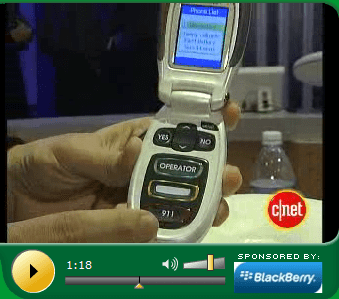
The simplest version, pictured above, does away with the 10-digit keypad and replaces them with three big buttons — 911, operator and a big custom buttons. (According to the Jitterbug Web site, “We’ll personalize the middle button for you before we ship your phone. Choose ‘Friend,’ ‘Home,’ ‘Tow,’ ‘Work,’ or ‘My Choice.'”) There’s also a menu of 10 speed dials. If you want to call someone else, you call the operator and he or she puts you through.
Ironically, many of the ads I saw while researching Jitterbug were for phones at the other end of the spectrum. The CNET video in the screenshot above is sponsored by Blackberry.
The Jitterbug has two big problems. It’s offered by an MVNO named GreatCall. MVNOs have had a tough time lately. One of the largest, Amp’d mobile, is likely to be shutting down next week.
The other is price. The phones cost $147 and the service is also premium priced. Features like unlimited nights and weekends and unlimited in-networking calling aren’t available. It only really makes sense if you rarely use the phone. It would be a much more compelling offer if you could add the phone to a family plan for a major carrier.
The HP Printing Mailbox from Presto is designed to print email and photos sent to an email address. In theory, you buy this printer for your parents, set it up and connect it to the phone line.
When you send them email, it gets printed out the next day. There’s no way to send an email back. (“Users do not have the cost and hassles of a computer and Internet account, and do not need to learn to send email or use a keyboard.”) They can call you (using a Jitterbug?) or write a letter. Only emails from approved email addresses are allowed. There’s also an option to subscribe to newsletters and articles from companies like Better Homes and Gardens and the Wall Street Journal.
Cost is an issue here, too. The printer costs $99 and the service is $10 a month. And then there’s the pricey HP ink cartridges.
The big problem I see with the HP Printing Mailbox is that it assumes a one-way relationship. To me, giving this to someone says “I don’t really care about you.” When I send an email to you with HP Printing Mailbox, I know you can’t email me back. It’s like calling someone’s work number at 9 p.m. hoping to get voicemail because you don’t really want to talk to them. There’s one opportunity for increased interaction: if you actually use the thing, you’ll probably have to visit every few months to change the ink cartridge.
But then again, I’m not the target market.

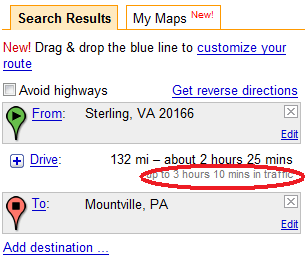 Google Maps is now including estimated travel times in heavy traffic in its driving directions. The details on Google’s LatLong blog post are vague. The service is available in “a limited set of metropolitan areas.”



 Rakesh Agrawal's blog