Hngry. Snd pzza now.

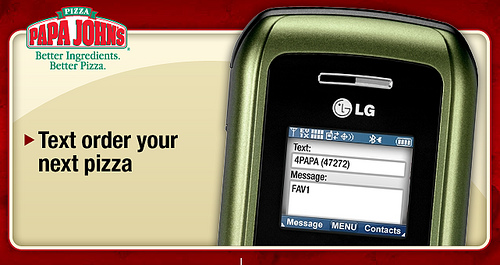
In a first for the U.S. pizza market, Papa John’s is now letting you order your carbs by text message.

Papa John’s SMS ordering

This won’t work for last-minute cravings. You have to create an online account at papajohns.com and pre-configure the pies that you might want someday. Just in case your pizza tastes vary from time to time, you can configure up to four favorite orders.

It sounds like way more work than it’s worth. But that’s what I think of their online ordering system and yet an astonishing 20% of Papa John’s orders come from the Web site. I’ve used it a few times, but it’s generally easier to pick up the phone.

An added bonus (for Papa John’s) on SMS orders: you pay full menu price instead of getting their latest specials. With specials frequently knocking 40-50% off an order, that could be a lot of dough.

Posted in fun, random, sms, wireless, wireless data | Comments Off on Hngry. Snd pzza now.

Introducing the Rival Crockpots

I haven’t been a fan of video games in general because they tend to be anti-social. But with the Wii and now Rock Band, they’ve become really good group experiences. Rock Band is an incredible game that lets four people get into the act on drums, guitar, bass and vocals.

It also is a pretty good business. In addition to the game and accessories, they can generate additional money by releasing new songs for your band to try. The staggered release maintains enthusiasm for the game and brings in recurring revenue. As much as I criticize the music industry, I have to give them kudos for licensing music for innovative uses like this.

Here is a slideshow from the Rival Crockpots. (If you’re reading this in an RSS reader, you will need to clickthrough to the blog.) The pictures are available on flickr.

Posted in fun, random | Comments Off on Introducing the Rival Crockpots

Facebook improves News Feed algorithm

In a much anticipated move, Facebook has changed its News Feed algorithm. The new algorithm rewards applications that compel their audiences to interact with them regularly. Scrabulous is a great example of a winner from this change.


Facebook News Feed with Scrabulous

Under the old algorithm, you would only see News Feed items from applications that you have installed. If all of your friends loved Scrabulous, you wouldn’t hear about it except possibly when they installed the application. I find this particular feed item from Scrabulous a bit spammy because the text doesn’t reflect anything that Ben did within the application. If it said “Ben played the word QUARTZY for 126 points” it’d be a more interesting news item.

This change also helps applications that compete with Facebook core features like the Wall and Photos. They are now on a more equal footing when it comes to promotion in the News Feed.

The additional competition for inclusion in the News Feed will hurt applications like Vampires that have large installed bases because they got in on the spam-all-your-friends bonanza when the F8 platform launched.

An earlier change by Facebook allows you to vote on News Feed items. In the screenshot above, clicking the thumbs up icon indicates that you like an item. Clicking on the “X” indicates that you don’t like an item. It’s unclear whether the vote applies to the person that the item is about or the application that generated it.

More on: Facebook

Posted in facebook, social networking, web 2, web 2.0 | Comments Off on Facebook improves News Feed algorithm

Technology in pop culture and geek trivia

In the last week or so, I’ve seen a few of our favorite geek topics appear in pop culture. Twitter provided key clues in CSI. The Simpsons finally got Tivo. Doonesbury featured Pandora.

Tuesday’s Jeopardy! had as the Final Jeopardy! clue:

This company’s name is a variation on a word coined by Milton Sirotta & used in the book “Mathematics and the Imagination”

Answer after the video.

Jeopardy! answer: What is Google?

Google is a variant of googol, which is the number 1 with a hundred zeros after it. Larry Page was in my high school class and was fascinated with googol even back then.

Two of the three Jeopardy! contestants got it right. The other answered Yahoo!

Yahoo, by the way, originally stood for Yet Another Hierarchically Officious Oracle.

Bonus question: What is the name of the first search engine developed by Larry and Sergey?

(Bonus question courtesy of Adam Lasnik.)

Posted in fun, google, random, twitter | Comments Off on Technology in pop culture and geek trivia

Lake Tahoe and Reno pictures on flickr

Pictures from my trip to Lake Tahoe and Reno are online. Highlights of the trip were Emerald Bay, Virginia City and the National Automobile Museum in Reno. The museum is really the only thing in Reno I found worthwhile. Here is the map.

Reflections in the lagoon

Posted in rocky's travel | Comments Off on Lake Tahoe and Reno pictures on flickr

Flickr places provides a wide-angle view of the world

My friends who’ve seen me walk around with a GPS as I take pictures on vacation or hikes think I’m a little bit odd. But apparently, I’m not the only one. In the 15 months since Flickr officially supported geotagging, more than 35 million pictures have been geotagged — enough that they can launch Flickr Places to show them off.

One of my big complaints with most travel sites is that they downplay the visual and visceral elements that make travel fun. At Flickr Places, that’s front and center. Places offers a gorgeous travelogue of places around the world. You can see pictures, Flickr groups about the location and connect with photographers.

A tag cloud shows the top tags for an area; this sounds more useful than it is. Most places I searched came up with words like clouds, sunset, people, church. It’d be nice if the universal words were thrown out and the focus places on words that are unique or much more common for an area.

I’d also like to be able to zoom in on the map and see where the most photographed places are. (There are some data quality issues with this, but they’re manageable.)

veniceflickrplaces

Flickr also changed the way maps are presented. Although the maps and overall presentation are more visually appealing, some key functionality was lost. In the previous version, the map represented your search. If you zoomed in or out, the new map defined the boundaries. As a result, you could see new pictures that didn’t appear in the other view.

The World Map view now provides a tag visualization that shows the latest tags from around the world. (See my earlier coverage of World Explorer from Yahoo! Research.)

See also:

More on: flickr, geotagging

Posted in flickr, geotagging, maps, mashups, travel, web 2, web 2.0 | 1 Comment

Google’s My Maps becomes Our Maps

Google’s latest changes to My Maps allows you to collaborate on personal maps with others in much the same way you can share a Google Document or Spreadsheet.

ShareMyMaps

You can also allow anyone to edit a map.

Group editing is great for maps that are too hard for one person to scale. Before this release, I started maps of free Wi-Fi and restaurants with outdoor dining. Now I can invite my friends and the public to help build out the maps. Although some of these data is captured by vertical players such as JiWire and Skyhook, the integration with Google’s Local Search brings it to a much wider audience.

Google could use the same platform to have users build out vertical directories to augment data from providers like InfoUSA by actively soliciting users to contribute places on specific topics. This is already happening on an ad hoc basis as users follow their passions and create maps.

We’ve seen news organizations use My Maps to cover stories such as the California wildfires. They could open that up to a collaborative process with their readers.

See also:

Posted in google, maps, mashups, web 2, web 2.0 | 1 Comment

Google Maps tackles the last block problem

A longstanding problem with online maps and navigation devices is that your destination is often not where they say it is. When you reach the “destination”, you’re often a few hundred feet from where you wanted to be. There are three common reasons for this:

  • No one has walked every street and identified where each address is. Addresses are approximated based on standard numbering schemes. On a block that goes from 200 to 300, 250 will be placed in the middle.
  • Businesses sometimes use vanity addresses. The business may have an address on Madison Avenue in New York, but the real entrance is off less glamorous 54th Street.
  • The business address is incorrect or malformed in the database.

Google Maps is now tapping users to help fix this problem. Users can edit the location markers for a given address. To prevent abuse, any movements greater than about 600 feet are moderated.

This is especially helpful for addresses that are incorrect in the Google database or can’t be accurately geocoded. These appear on Google Maps with a circle to mark the location and a warning.

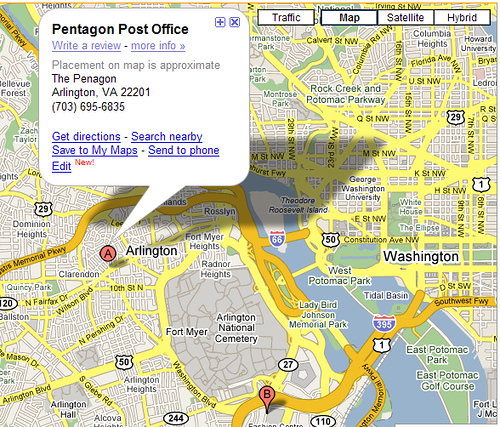
The Pentagon Post Office is listed with an address of “The Penagon, Arlington, VA 22201”. As a result, it appears about three miles from where it really is. I was able to move it to the correct spot, on top of the Pentagon. Because this is more than 600 feet, the change will be moderated. I’ll be watching to see how quickly that happens. (Update: Google has since removed the Pentagon Post Office record altogether.)

Pentagon Post Office on Google Maps

If this feature takes off, it will make Google’s Street View feature much more useful. Right now, when you pull up a Street View of an address, there’s a good chance you won’t see the business you were looking for because it shows a view of the approximated location.

More on: Google, maps, satellite navigation

Posted in google, local search, maps, satellite navigation, street view, web 2, web 2.0 | Comments Off on Google Maps tackles the last block problem

Searching outside the search box

A large untapped opportunity in social networks is connecting people with information they’re looking for.

I was flying home this weekend from Lake Tahoe and connected in Salt Lake City. While I was there, I updated my Facebook status to indicate that I was in Utah for the first time.

Later that night I received a message from my friend Dean:

hey Rocky, whatcha doing in the beautiful, bizarre state of UT?

I lived there for a year after AOL. Let me know if you need any tips on where to go while you are there.

Salt Lake City AirportWithout doing a search, I had information coming directly to me from someone I knew. I was just in Utah for 90 minutes, so I didn’t need any tips. But when I go there for real, I now know to begin my search with Dean.

By distributing information needs through our network, social networks allow us to tap into a large base of knowledge from known sources.

Services like Yahoo! Answers allow you to ask questions, but Answers is largely anonymous. Too many of the answers devolve into insults and name calling and it’s hard to tell if people know what they’re talking about. There is also an incentive problem: I don’t participate in Yahoo! Answers because I don’t have enough time to answer questions for random strangers. But I’m happy to answer questions for friends.

LinkedIn’s Answers product usually delivers better results by posing questions just to your network. And because I know these people, I can easily assess the credibility of their answers. LinkedIn’s professional focus is a bit limiting; I wouldn’t pose questions about vacation plans there.

If I were really going to Utah, I suppose I could spam everyone I know with an email asking if anyone knew anything about Utah. The passive approach of updating my Facebook status is more socially acceptable.

For now, this relies on my friends seeing my status message and responding. It was more or less random that Dean saw my status message. As social networks get smarter (and get more data), the request can be routed automatically to the people likely to have a good answer. My status message could be displayed more prominently to friends whose profiles indicated that they’d lived in or visited Utah.

Marketers can also be part of the conversation. Facebook allows you to become a “fan” of a company or a product. If I become a “fan” of United Airlines, they could send me information about their Utah service or upcoming sales. I’d love to hear about any great deals to Park City this winter.

More on: Facebook, search

See also:

Posted in facebook, search, social networking, web 2, web 2.0 | Comments Off on Searching outside the search box

Ethernet everywhere

Ethernet-enabled urinals at The Local

Yup, that’s an Ethernet jack above the urinal. I saw this at my friend Kieran’s pub, The Local in Minneapolis.

No, I didn’t try plugging in.

Here’s what the jack is really used for.

Posted in advertising, fun, marketing, random | Comments Off on Ethernet everywhere