Groupon, LivingSocial and daily deals – consumer FAQ

Judging from the queries that come to this blog, there are a lot of questions that consumers have about daily deals from Groupon and LivingSocial. If you are a merchant and are interested in learning about the merchant experience, see the Groupon merchant FAQ. Please note that although I use “Groupon” extensively throughout this post, the same general principles apply to other U.S. deal sites, including LivingSocial

These are the most frequently asked questions about daily deals:

My Groupon expired. Is it still worth something?

Yes, Groupons and LivingSocial vouchers that expire are still worth what you paid for them forever. In some states, the merchant may be required to honor the full face value (including promotional discount) past the expiration date. You can try to use it at the merchant. If they won’t honor it, call up Groupon or LivingSocial and ask for a refund.

The business I bought a Groupon for went out of business. Can I get my money back?

Yes. Call the deal company and you will get a refund of the money that you paid. They may initially try to give it you in Groupon credit; insist on getting a refund to your credit card.

Do I have to use my Groupon all at once?

Many daily deals state that they must be used in one visit. However, this may be contrary to state law as some states require that prepaid vouchers can be used over the course of multiple visits. It’s still unclear how this will play out. But if you’re dissatisfied, call or email your deal provider and explain your situation. You can use vouchercomplaints.org to help craft your email and learn more about the specifics that apply to your state.

Can I get a cash refund for my unused Groupon value?

Some state require that any balances below a certain value be refunded in cash if requested. For example, in California, merchants are required to refund gift cards with value below $10 upon request. It’s still unclear how this will play out. But if you’re dissatisfied, call or email your deal provider and explain your situation. You can use vouchercomplaints.org to help craft your email and learn more about the specifics that apply to your state.

Will I get worse service if I use a Groupon?

It’s not uncommon to experience poor service when using a Groupon. This happens for two primary reasons: 1) Many businesses end up selling a lot more vouchers than they expected, leading to a crush of demand that they can’t service. You may want to wait until a month or so into the Groupon, when the initial rush dies down. 2) Many servers have bad experiences with Groupon customers. I’ve heard many complaints about poor tipping and customers being extra demanding. As a result, they treat all Groupon customers poorly.

I bought a Groupon for a cleaning service, but when I call they tell me that they can’t book me for 4 months. What can I do?

Because Groupon generates so much demand, it’s pretty common for service businesses like cleaners, spas and auto detailers to be booked up for months. If you can’t book in a timeframe that meets your needs, call Groupon and ask for a refund.

I bought a Groupon Getaways voucher. I tried to book my trip, but the hotel says it’s not available for Groupon use. I checked their Web site and they have rooms available. What’s going on?

Groupon Getaways and LivingSocial Escapes are generally sold based on “availability.” Availability doesn’t mean it’s valid if any room is available. Like airlines, hotels allocate rooms into multiple inventory buckets. In order for you to use your voucher, there must be availability in the bucket that corresponds to your voucher. Availability is always in flux; if you’re told that it’s not available today, it might be available tomorrow and vice versa. If you cannot book the dates that you want, call Groupon or LivingSocial and ask for a refund.

Are Groupons bad for businesses?

It depends on the type of business and the type of deal. In many cases, Groupons are harmful to the businesses that run them. This is especially true if you are an existing customer and use a Groupon when you otherwise would have paid full price. See the Groupon merchant FAQ for more information.

I have another problem with Groupon or LivingSocial that isn’t addressed here. Where can I get help?

You can email support@groupon.com or call their customer service at  1 (877) 788-7858, 9a.m.-5p.m. CT.

For LivingSocial, visit http://help.livingsocial.com/contact_us or call 877-521-4191.

Although I usually hear negative things from merchants about daily deal companies, I generally hear very positive things from consumers about customer service.

If they aren’t able or willing to help, try calling your credit card company and requesting a chargeback.

If you have an interesting situation or a negative experience with their customer service, feel free to also email me at dailydeals@agrawals.org. Because of the volume of email I get, I can’t respond to every message.

You can also leave a comment on this post.
Posted in daily deals, groupon, livingsocial | 3 Comments

Groupon, LivingSocial and daily deals – merchant FAQ

Judging from the queries that come to this blog, there are a lot of questions that merchants have about daily deals from Groupon and LivingSocial. If you are a consumer and are interested in learning about the consumer experience, see the Groupon consumer FAQ.

These are the most frequently asked questions about daily deals:

Does it make sense for a small business to run a Groupon or LivingSocial deal?

In many cases, it does not make sense. For most of the cases I see with small businesses, I would advise against it. It is especially bad for restaurants, bars, spas and other service businesses. It’s possible to make daily deals work — if you are very careful about the construction of the deal. You want to try to ensure that people spend more than the value of the voucher. You also want to try to get people to come back. See my list of Groupon and LivingSocial best practices for guidance on how to negotiate and prepare for your deal.

In what cases does it make sense to run a Groupon?

The absolute best time to run a Groupon is if your business is about to go out of business. In the United States and Canada, Groupon and LivingSocial provide cash upfront. This might help your business get over the hump. Because they don’t do background checks, you can run a Groupon even if you can’t get a loan from the bank.

How big a cut do the daily deal companies take?

Typically, they take 50% of the value of the deal. If, for example, you sell $50 worth of product for $25, you will receive $12.50. The commission rate varies. I’ve seen it as high as 100% and as low as 10%.

Is the fee negotiable?

Yes. You can negotiate the terms with your sales rep. If you business is well known within the community or you have a unique product offering, there’s a reasonable chance that you can negotiate an 85% or 90% share.

Do I control when the Groupon runs?

No. Groupon typically runs a deal when it thinks it will be most profitable for them. You might only get a few days notice before your deal runs. Do not believe any assurances that your sales rep gives you about when he expects it might run. If it’s not in writing, it’s not a commitment.

What is the biggest risk in running a Groupon?

For many businesses, the biggest risk is that the customers who come in are already your customers. Instead of acquiring new customers, you will end up taking a loss on your existing customers who would have come in anyway at full price. Plus, I hear more stories lately from consumers who choose not to go back to their favorite restaurants for several weeks after a Groupon runs because they don’t want to deal with the Groupon people.

Running a Groupon can also lower your Yelp ranking in a way that might be hard to fix. This can have a long-term negative effect on your business because many people rely on Yelp reviews to decide where to go.

Is Groupon really no risk advertising?

No. The best way to think of Groupon is “no money down” advertising. Instead of paying for ads upfront as you would with a newspaper or magazine ad, you pay for it in the form of large discounts and fees over time. I talk to many businesses who lose tens of thousands of dollars running Groupons. With a newspaper or magazine ad or Yelp subscription, the most you can lose is the price of the ad.

Can I cap the number of deals sold?

Yes. It is absolutely essential to set a maximum number of deals sold. It’s not in Groupon or LivingSocial’s short-term interest to cap it because they make more money if they sell more deals. Insist on a cap and make sure it is in your contract. I’ve heard from former deal sales people that they would lowball the number of deals that they estimated so as not to scare merchants. For example, if they expected a deal to sell 1,200, they would tell the merchant it would only sell 300 so that the merchant would run the deal without a cap.

Will Groupon or LivingSocial give me the email addresses of the people who come in?

No, Groupon and LivingSocial do not provide email addresses, phone numbers or other contact information for customers. To maximize the effectiveness of your deal, you should ask each customer for their email address. This will give you the opportunity to re-market to them. Be sure to train all of your staff to ask for this.

What does a daily deal contract look like?

See:

I signed a deal agreement three months ago, but my deal hasn’t run. What can I do?

In the agreements I’ve seen, there is nothing you can do. The deal company has total discretion over when a deal runs. They can also choose never to run the deal.

I changed my mind. Can I get out of my contract?

In the agreements I’ve seen, merchants cannot break the agreement. If I were in this situation, I would consider telling my sales rep that I will not honor any deals that come in if they run the deal. The deal company is typically on the hook for refunds, so this may get them to choose not to run it. (See the comments section on this post for a business that took this approach.)

My Groupon ran already, but I’m fed up with Groupon customers. What can I do?

Some businesses choose not to honor any more Groupons and tell customers to call Groupon for a refund. In theory, Groupon could sue you. But I haven’t seen it happen yet. Regardless, I would honor any Groupons from my existing, loyal customers.

Am I responsible for honoring expired Groupons?

Technically, according to current terms and conditions, you are responsible for honoring the original price paid for the Groupon for eternity. Legally, you may be required to honor the full value (including the discount) depending on your state. In practice, Groupon and LivingSocial will issue refunds to customers who complain. I might encourage consumers who aren’t regulars to call the deal company and ask for a refund.

Has Groupon sued a merchant?

I don’t know of any cases where Groupon has filed suit against a merchant. If Groupon is threatening to file suit against you, please email me at dailydeals@agrawals.org.

Why do you hate Groupon so much?

In its current state, Groupon is selling its product in a fundamentally dishonest way and is ripping off many small businesses. While it’s certainly true that Groupons can work under the optimal circumstances, many of the deals I see are bad for businesses. If Groupon changes its business practices and does a better job of taking into account the needs of small businesses, I will happily say so.

If you have other questions, you can email me at dailydeals@agrawals.org. I’m always interested in hearing from merchants about experiences, both good and bad. Due to the volume of mail I receive, I can’t respond to everyone. But I do read every message.

Posted in daily deals, groupon, livingsocial | 22 Comments

PR tip: My policy on vanity metrics

As you may have seen in my VentureBeat post, I’m not a fan of vanity metrics.

They are dishonest to consumers and the media. And they’re bad for startups because they shift focus to the next milestone to announce and creative accounting instead of focusing on the product and delivering what consumers want. (Which should lead to the real numbers that matter, an engaged audience and revenue.)

I will not publish vanity metrics, except as necessary to mock them and to help educate people about deceptive statistics.

If you give me a giant percentage increase without giving me a base, I won’t publish it.

If you give me a number, I will probably ask you six different questions about how it was calculated. If it’s based on a survey, I will ask about sample size and methodology. I will ask to see the exact wording of the questions you used.

If you tell me that you sold 45,000 room nights, I will look up Priceline and point out that they sold 40.6 million.

Figuring out the right metrics to use can be very hard because every business is different and there is so much innovation going on. In general, the numbers that I consider completely useless are registered users, hits and email addresses. The best comparable metrics right now are monthly active uniques. (Though for companies like foursquare, I consider weekly active uniques the best gauge.)

Money is also good. If you have revenue coming in, that’s a great metric. But less so if you’re losing money on each transaction.

I’m a hard ass when it comes to numbers and statistics.

But the bright side is that if I do quote your numbers and explain them, readers should be able to trust them.

Note: This statement applies only to work with my byline. I do not speak on behalf of other media outlets.

Posted in Uncategorized | 1 Comment

The chart every member of Congress should see

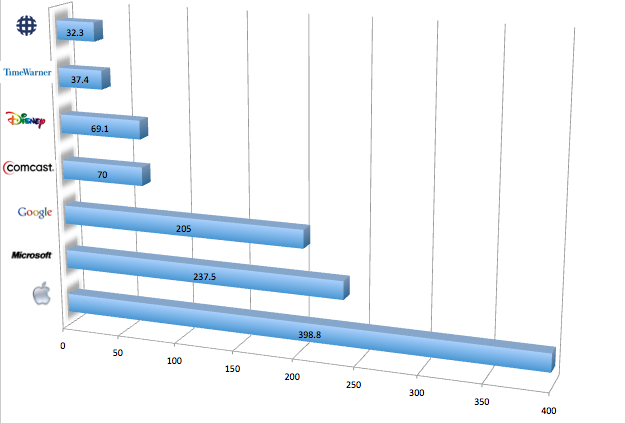
This chart illustrates the market capitalization of 3 top tech companies and 4 top media companies. (In billions.)

If you add up the 4 media companies, they are roughly half the valuation of Apple. Even the largest of these media companies, Comcast, is less than half the valuation of the smallest, Google.

Need I do a trend chart, too?

Posted in Uncategorized | 2 Comments

My New Year’s message

Lena says Happy New Year!

My 3-year-old niece Elena with a message to you.

If you’d told me at the beginning of 2011 that I’d be returning to my journalism roots and appearing regularly on CNBC and Bloomberg TV, I never would’ve believed it.

2011 was a crazy year. It was full of many highs and lows, sometimes at the same time. The highs were public, the lows have largely been private. (But my writing — and your reading of it — has really helped offset the lows.)

I spent a lot of 2011 feeling like I was living someone else’s life. There were many scenes that would look totally made up if you saw them in a movie. One quick example:

I was supposed to go on CNBC for an interview, but didn’t have a jacket pressed. I found a dry cleaner who claimed to offer same-day pressing. I got there at 3 p.m. She said initially it was too late. I pressed her that I needed to be on TV. She asked what I was going to talk about. I explained that I was going to talk about Groupon. She got a little defensive and asked what I was going to say about Groupon. Not wanting to pollute her experience, I had her tell her story first. She ran a Groupon and had few new customers, many of the buyers were existing customers.

My jacket was pressed in 30 minutes, while I took a call from an investment bank about Groupon.

I re-discovered what makes Silicon Valley a truly magical place: the people. I met a lot of amazing people, including Tristan Walker, Semil Shah, Marc Bodnick, Charlie Cheever, Adam D’AngeloSara Huth, Keith Rabois, Megan Quinn, Emily Chang, Cory Johnson, Jon Stull, Jon Fortt, Rob Bailey, Andy McLoughlin, Jeff Pomeroy, Peter Pham, Mark RogowskyJeff Clavier, Ted Zagat and Emily White. Outside of the Valley proper, but still part of the same community, I was excited to meet with Angus Davis, Brian Norgard, Andrew Skotzo, Brian Roemmele, Rick Summer, Alex Meshkin, David Mihm, Ben Hatten,  Brad FeldErick Schonfeld and James Hritz.

There’s a list just as long of amazing people I couldn’t meet in 2011 because of scheduling issues, but hope to meet in 2012.

Silicon Valley isn’t perfect by any means. But it is one of the most meritocratic places on Earth. We accept people with non-standard academic backgrounds. We accept people of all ethnic backgrounds and immigration status (within the law). We accept failure. We accept and celebrate it when some wants to take  9 months off bike around Asia after a big win.

Here are the trends that I see in the upcoming years:

  1. Continued focus on the integration of online and offline commerce. As much as I’ve beaten up on Groupon for their business practices and business model flaws, they deserve credit for blazing a path for other entrepreneurs (or possibly even Groupon) to find the right products. American Express is one of the best positioned in the space.
  2. Significant changes in the way we consume television and movie content. I don’t think my 3-year-old niece will ever live in a world where she is waiting for anything other than live programming to start. By and large, this is a business model and channel conflict issue, not a technology issue. Unfortunately, there are many established interests that don’t want to see the future. But a really positive sign is that even companies like Comcast are investing in innovation and things like iPad apps.
  3. More services that increase efficiency in markets for local services. More and better from Square, Uber and Cherry fall into this bucket.
  4. More involvement with Washington. Issues like copyright, fair use, first-sale doctrine, patents, immigration, network neutrality, privacy and antitrust will get more and more attention. As the current fight over SOPA shows, Silicon Valley is awful at playing the Washington game. Although we can dismiss Washington as irrelevant, that would be a huge mistake.
  5. Increasing power of Amazon. Although many have focused on the Google-Facebook rivalry, Amazon is becoming a monster rival in its own right. It’s essentially the largest shopping search engine, providing results not only from its own inventory but also from other retailers across the world. It’s a logistics machine. With Kindle and its mobile apps, it’s putting a storefront in every pocket that dramatically increases Amazon’s threat to retailers who sell commoditized products.
  6. Rise of healthy living technologies. Our health-care system is so screwed up that we’ve built it largely in a way to profit from people being sick. I love the trend of companies like fitbit, Jawbone and Withings to make a profit by getting people healthier. Make things easier to track and people will do more of it.
  7. More natural user interfaces and intuitive design. It was fascinating to watch my niece jabbing at my laptop screen expecting it do something. She took to my phone naturally, flipping through pictures and watching videos. Apple had a great first launch with Siri. Kinect still has a lot of potential beyond gaming.

And then there’s mobile, Apple and Facebook, three of the biggest forces that will continue changing the core of how we live our lives.

I’ll be writing about these things and more in 2012.

Thanks for reading and engaging with me in 2011. Although I can’t personally respond to everyone, I do read your emails and tweets.

Happy New Year!

Some other great New Year’s reads from my friends:

Posted in Uncategorized | 5 Comments

PayPal to try to compete with Groupon, but will it matter?

PayPal is preparing to launch a Groupon competitor in the first  quarter of 2012, according to Bloomberg. The eBay subsidiary hopes to tap into its base of 103 million accountholders.

From what I’ve seen so far, this doesn’t seem like a credible competitor. The daily deals business doesn’t play to PayPal’s strengths. If it tries to compete with Groupon on Groupon’s terms, it will lose.

Among the challenges:

  1. Daily deals are sold,  not bought. Groupon and LivingSocial have built small armies of salespeople not because they want to, but because they have to. Self serve for small businesses hasn’t worked — even when Groupon has tried it with Groupon Stores and Groupon Now. PayPal would have to build a similar army. Self serve will happen eventually, but not in the next couple of years.
  2. Customer service is not PayPal’s strength. Groupon and LivingSocial have made great customer service (for consumers) a hallmark of their products. PayPal’s reputation with consumers and merchants has a lot of room for improvement.
  3. PayPal has historically been risk averse. Groupon is taking on way too much risk in their business model. But PayPal will likely take on too little risk, making the offer unattractive for both consumers and merchants.

This is not to say that PayPal’s entry won’t hurt Groupon. The biggest area for concern is the pressure that PayPal will put on the revenue share that Groupon gets for deals. This has already dropped dramatically — from 42 percent in 2Q to 37 percent in 3Q.

PayPal (like credit card companies) has built its business on taking small amounts of money from lots of people; Groupon has built its business on taking large amounts of money from few people.

For its payment services, PayPal charges about 3% of the transaction amount. If PayPal offers deals for 10% or even 20%, that will put a lot of pressure on Groupon. That’s especially true for large national, online and retail deals.

One strength that PayPal has is its acquisition of Where earlier this year. Where gives the company a strong mobile team, a mobile ad network and a mobile user base that had 4 million monthly active unique users at the time the acquisition was announced.

Posted in daily deals, groupon | 1 Comment

Scanning bar codes seems to be a popular holiday pastime

IDC’s 2011 shopper survey shows shockingly high usage of smart phone scanning tools to scan bar codes and QR codes.

Nearly 1/3 of those surveyed said they had scanned a bar code. A common use of this technology is to compare prices when at a retailer. That presents a significant threat to brick-and-mortar retailers like Best Buy, who now have to compete more aggressively with online retailers. This could put a lot of pressure on high-margin items like cables, which cost $80 in store when comparable cables online are $4 or less.

Although more than half hadn’t used the scanning feature, I consider these strong numbers for the technology’s adoption.

There was also high overlap among the scanners: 61% of bar code users have also scanned a QR code; 70% of QR code users have also scanned a bar code.

via Jonathan Gaw

IDC shopper survey

Posted in local search, mobile, mobile search | 1 Comment

Coping with a life-changing disease

Contemplating the future at the Fairmont Orchid on the Big Island

Contemplating the future at the Fairmont Orchid on the Big Island

TL;DR: I expect that I’ll be fine. I debated whether to post this, but decided that there was an off-chance that someone might find this information valuable. 

I was diagnosed with diabetes in September.

For someone who has never been admitted to a hospital or regularly taken any sort of medication, the last few months have been quite an adjustment. I’ve been to doctors’ offices more since September than I have the rest of my life. I’ve had to deal with fatigue that on some days made it hard to get out of bed.

My “vacation” to Hawaii earlier this year was spent figuring out how to check my blood sugar daily (the user interface design on medical devices is terrible!) and figuring out the major lifestyle changes I would have to make.

The Hawaiian islands illustrate the circle of life. On the Big Island, lava spews forth creating new land. But with Kauai, you’ve got a dying island with ancient cliffs falling into the ocean. Visitors to the islands also illustrate this. Many come for their honeymoons, where undoubtedly new life is conceived. But many also come to have a last wish fulfilled. (I was reminded of this by a sign at Kona airport advising passengers to remove breathing machines from baggage for separate screening.)

The adjustment has been even harder because I recently moved and don’t know many people in the Bay Area.

I feel old and angry. Old because it’s not a disease that people my age typically get. Angry because I didn’t adjust my habits earlier.

In the grand scheme of things, there are much worse things to have than diabetes. Mine was caught early and with some significant changes, I can lead a mostly normal life.

The biggest changes so far have been in diet and exercise. I’ve forced myself to get used to eating smaller portions and on a more regular basis.

Eating right is a surprisingly difficult thing. Most of the incentives around us are to eat poorly. It’s especially hard when you travel as much as I do. Fortunately, my health insurance covered a diet coach. Even as a well-educated adult, I was surprised at what I didn’t know about nutrition.

Adjusting food and drink is especially hard because there is often a social component to eating. Still, I’ve managed to all but eliminate dessert from my vocabulary. (I made exceptions to split a piece of cake with a friend for her birthday and again for my brother’s birthday.)

I’ve tried to take a scientific approach to the disease. After a night of drinking with friends, I tested my blood sugar and found it off-the-charts high. (Can’t do that again.) In other cases, I’ve been pleasantly surprised that foods that I like and thought I’d have to give up didn’t spike my blood sugar.

As a technologist, I’m impressed by how many companies, especially startups, are focused on helping people live better. It’s a marked contrast with companies like Monsanto and Cargill that profit from obesity.

I’ve been using a Fitbit regularly to make sure I exercise. I’ve set a goal of 10,000 steps a day, with self-imposed penalties if I don’t make it. Sometimes this results in doing silly things like laps of downtown Palo Alto. (It’s 2,373 steps for me to do a walking loop of University Avenue from High to Webster.)

I also have a Withings scale, which tracks weight and body fat.

Both devices take data and make it easily accessible. They cost a lot more than their non-Internet connected counterparts, but I find having the data automatically stored to be well worth it. I’ve even pulled up my Fitbit records at the doctor’s office.

Glooko offers a hardware/software solution for diabetics to keep track of their glucose levels. Withings also offers a blood pressure monitor.

They’re different from traditional medical devices in that they focus on great user experience, are designed with the Internet in mind and relatively affordable. (Though, sadly, not covered by insurance or eligible for various government medical tax breaks.)

Devices like these are the embodiment of improving what you measure. The vast majority of days, I hit my goals.

With changes in diet and exercise, I’ve lost about 10 pounds in the last two months. That feels good.

Posted in Uncategorized | 5 Comments

LivingSocial testing new subscription service

LivingSocial is testing a new subscription service called LivingSocial Plus.

LivingSocial Plus, a new subscription service

LivingSocial Plus, a new subscription service

For $20 a month, subscribers will receive $25 in Deal Bucks good on LivingSocial purchases. $5 is good only in that month, the remaining $20 can be carried over for 5 years or longer depending on gift card rules.

The service also offers priority access to deals that expired, subject to availability.

It’s an interesting idea that could lead to steady recurring revenue, which is something Wall Street loves. On the other hand, the people most likely to buy the subscription service would be people who are already big spenders on daily deals. That threatens the margins of the business, which is a concern that has hammered Groupon’s stock since it went public.

As a consumer, I don’t love it. I think the price is too high. Spending $20 to get a $25 store credit seems steep.

After all, LivingSocial and Groupon have trained us to believe that anything below 50% off isn’t a deal.

From the LivingSocial Plus FAQ:

what’s livingsocial plus?
LivingSocial Plus is our new premium membership program and the best way to get the most out of your LivingSocial experience. It’s our little way of sharing the love with our most loyal and adventurous LivingSocial members, month after month.

what do i get?
You get 25 Deal Bucks to spend every month—5 for this month, and 20 for anytime you want (within five years, or longer if required by the laws of your state). You can use your Deal Bucks on all sorts of LivingSocial deal purchases.
You’ll also get exclusive access to selected deals after the clock runs out – just contact us within 48 hours and we’ll do our very best to get another voucher just for you, subject to availability.

what are deal bucks again?
See Deal Bucks FAQ

how do i request a deal after it closes?
Your LivingSocial Plus membership welcome email contains a Priority Waitlist email address, exclusive to LivingSocial Plus members.

how much is it?
$20 per month.

what if i change my mind?
No problem. You can cancel anytime via your LivingSocial account, and your Deal Bucks will remain in your account until they expire.

can i get a refund of my subscription?
You may request a refund if you cancel within five (5) days of subscribing, providing you have not used any of your Program Benefits prior to that time.

Posted in daily deals, groupon, livingsocial | 1 Comment

Funny juxtaposition of Google Offers ad on anti-Groupon story

Google Offers ad on anti-Groupon story

Original story on Mail Online.

Posted in daily deals, google, groupon | Comments Off on Funny juxtaposition of Google Offers ad on anti-Groupon story
