Why I’m joining Groupon

My life has taken quite a few turns over the last year, but none stranger than yesterday’s.

After taking Groupon to task for the bazillionth time, I got a call from Andrew Mason. This was shocking because Groupon PR has kept me from talking to him for 9 months now. As I’ve said before, I think that’s an idiotic strategy — it’s best to engage with your critics, not ignore them. Especially when they have a platform and can clearly explain your challenges. (I was talking to one senior exec who said that if he’d been in Groupon’s shoes, the first thing he would have done after the quiet period was to put Andrew on stage for a no-holds barred interview with me.)

Andrew finally decided to engage me. During a lengthy conversation, I realized that he actually cares about the success of small businesses as much as I do and that he genuinely wants to do the right thing by them and help them to grow. He sees many of the same problems that I’ve pointed out in my analysis of Groupon since last June and wants to improve the company and create better products for SMBs.

Aside from the last year, I’ve spent my entire career in product management and business development. It’s my true passion. I’ve also spent much of my career on local products. It’s time for me to get back to that. I’m pleased to announce that I will be joining Groupon to help them create better products that truly meet the needs of small businesses.

Most such announcements are filled with flowery language about how great the company is. Obviously that would be fake coming from me, so I won’t make such claims.

I will still be based out of Silicon Valley. As I said yesterday, I think one of Groupon’s strongest chances for success is finding companies they can acquire to create a more sustainable model for Groupon and a better value for merchants. Because I have a knack for finding and analyzing companies, this will be part of my work.

I’m going into this with my eyes wide open:

  • I realize that part of the reason that Andrew extended the offer may be to offset the shellacking that Groupon will likely receive tomorrow in light of the restatement. Being able to announce that their biggest critic is joining the team to help them improve their business might preserve a bit of their market cap.
  • I know that the company faces a number of challenges — I’ve been chronicling them more than anyone. There are many others that I haven’t written about.
  • I will undoubtedly have to deal with a lot of ruffled feathers.

It would be intellectually dishonest (and futile) to try to remove my criticisms of Groupon from the Web. Instead, they’ll serve as a to-do list of things that need to be fixed. But it does mean that I won’t be publicly exposing any more flaws in Groupon’s business; I will work to rectify them from the inside.

I have always believed in tackling hard challenges and I think this will be a tough one, but I’m looking forward to it.

Thank you for all of your support over the last year!

Oh, and Groupon’s lawyers insist that I add this:

Forward-Looking Statements

This announcement contains forward-looking statements that involve risks and uncertainties, and actual results could differ materially from those discussed. Factors that could cause or contribute to such differences include, but are not limited to, the factors included under the headings “Risk Factors” and “Management’s Discussion and Analysis of Financial Condition and Results of Operations in the company’s registration statement on Form S-1, as amended, filed with the Securities and Exchange Commission on November 1, 2011, copies of which may be obtained by visiting the company’s Investor Relations web site at http://investor.groupon.com or the SEC’s web site at www.sec.gov. Groupon’s actual results could differ materially from those predicted or implied and reported results should not be considered as an indication of future performance. The SEC particularly advises investors to be skeptical of announcements posted on April 1 of any year.

You should not rely upon forward-looking statements as predictions of future events. Although we believe that the expectations reflected in the forward-looking statements are reasonable, we cannot guarantee that the future results, levels of activity, performance or events and circumstances reflected in the forward-looking statements will be achieved or occur. Moreover, neither we nor any other person assumes responsibility for the accuracy and completeness of the forward-looking statements. We undertake no obligation to update publicly any forward-looking statements for any reason after the date of this press release to conform these statements to actual results or to changes in our expectations.

Posted in groupon | 12 Comments

Why Groupon is poised for collapse — an update

Groupon was forced to restate fourth quarter earnings, sending its stock down 6% in after-hours trading. This surprised me as much as my $2 investment in the Mega Millions jackpot not paying off.

The reasons for Groupon’s restatement were higher refund reserves and weakness in internal controls. These are issues I’ve repeatedly discussed. I raised them directly with Groupon PR in September (back when they still would speak to me) and I was assured that refunds weren’t an issue for Groupon.

I also spoke with a former Groupon salesperson who claimed he was fired because he raised concerns about poor internal systems that didn’t track deals correctly and complaints about poor risk management when it comes to running deals.

So what’s happening at the coupon company?

Well, for starters, it’s not a coupon company nor a marketing company. At its core, Groupon’s U.S. business is a receivables factoring business, as I wrote last year. They give loans to small businesses at a very steep rate (the price of the discount plus Groupon’s commission). They get the money to fund these loans from credit card companies such as Chase Paymentech. Groupon is essentially a sub-prime lender that does zero risk assessment. And as word continues to spread about what a terrible deal running a Groupon is for many categories of businesses, the ones that will choose to run Groupons are the ones that are the most desperate. For U.S. based businesses, the only time I can definitely recommend running a Groupon is if it is otherwise going to go out of business.

Another factor is that Groupon is selling bigger and bigger deals and many of these have requirements for use. Some deals have medical qualifications. The former salesperson told me about Groupons for a procedure called “cool sculpting”. In this procedure, fat is frozen off the body. In order to get the treatment, patients must be medically qualified. But Groupon has no way of medically qualifying purchasers and will sell it to anyone. When they go to the doctor and find out that they aren’t eligible, they call Groupon for a refund. If this is several months later, after Groupon has paid out the entirety of what it owes the provider, this can mean a refund loss for Groupon.

Travel is another risky category for Groupon. Unlike Expedia, Travelocity, Priceline, Jetsetter and nearly every other major travel provider, Groupon does not require consumers to pick their dates and confirm availability at the time of purchase. When a consumer finds he can’t use his Groupon months later, he calls for a refund. Groupon also hides material restrictions on travel deals, something I pointed out in September and Groupon still hasn’t rectified.

Because these are higher ticket items that cost hundreds or thousands of dollars, consumers are more likely to ask for a refund than on lower ticket items. In the short term, it means a revenue boost to Groupon, which the company needs as its once torrid growth itself cools. In the long term, it means refund losses.

The “Groupon Promise” is another risk factor. It’s an overly broad promise designed to allay consumers’ concern about using Groupons. Because it is so broad, it results in higher refund rates than would otherwise be the case.

Yet another concern is that Groupon does not track how much outstanding Groupon “debt” there is. There is no one in the world who can tell you how many and how much Groupon value is outstanding. Unlike typical gift card sales, Groupon books revenue immediately and then does not show the Groupons on its balance sheet. By my estimates, Groupon has between $500 million and $750 million in liabilities that it doesn’t show on its balance sheet.

In theory, Groupon’s exposure to that risk is covered by its refund reserves — but we don’t know the size of those reserves. And as yesterday’s restatement shows, they’ve calculated them poorly. Unless Groupon begins to do risk assessment on deals before they run, changes its payout terms to businesses or drastically changes its refund policies, I expect refund rates to continue to rise. If they do any of those things, I expect revenue declines because it will make running Groupons less attractive to businesses and buying Groupons less attractive to consumers.

Groupon has also worked hard to hide their refund rates. While going through their S-1 process last year, Groupon continually revised its accounting. At one point, I discovered a way to calculate their refund rates and found that refund rates had likely increased more than 40% year-over-year. In the next amendment to their S-1, they changed their accounting again to bury that data.

Investors should also be concerned about the fact that Groupon’s lock up should end in early May, releasing a lot more shares on to the market. I wouldn’t be surprised to see Groupon trading in single digits after that and heading to zero within the next 36 months. Groupon’s best bet is if they can acquire their way into a sustainable business model; I’m doubtful that will happen considering the companies they have purchased to date.

With its restatement, Groupon said that its guidance for the first quarter remained the same as earlier. Given that their lockup should end shortly before they report first quarter results, I would take that assessment with a mine full of salt.

See some of my previous writings on Groupon:

Posted in daily deals, groupon | 20 Comments

Office hours in NYC

I’ll be in New York next week. I’m holding office hours at the Standard Biergarten starting at 6:30 p.m.

Stop by and say “Hi!” Tweet at @rakeshlobster if you’re coming. (I’ll tweet when I’m leaving.)

Posted in Uncategorized | Comments Off on Office hours in NYC

Weekly reader: PayPal vs. Square, AmEx, Yahoo! as patent troll and deals

This contains a summary of my work, where I’ve been quoted by others as well as some other highlights of the week.

My work

PayPal at retail is a terrible product — I had a chance to look at PayPal’s new retail product being used at Home Depot. I can’t find a reason why consumers would adopt this. It’s less convenient than a credit card and less rewarding. Although it may be good for merchants in the long term, this is a two-sided market and you need to have a reason for consumers to adopt. A note about the headline: Initially I’d proposed “POS is a POS,” trying to be humorous. In retrospect, I shouldn’t have agreed to spelling it out. 

What I’ll be looking for in a Square competitor — My preview of PayPal’s Square competitor and the economics of the space.

How PayPal Here aims to be a full-service financial product for small businesses — My analysis of PayPal Here, PayPal’s competitor to Square. PayPal wasn’t very aggressive in their pricing, but the structure of their offer may be compelling to many. Regardless, it’s not a winner-take-all market.

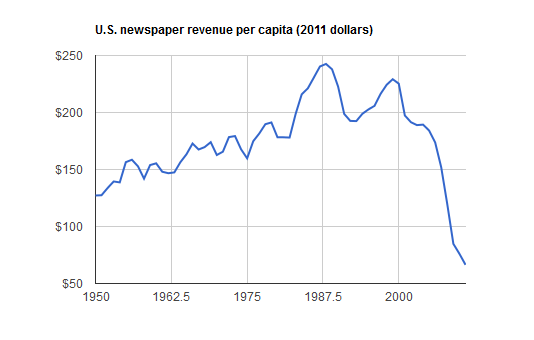
Decline in the U.S. newspaper industry in 3 charts — It’s been an ugly decade for the newspaper industry and things only look to get worse. I look at U.S. newspaper revenue (excluding digital) in three ways: the absolute decline, the inflation-adjusted decline and the per-capita decline. The per-capita decline is particularly stark: since 1998, this has dropped from $243 to $66.

Quoted elsewhere

Report: PayPal takes on Square in mobile payments (USA Today) — I talk to USA Today in advance of the PayPal announcement.

Other interesting nuggets

AmEx/Twitter deal real-time tracking — An infographic that charts the success of the AmEx/Twitter promotion campaign. Ignore the parts of the chart labeled “total spend” and “discounts”. (They have no way of gathering these data.)

The new iPad — The Retina display is gorgeous and the new camera is amazing. I’m not sure I’d ever use the camera in real life, but it’s a vast improvement over the camera on the iPad 2.

Design still sucks — This week, I picked up a router, a NAS and received review units of Logitech’s Harmony Link and 900. I’m well above average when it comes to these products and these things are still way too complicated.

Weekly deals

This week I’m starting a new feature of deals that I think readers might be interested in. If I get something in return, I’ll call it out.

  • Yammer CEO David Sacks is offering a $25,000 bonus to anyone who leaves Yahoo! and starts at Yammer in the next 60 days. This is a protest to Yahoo! suing Facebook for alleged patent infringement.
  • Related to the above, I promise a pre-launch pitch meeting to any startup founders who leave Yahoo!
  • 20% off this week’s Ignition conference if you use promo code IGNITION20 for my readers.
  • If you’re in the market for a Sonos (they’re great), get a free wireless bridge ($49 value). If you do this, I get a $10 iTunes gift card. If 5 of you do this, I get $100 toward my next Sonos purchase.
  • On Tuesday, AmazonLocal will be offering a $10 Amazon credit for $5. This is much less generous than LivingSocial’s $20 credit for $10 from a while back. But free money is free money.
Posted in weekly reader | Comments Off on Weekly reader: PayPal vs. Square, AmEx, Yahoo! as patent troll and deals

Decline in the U.S. newspaper industry in 3 charts

Grim

This chart shows U.S. newspaper print revenue in nominal dollars.

Grimmer

Take the same data and adjust it for inflation. Now we’re nearly at 1950 levels. (2011 dollars)

Grimmest

Now take the inflation adjusted data and do a per capita calculation. Newspaper revenue is a tiny fraction of its peak and less than half of 1950 levels.

Posted in journalism, newspapers | Comments Off on Decline in the U.S. newspaper industry in 3 charts

Weekly reader: American Express, Virgin America, startup advice

I’m testing a new feature summarizing my work and interesting finds of the week. This will contain a summary of my work, where I’ve been quoted by others as well as some other highlights of the week.

My work

11 tips for entrepreneurs on dealing with the press — My guide for how startups can get the best coverage.

AMEX’s new Twitter integration is “brilliant” marketing — A look at American Express’s card-linked offers, which can be loaded from a tweet.

Groupon’s whale problem — Groupon’s business model is fundamentally at odds with the needs of the business. If you’re a great Groupon customer, you’re a terrible customer for the merchant.

What Silicon Valley can learn from a failure in public policy — Virgin America wants to fly to Washington National Airport. But it can’t because of a rule from the 1960s and entrenched political interests.

How to pitch your startup at conferences — My guide for entrepreneurs on how they can improve their pitches, including the booth and the presentation. If you’re spending the money and time to go to a conference, it’s best to maximize it.

6 promising startups spotted at the Launch Festival — 6 of the most interesting startups I saw during my one day at the Launch Festival.

Quoted elsewhere

Send a tweet, get an AmEx #discount (CNNMoney) — I’m quoted in this summary of theAmEx news.

Other interesting nuggets

Pulse announces local section for its popular news reading apps. (Bloomberg Businessweek)

Clovers launches its mobile payments platform with $100,000 to boost consumer adoption. (TechCrunch)

Postmates announces its GetItNow service.

Bloomberg West celebrated its first anniversary. The show keeps getting better and better. Congratulations to my friends Emily Chang, Cory Johnson and Jon Erlichman.

Download the Travel Channel’s The Layover app for iPad. It’s what a travel app should be.


Posted in weekly reader | Comments Off on Weekly reader: American Express, Virgin America, startup advice

No.

No, I will not be at SXSW this year.

But in an effort to make connecting with me easier, I’m posting a public calendar.

Posted in Uncategorized | Comments Off on No.

Survey says: you’re not helpful

Yesterday, I ran a survey of my readers about the type of writing I do. I asked whether you preferred stories about specific companies or themes.

Here are the results:

Thanks a lot!

This is different from what I measure. I find that posts about companies get a lot more traffic, retweets and shares than posts about themes. One of the posts that I thought was important — When marketers create their own content, what can you charge them for? — got very little engagement.

The more interesting data were the backgrounds of the respondents:

It seems I have both investors and entrepreneurs following me. If only there were an efficient way to connect the two…

Posted in Uncategorized | 1 Comment

Please take this survey

I’m trying to get a sense of where to focus my energies. If you’re a regular reader of my work, please take this 2-question survey

I’m also a big believer in seeking out criticism. If you dislike my work, please also take this other 2-question survey.

Posted in Uncategorized | Comments Off on Please take this survey

Rocky’s top 10 tips for dealing with the press

Chris Dixon has one of the best posts I’ve seen on how startups should deal with the press. I added a few items in his comments, but thought they were worthy of sharing here.

I sit in a weird spot: although many consider me to be press, I also talk to a lot of other media outlets. I’m often quoted in national newspapers and magazines and regularly appear on TV. This happens partly because I have something interesting to stay; it’s also partly because I treat people how I like to be treated.

Here are my top tips for dealing with the press (including me):

  1. Learn about the news outlet and the specific person you’re approaching. Every outlet has a specific feel and each person with an outlet has their own coverage area, interests and motivations. Read their stuff and figure it out. Nothing will fall flatter than a bulk email sent to every “tips@” account that begins “Dear reporter”. Learn what each person values. In my case, I don’t really care that much about being first on a story. I add the most value when I do deep analysis. I’m a data and numbers guy; if you have those, I’m more likely to dig in.
  2. Build relationships before you need them. This is similar to the career advice people get for networking. Follow the people you’re interested in on Twitter. If they tweet something where you can help, offer it. Even if it doesn’t relate to what you do. Offer them access to your network if you know someone who can answer a question.
  3. Maintain relationships after you have them. Keep in touch with people on an ongoing basis. I don’t mean daily or weekly, but keep in touch as appropriate.
  4. Be fast. Reporters are often on tight deadlines. And in the blog world, a lot of people value being first. The faster you return a call or email, the more likely it is that you’ll be included in the story.
  5. Be brief. Get to the point. Your pitch shouldn’t ramble on for pages.
  6. Be interesting. If you speak in PRese, it’s a lot less interesting. Avoid cliches like “We’re the leading…” Everyone claims to be the leader — except the real leaders. When I’m preparing for an interview, I’ll come up with two or three lines that are interesting, sharp and brief to make it easier to quote.
  7. Be patient. Depending on the story, somebody might run a piece weeks or months after they talk to you. (I often do this.) In the meantime, it’s OK to follow up periodically if there were updates to what you said or things that the reporter should be aware of. I once did a taped segment for Bloomberg that didn’t air until weeks later. Better reporters will let you know after they use something if there’s been a long delay. (Emily did.)
  8. Don’t expect too much. Just because you spent 30 minutes on the phone with a reporter doesn’t mean they’ll use what you said. Sometimes the news changes and the story isn’t relevant anymore; in other cases, they found other people to quote. That’s just part of the news business. I do quite a few interviews where I don’t get quoted — but it goes back to building relationships. I genuinely want to help people tell better stories.
  9. Realize that we talk to each other. Although we compete, we also chat. If you’re an ass to someone, it will get around.
  10. Engage with your critics. This is a controversial one, but I wholeheartedly believe this. I regularly write about two companies in the same space and I’m extremely critical of both. One refuses to talk to me; the other responds within minutes. The second one gets to tell its side of the story and influence my opinion. Both the company and the reading public are better served by having the conversation. The company gets better coverage — not because there is a quid pro quo, but because the dialogue leads to better analysis. And because most of the people who cover the space talk to me (see #9), it helps their overall coverage.
  11. UPDATE: Never, ever lie. In order of preference, I want: True, technically true and no comment. The best PR folks never lie. (And the best management teams don’t lie to their PR folks.) If you lie to me and I find out, it creates another story. It also means I won’t ever trust anything you say again. See also, #9.

A journalist’s job is to bring interesting and informative stories to readers, not to promote your company. If you help them do their job, you’ll do much better at your job.

Posted in Uncategorized | 7 Comments