Oregon chiropractors ban Groupon type deals; dentistry board has concerns

The Oregon Board of Dentistry is notifying dentists that running Groupons and other daily deals may violate rules against “unprofessional conduct.”

From the board’s Web site:

!!NEWSFLASH!! Internet Coupon Advertising!!! Please Read!!

The Board has recently become aware of different companies soliciting Oregon licensees to enter into contracts for marketing and promotion services between the licensee and the company to promote voucher systems for potential patients. The Board has preliminarily determined that these may violate the unprofessional conduct rule OAR 818-012-0030(3) which prohibits offering rebates, split fees, or commissions for services rendered to a patient to any person other than a partner, employee or employer.The Board suggests that until this can be fully reviewed by the Board, licensees proceed with caution and if they feel necessary seek legal counsel on this matter or contact the Board office at (971) 673-3200.

Earlier, Oregon’s Board of Chiropractic Examiners is forbidding Groupon-type deals, saying they violate fee-splitting arrangements. In a July letter posted on the board’s Web site, it says “Groupon-type fee splitting arrangements are still prohibited for chiropractic physicians.”

The letter goes on to say that LivingSocial has changed from a fee-splitting arrangement to a flat fee for marketing.

While I’m generally a fan of consumer-protection rules, I don’t believe these rules fall into that category. I think they just prevent competition and are anti-consumer.

That said, the rules are the rules. Local services are a quagmire of regulations that further strain the business models of Groupon, LivingSocial and other deal companies.

Posted in Uncategorized | 4 Comments

Thoughts on love, hate and Twitter, blogging

If you’ve been following me on Twitter or reading this blog, you’ll undoubtedly have noticed that I frequently use words like “sucks,” “shitty,” “terrible” and “horrid.” I also frequently use words like “brilliant,” “genius,” “amazing” and “great.”

So, you may be wondering: Is Rocky manic-depressive?

The answer is no. I’m fairly even-keeled most of the time. But if I take the time to tweet or blog about something, it’s because it moved me enough (positively or negatively) to take the time to comment. If something was so-so, OK or fine (most things are), it just doesn’t rise to the level of tweeting, writing, etc.

I’m also a writer by training, so I try to make my writing interesting and punchy. I won’t make up stuff just to have it interesting or punchy, but I will be sharp about it. I try to include quotable sentences and sometimes will even check to make sure those sentences will fit in a tweet.

You may also notice that I’m often a contrarian. This is in part because I’m a generalist. I find usability, psychology, marketing and brand, graphic design, investing, incentive systems, operations, market research and fraud all equally fascinating. I try to take a holistic approach to products and experiences and evaluate them based on all of these disciplines.

When I evaluate products, I try to step out of myself and evaluate it from the perspective of others. Just the other day, I was testing out an RFID room entry system at the Sheraton Delfina. I was studying how long it took for entry, whether it beeped (for blind guests) or had visual indicators (for deaf guests).

Technology should serve humans; not the other way around. Too many technologists start with the technology and not the person. I hate technologies that are looking for a problem.

Some of my favorite examples of this, both in the love and hate department:

  • Bloomberg’s guest-badging system. It’s such a simple thing that we do pretty regularly, but most people don’t think to improve it. By taking into account everyday scenarios, they dramatically improved what may seem like a trivial experience not worth focusing on.
  • American Express’s phone system. You probably know that I’m a big fan of American Express. But their phone system drives me nuts. I do everything I possibly can online using their Web site. This includes paying my bill, checking balances, reviewing transactions and initiating disputes. Except for their bill payment system, the Web site is generally great. So what happens when I call? I have to go through the same damn phone menus as everyone else. If my task was automatable, I would have done that on the Web site! If I’m calling, I need to talk to a representative. Don’t waste my time in phone menus. (Disclosure: I worked for Tellme, the company that runs AMEX’s ASR systems.)
  • Starwood’s Twitter support. Starwood has long been an industry leader in adoption new customer care technologies. They seem to have a 24×7 support team. I had a request on a recent trip to Los Angeles and I was able to take care of it almost entirely over Twitter. Being able to resolve problems asynchrously is a big deal — I don’t have to wait while agents perform tasks or hang on while their slow computer system pulls up reservations.
  • Google NFC. This is the ultimate example of technology looking for a problem to solve. Swiping a credit card to make a payment just isn’t that hard. When you add up all of the steps — unlocking your phone for corporate restrictions, launching the app, unlocking the payment wallet and then tapping — it actually takes more time than swiping a card. It’s technology for the sake of technology.
  • Dell’s customer service policy. Incentives work really well and people adapt to them. Often, systems create unintended incentives that are bad for business. Dell wanted to reduce costs of processing returns. If you called up Dell with a complaint about a system you purchased, they would try to get you to keep it by offering a discount (often $50-$100). It was a perfectly rational thing to do; it would’ve cost them more to process the return and they’d have to sell the item as a refurb at a discount. But word got out that this was happening and people started using it as a mechanism to get discounts on items they never intended to return. Great for consumers, bad for Dell.
  • Mobile carrier’s order page. One of the large national carriers was doing some analysis on their online ordering. They found that the “promotion code” field caused a lot of people to abandon the shopping cart. They felt screwed if they didn’t have a promotion code — someone else was getting a better deal! Most companies would have just hidden the promo code field. This company did one better; they seeded the Internet with easily Googlable promotion codes. The discount was a low-value discount, but now the customers went from feeling like they were getting screwed to feeling like they were outsmarting the system. Consumer psychology in action!
Posted in usability | 1 Comment

There are only two deal companies that matter: Facebook and Google

Much has been made of Facebook’s decision last week to exit the daily deals space. Yesterday, Yelp told Bloomberg’s Doug MacMillan that it is also exiting the daily deals space.

A lot of the analysis has used these examples to illustrate what a great position this puts Groupon and LivingSocial in. That analysis is wrong.

I reached out to Facebook PR for some more detail on their decision. Here is what spokeswoman Annie Ta told me (emphasis added):

After testing Deals for four months, we’ve decided to end our Deals product in the coming weeks. We think there is a lot of power in a social approach to driving people into local businesses.  We remain committed to building products to help local businesses connect with people, like Ads, Pages, Sponsored Stories, and Check-in Deals. We’ve learned a lot from our test and we’ll continue to evaluate how to best serve local businesses.

That reads to me like Facebook is still very committed to local, it’s just that they don’t see the daily deals model as the right path to it. Like Google, I’ve always thought of Facebook as too good a company to be in the space in its current exploitative state and I’m happy that it got out.

Over the last couple of months, I’ve had several conversations with Eric Rosenblum, the head of Google Offers.

Part of the reason I haven’t aggressively beaten up on Google Offers, aside from the initial piece titled Why I Want Google Offers And The Entire Daily Deals Business To Die, is that I really believe that they want to do the right thing. People have pointed to the slow rollout of Google Offers as a sign of weakness and the relative strength of Groupon; I view it as a sign of discipline and wanting to truly learn about what works and what doesn’t for merchants. They view it as a market-entry strategy and a way to educate local merchants about online advertising. (To be fair, I may just be buying their spin. But I don’t think that’s the case. Groupon largely has refused to talk to me, despite numerous requests.)

At the rate that Groupon is growing, it’s hard to learn anything. It’s also impossible to maintain quality talent when you grow headcount 35% in one quarter. In just one quarter, Groupon has added about as many employees as Facebook has in total.

Google and Facebook can afford to take their time. Rosenblum told me that because he’s not on a march to an IPO, he can afford to treat merchants right and build for the long term. That shows in the structure of the deals that Google Offers runs. There are more restrictions that make it a better deal for merchants.

Offers will be just one tool in Google’s toolbox for merchants. It is essentially a cost-per-acquisition model. Small businesses don’t know what an impression or a click is worth, but they have a better sense of what a customer is worth. But many categories haven’t been exposed to online advertising and that’s what Google is trying to change with Offers. Eventually, Rosenblum believes that merchants will use Google’s self-serve tools. The several-thousand strong sales army of Groupon will feel more like an anchor than a moat.

I believe Facebook has a different play. Its entire business is about connecting people and having them share information with each other. If Facebook sells someone an offer and they then connect directly with the business on Facebook, that’s additive to Facebook’s core business.

By contrast, Groupon and LivingSocial have every incentive to keep you from building a relationship with the merchant. They would much rather sell you another deal themselves than have you go back to the merchant directly. Groupon is even running ads telling consumers to stop paying full price — undercutting the value that merchants provide. At every step of the way, their business interests are directly opposed to those of merchants.

They could change that — I wrote a post with more than a dozen ways how the merchant experience could be improved — but they won’t. They’ve sold investors on the story of massive revenue growth and the fastest way to do that is to con merchants into selling big deals that they don’t fully understand. Even if they fully agreed with my analysis of the business, the best path for insiders right now is to continue the march to IPO and cash out as fast as possible.

Both Google and Facebook have enormous amounts of leverage in their business. The number of people each employee at Facebook impacts is unprecedented. Groupon is not a scalable business. In fact, it’s showing declines per employee as it gets larger. Its average sales per sales rep dropped from $172,000 in Q1 to $138,000 in Q2.

In a few years, we’ll look back and see the daily deals business as a fad that delivered untargeted, unsustainable discounts to unprofitable customers. The Groupon and LivingSocial brands may be around, having been sold to some company in a liquidation sale or bankruptcy proceeding. (Though even that may be difficult, as many merchants hate them.) Even if they survive as companies, the product they sell will be very different.

And we’ll see Google and Facebook ruling the much larger, sustainable local advertising market.

Posted in facebook, google, groupon | 7 Comments

An open letter to Andrew Mason: You’re wrong

Dear Andrew,

I must admit I was surprised to read your email to employees yesterday. I say this because I’ve reached out to your PR team in the course of covering Groupon and they’ve often used the excuse that you’re in a quiet period to refuse to comment to me. So, clearly, Groupon knows what a quiet period is.

Which is why I found your email surprising. I would have thought the big op-ed in the Journal by Groupon investor Marc Andreessen would have made regulators squeamish given that you’re in your quiet period. But your email seems like a blatant violation of quiet period rules to tout your company to investors. Releasing (likely unaudited) partial quarter results is also something the SEC should look into. I know it was framed as a letter to employees, but it was clearly written with the investor community in mind. You know as well as I do that in a company as large as Groupon, any such letter will make it to the press and will get widespread attention.

Let’s move on from the basic legality of your email, which is for the SEC to investigate, to the substance of your letter. Many of your points are dead wrong. Andrew, if you truly believe everything you’ve written, that’s reason enough in my mind to short Groupon. Most of the serious investors I talk to are already planning to do that. I even had one short ask me to stop writing about Groupon because he wants to maximize his return when he shorts you.

Adjusted CSOI

It’s amazing to me that after getting beaten up by just about everybody who covers Groupon for making up a fictional metric to show what a great company Groupon is that you continue to tout this metric. After all, you removed this from your S-1 because it was giving the SEC a lot of concern. So why bring it up again? Do you think that just because it’s not in an official filing that that’s OK?

You make the argument that once you acquire a customer you never have to spend marketing dollars on that customer again. That is utterly ridiculous. Your business is essentially a subscription business. Ask other subscription businesses if they retain customers for life. Ask magazines and newspapers. They would love it if that were true. Too old school? Ask Netflix. They’re among the best acquisition marketing and retention companies in the business. They still spend a lot of money on marketing.

All of these companies report another metric in addition to subscribers: churn. These are the people who stop subscribing. In your case, most of them don’t unsubscribe, they just stop opening emails. The trend on email open rates is a critical number that is conspicuously absent from your S-1. I bet I can guess what that trend line looks like.

If I weren’t covering Groupon, I would have stopped opening the emails a long time ago. The deal quality continues to decline as merchants become wiser and realize that in most cases running a Groupon is a terrible business decision that doesn’t result in high quality, repeat customers. You have another problem: in many cases, the merchants you do get don’t generate high frequency purchases. I’ve had readers send me actual Groupon deals for cars, enemas and boob jobs. I can eat at a restaurant 3 times a day 365 times a year. But how many boob jobs can a person get?

Your own numbers — pulled straight from the S-1 — belie the claim that you’ll never again have to spend marketing dollars on Groupon subscribers. The median number of Groupons purchased by a list subscriber is: zero! The median number of Groupons purchased by a Groupon customer is: 1! More than half of people who have purchased a Groupon have never purchased another one.

I’ve seen you run winback campaigns to get people who have stopped buying Groupons to start buying again. You give away Groupon dollars for that. Isn’t that a marketing expense?

Ponzi scheme

This is an area where you and I have some common ground.

As people colloquially refer to Ponzi schemes, Groupon is absolutely a Ponzi scheme. However, the SEC lays out on its Web site a very clear definition of a Ponzi scheme. (I looked.) By that definition, I don’t consider Groupon to technically be a Ponzi scheme.

It has many of the characteristics and will likely collapse for the same reasons Ponzi schemes collapses, but I don’t think you or your co-founder Eric will join Bernie Madoff in jail. It’s more like the subprime mortgage crisis. A lot of bad things were done, executives got rich, but no one went to jail. In Groupon’s case, consumers, merchants and credit card companies will feel the biggest impact if Groupon collapses.

I think the house of cards analogy I used in my post “Why Groupon Is Poised For Collapse” is most apt. I can think of numerous — and likely — scenarios in which the Groupon house of cards will come tumbling down.

I spent a lot of time studying economics when I was (like you) at Northwestern. I sent my economic analysis of Groupon to a respected economics professor there and his response was “Wow, that’s the most brilliant analysis of Groupon I’ve ever seen.”

The broader point here is that in the last few weeks, some of the smartest analysts I know have described Groupon as “doomed,” “trainwreck,” “Ponzi scheme,” “low on dough,” “insolvent” and close to “going bankrupt.” (I didn’t write any of those.) The only people who have had positive things to say are Groupon insiders, including your co-founder Eric who violated SEC quiet period rules by telling Bloomberg West that Groupon would be “wildly profitable.”

I’ve never seen a company about to go public where a founder has to publicly defend the basic legality of its business. What’s next, releasing a video of Eric saying “I’m not a crook”?

Your new businesses suck

You tout Groupon Getaways and Groupon Now! as the future of Groupon and huge opportunities. These are both going to be terrible businesses in the short- to medium-term.

I’m not just saying that because Groupon Getaways burned me out of $500 this week. After being told that I could use my Groupon Getaway “tomorrow”, I called to reserve a room for a trip I’m taking to Santa Monica this weekend. I was told that the voucher was not valid until early September. (This information is cleverly hidden away on a separate tab; other sites display the restrictions more prominently.)  Even on dates when it is valid, the rooms that are available to Groupon customers are limited. There were dates where I could buy a room, but I couldn’t use my Groupon.

Diane in customer service tells me Groupon will refund my money. That’s great. But until then you have free use of my money. (Well, as of this moment, it’s Discover’s money.) But Groupon Getaways is a business where you’re selling vouchers that customers may never be able to redeem. People who book air travel or make other arrangements expecting to use a deal will be scrambling at the last minute to make other plans when they’re told the Groupon won’t be honored.

There are many other problems with the Groupon Getaways business, including profitability to hotels, registered seller of travel laws, taxation, etc. But they’ll have to wait for a future post. In the meantime, it looks like you’re using large amounts of revenue generated from these deals to help cover your cash flow issues. (A $500 travel deal is much more revenue in one shot than your typical laser hair removal deal.)

Groupon Now! has a lot of issues itself. The two biggest: merchants today aren’t ready for self serve and you’re taking too big a cut. For a restaurant, my advice after doing a deep analysis of Groupon Now!, is that they’re better off leaving a table empty than serving a Groupon Now! customer.

We don’t suck as much as LivingSocial is not a winning argument

You allude to LivingSocial’s tactic of selling $20 Amazon gift cards for $10 and eating the loss. You say that buying revenue is a terrible idea. This is another area where I’m in complete agreement with you. This is also why I’ve advocated that Groupon book net revenue and not gross revenue. Booking gross revenue is a recipe for game playing of this sort.

LivingSocial shouldn’t buy revenue, even if it does generate a lot of press.

But I believe you’re guilty of doing the same. You have frequently sold movie tickets below what they should cost you. As far as I’ve been able to determine, you’re using this to get a credit card on file.  And every one of those customers who bought the movie ticket deal counts as a customer in your S-1. (Keep in mind that most people buy only one Groupon.)

There are other reasons why LivingSocial’s model may be more unstable than Groupon’s. But that doesn’t make Groupon itself more stable.

Rocky’s daily deal

Your business is incredibly complex. I frequently talk to investors about Groupon and explain the model to them. Just yesterday, I was talking to a top-tier VC about Groupon. His jaw kept dropping as I explained the multiple levels of risk inherent in Groupon’s current model.

No one who understood risk would ever design a model that was as prone to failure as Groupon is. It’s so complex and there are so many holes that I’m confident many people who work at Groupon don’t understand it.

I usually charge $900 an hour for my consulting services. But I’ll make you a deal, valid September 1 through 6, when I’m in Chicago: buy me lunch and I’ll be happy to share more of my insights. You can even use a Groupon to buy lunch.

Note to current and former Groupon employees who may be reading this: if you’d like to get together, please see the details of my trip to Chicago.

See also:

Posted in groupon | 4 Comments

For Groupon employees: my visit to Chicago

I’m interested in meeting with Groupon employees and former employees when I visit Chicago next week.

I will be in town from the evening of Sept. 1 through the evening of Sept. 6 and would love to meet with you. Please email dailydeals@agrawals.org. (Please put “chicago” in the subject line.)

Some things you may be wondering:

Who the heck are you and why do you want to talk to Groupon employees?

I’m a journalist who has been writing extensively about Groupon and the daily deals space. You can read and watch my coverage on my Groupon resource page. I want to talk to Groupon employees to share a more complete picture of what Groupon is all about.

Are you interested in only negative stories?

Absolutely not. I want to share the good and the bad about Groupon. Yes, my reporting has been largely negative — but that reflects what I’ve been able to cover in talking with merchants and employees. If you have a positive story, I’d love to share it.

Will you keep my identity confidential?

Absolutely. If you would like to remain anonymous, I will honor that.

Where will you be?

To preserve anonymity, I won’t be sharing locations, but will schedule a time and location that works for both of us.

I can’t meet with you while you’re in Chicago, but I’d like to share my story. How can I do that?

Drop me an email and we’ll find a time to talk on the phone.

Do you pay for interviews?

No. Like most respectable journalists I don’t pay for interviews.

Posted in Uncategorized | 1 Comment

Moo does things right

Business cards from Moo

A couple of years ago, I’d ordered some business cards from Moo. At the same time I’d prepaid for my next pack. Atypically for me, I forgot to note the details of the offer.

When it came time for me to re-order cards, I went back to Moo and could’t find any record of the cards I was due. I wrote to customer service and said that I thought I’d prepaid for 50 or 100 cards and wanted to order them. Moo replied with a code valid for 200 cards with free shipping.

Not only do they have great customer service, the product is fantastic, too. Both sides of the cards are printed in full color on heavy stock. The front has my contact information and the back has 1 of 34 pictures I’ve taken. I’ve found these to be great conversation starters as people want to talk about the various pictures.

Designing and editing the cards is easy, too. Moo integrates with flickr’s APIs, letting me easily select the pictures I wanted to use.

Add to that sustainably sourced stock produced with wind power and it’s a company I’m happy to do business with.

Pictures above include the road to South Point, Big Island, Hawaii; Blue door, Santa Fe, New Mexico;  Stingray at Hamelin Bay, near Perth, Australia; Hawi wind farm, Big Island, Hawaii; Sunset over Berlin; Great Cruz Bay, St. John, U.S. Virgin Islands; Persian Ceiling by Dale Chihuly; hanggliding on Kauai; and A lonely, colorful holdout, Detroit, Michigan.

Posted in Uncategorized | 2 Comments

Roundup of my Groupon and daily deals coverage

If you have experiences — good or bad — that you’d like to share, email dailydeals@agrawals.org. I also maintain a companion blog focused on sharing Groupon, LivingSocial and other deal experiences.

Start here

Analysis of the S-1/third amendment

Analysis of the S-1/second amendment

For businesses considering using Groupon

For potential investors

For consumers

My daily deals stories on TechCrunch

My comments in other media outlets

My series on local search

Groupon IPO at risk/Groupon in danger of collapse stories from other outlets

Other great resources on daily deals space

Originally published June 12, 2011; regularly updated.

Posted in daily deals, groupon, livingsocial | 14 Comments

The terrible numbers that Groupon doesn’t want you to focus on

Note: If you have Groupon or other daily deal experiences to share, please email dailydeals@agrawals.org.

Even in its revised S-1 issued last week, Andrew Mason’s letter directs potential shareholders to three key metrics: gross profit, free cash flow, and the much laughed at adjusted CSOI. (The fact that they still mention this dog should tell you tell something.) Two of these three metrics are, in a word, crap. They paint an extremely optimistic view of the business.

Gross profit (what I consider revenue) is the only one that is a useful measure of the company’s fortunes. And the growth rate on that has plummeted.

Also read my editorial on how Groupon is trying to hide these numbers from investors.

Here are some numbers that Groupon doesn’t want to focus on.

Revenue and subscriber growth

  • The median number of Groupons sold to each Groupon customer (someone who has bought anything): 1.
  • The median number of Groupons sold to each person on Groupon’s mailing list: 0.
  • Sequential revenue* growth from Q4 2010 to Q1 2011: 76%.
  • Sequential revenue* growth from Q1 2011 to Q2 2011: 26% (a drop of 50 percentage points in one quarter).
  • Sequential growth in Groupons sold from Q4 2010 to Q1 2011: 73%.
  • Sequential growth in Groupons sold from Q1 2011 to Q2 2011: 16% (a drop of 57 percentage points in one quarter).
  • Sequential growth in featured merchants Q4 2010 to Q1 2011: 62%.
  • Sequential growth in featured merchants from Q1 2011 to Q2 2011: 38% (a drop of 24 percentage points in one quarter).

Revenue share to Groupon

  • Average revenue share to Groupon (what Groupon calls “gross margin”) in Q1 2011: 42%.
  • Average revenue share to Groupon (what Groupon calls “gross margin”) in Q2 2011: 39%.
  • Revenue share that American Express is expected to take in its Facebook deal: 3-4%.
  • Reasonable expectation for Groupon’s revenue share in the long term: 10-20%.

Subscribers and acquisition cost

  • Percentage of mailing list who has purchased even one Groupon: 20%.
  • Cost per new list subscriber: $5.37.
  • Cost per new customer: $24.08.
  • Real revenue per subscriber: $3.43.
  • Real revenue per customer: $17.55 (less than acquisition cost — keep in mind most people buy only 1).
  • Real revenue per Groupon sold: $10.49 (less than acquisition cost).
  • Amount spent on marketing, full year 2010: $241.5 million.
  • Amount spent on marketing, first half of 2011: $345.1 million.

Merchant liabilities

  • Amount owed to merchants Q1 2011: $290.7 million.
  • Amount owed to merchants Q2 2011: $391.9 million (a 35% increase).

Sales effectiveness

  • Average sales per sales rep, Q1 2011: $172,000.
  • Average sales per sales rep, Q2 2011: $138,000.

Staffing

  • Ratio of Groupon employees to Facebook employees: approximately 3:1.
  • Ratio of Groupon editorial employees to Groupon technical employees: approximately 3:1.
  • Growth in headcount from Q1 to Q2: 35%.
  • Growth in sales headcount from Q1 to Q2: 37%.
  • Growth in editorial headcount from Q1 to Q2: 27%.
  • Growth in technology headcount from Q1 to Q2: 50%.
  • Percentage of Groupon employees employed in technology: 4%.

Misc.

  • # of purported class actions against Groupon: 16 (up from 15 in 1Q).

* This is based on net revenue, what Groupon calls “gross profit”.

Also see these stories about how soon Groupon could collapse (not written by me):

Posted in groupon | 26 Comments

Could Google use Motorola and mobile to muscle its way into social? Does antitrust law matter?

Today’s announcement of Google’s acquisition of Motorola Mobility shines a brighter light on the antitrust conversations that were getting louder at the end of last week.  Bloomberg reported that companies such as Microsoft, Expedia and Yelp may have been asked to provide information to the FTC.

It also brings up the question of what happens in social — and mobile is the future of social. Already, more than 250 million people use Facebook on their mobile devices. In many parts of the world, a mobile device is the only computer most people will have.

More than a month in, Google+ still feels like a very boring place. Today’s news has diversified the conversation in Google+ from being primarily about Google+ to primarily about Google+ and Google/Motorola. My feed remains dominated by the tech elite. Conversations from real friends (those who are not geeks) are few and far between.

Google must figure out social. If you think about how people solve problems in real life, starting with friends and family is often the first step. If I need a dentist, I start by asking my friends first. (I’m visiting the dentist tomorrow, one recommended by my friend Tristan Walker.) Travel is often the same way — many friends post requests to Facebook asking about what they should do in a new city. Facebook has already started detecting topics in status messages and promoting related content.

To the extent that Facebook can capture these requests, it represents a significant threat to Google’s business model. Of course Google knows this, which is why they keep trying to get social right.

So far, its efforts have been failures. The only buzz that buzz got was for violating users’ privacy. Wave was greeted by the ennui of baseball fans who are so bored with the game that they start doing the wave.

Although Google+ has reached more than 25 million unique users, a company with as much traffic as Google can do that by accident. What matters is whether people truly engage and adopt the platform. So far, I’ve seen little sign of that happening. Friends still primarily post on Facebook — because that’s where their friends are.

Importance of mobile

Google has an important weapon in this fight, one that hasn’t been fully brought to bear: Android. In its second quarter earnings call, Google touted more than 550,000 Android activations each day.

Four years ago, when Facebook first appeared on iPhone, I wrote about the importance of mobile to social and how the iPhone would be the center of the social network. This was before Android existed, but the same could apply to Android.

Among the features a social-network centric phone would have:

  • Pick up a new phone and enter your account information. Your contacts are automatically populated, complete with pictures of your friends. No need to fiddle with re-entering all your data.
  • Check the status of your friends before you make a call. If you see that your friend is on the phone, you can call later or send a text message. (Similar to presence on IM.)
  • When a contact changes their phone number, the new information is automatically updated. You don’t have to worry about outdated phone numbers.
  • Pull up a map of where your friends are when you’re trying to meet up.
  • Take pictures and videos and upload them straight to your social network.
  • Get reminded of events in your network without having to manually add them to another calendar. The reminder leads straight to maps and directions.

Every one of these features now exist in some form on some phones, whether it’s an Android or an iPhone. But the integration is often clunky, some require separate app downloads, others work only a very limited number of handsets. And even a minimal amount of friction in these applications can dramatically reduce adoption. Deep integration of features like these would greatly enhance the social experience.

One thing that is becoming increasingly common in social situations is connecting with others on the spot. Someone adds you to their Facebook network from their phone when you meet them. But right now, it has a lot of friction — it takes a lot of steps and requires entering someone’s name.

Imagine an alternate scenario: you meet someone and all you have to do is tap your phones together. Using the NFC chips, your ID is transmitted to the other phone and vice versa. You’re automatically added to each others Google+ networks. The phone could automatically capture where you were and when. (No more wondering how you met.) If you were attending a scheduled event like a conference or a party, that could also be noted. Inferences could be made about whether it was a business or a social relationship. This makes for a much richer social graph.

Android and Google+

Google could do all of this with Google+ and Android. By deeply integrating Google+ with Android, it could improve the adoption that Google+ is currently lacking.

There are already signs of this: although I’ve been generally bearish on Google+, one feature I really like is the automatic upload of photos from the phone to Google+. As soon as you take a picture with the camera app, it’s automatically uploaded and ready for you to share on Google+. It’s the lowest friction way to upload a picture that I”ve seen yet.

Google could also integrate your calling, SMS, email and IM habits into Google+. As much as we use social networks for communications, they don’t capture all of our activity. The activity in other modes of communications often capture relationships that aren’t fully expressed within the confines of a social network.

With the potential deeper hardware integration that a Motorola acquisition offers, Google could add in other sensors.

Google and antitrust

Integration like this can be extremely useful to consumers because it removes a lot of tedium and data inconsistency.

The big question is whether Google will let others integrate at this level with Android. Will Google allow open access to others trying to integrate deeply into Android? Or will we see a return of the Microsoft vs. Netscape wars of the 90s?

Google is already reportedly under FTC scrutiny with respect to its dominance in search. As Google has grown, it has introduced many new products that compete with these companies. Many Google products rank very highly in Google search, which is the de facto starting point for many Internet users. A top 3 three ranking can mean a lot of traffic; being dropped “below the fold” can kill an otherwise thriving business.

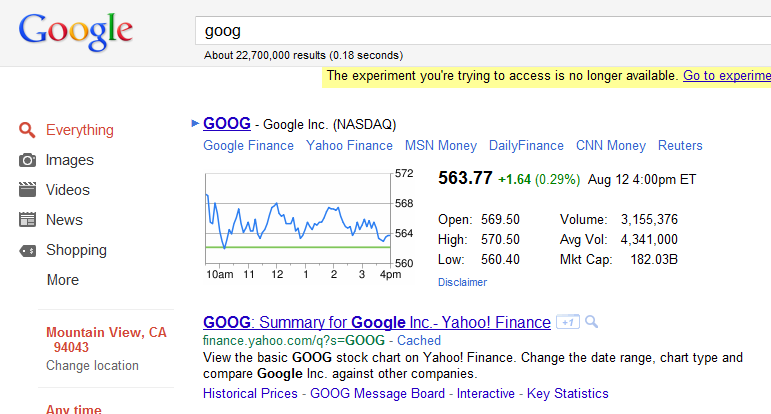
Google claims that it doesn’t alter the search order to favor its own products. This is technically kind of sort of true, but also misleading. The positions in organic listings doesn’t change. But take a look at this result for the search “GOOG”:
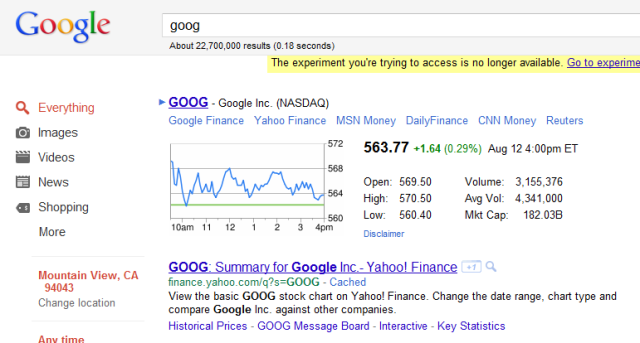
The most prominent spot on this page takes you to Google Finance

The most prominent spot on this page takes you to Google Finance.

The thing with the big stock quote and chart? That doesn’t count as an organic listing. Click anywhere on the big graph and you’ll go straight to Google Finance. (Yahoo! Finance is the first organic listing.)

I worked on search products at AOL. A presentation like the stock chart above can easily garner 40-50% of all the clicks on such a page. The graph is where the eye will go and what people will click.

Other Google products are often presented in their organic order — but with a different, more prominent presentation. Even small changes in presentation can have huge impacts on clickthrough rates.

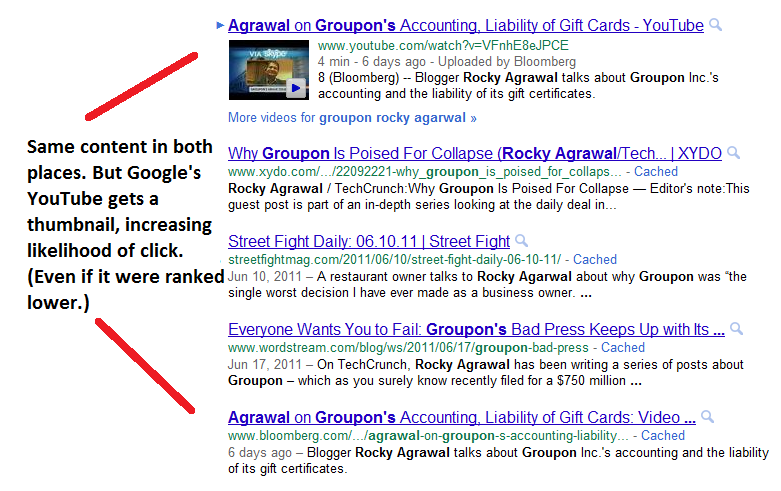
In this screenshot, compare the treatment of the YouTube video with the same content on Bloomberg’s site. Even if were ranked lower in the results, the video with thumbnail would get higher clickthroughs.

Comparison of organic results in Google search

Comparison of organic results in Google search

Google’s aggressive moves in mobile

Even before today’s announcement, Google has been taken an aggressive stance in the mobile space.

Skyhook Wireless, which pioneered WiFi location-based tracking, is suing Google over allegations that Google interfered with a deal it was trying to do with Motorola.  In my conversations with Google, I’ve been told that at least the NFC chips will be locked down and not available to other applications. Google’s introduction of its free navigation product on Android has decimated the markets for companies like Telenav, Garmin and Magellan.

Google has also made it known to Android manufacturers that it wants to preserve the Google experience on its handsets, even threatening to withhold access to early code of future releases. Will Google make Google+ a required part of Android? And will it try to keep OEMs from preloading Facebook? If the acquisition goes thorough, it’s safe bet that Google+ app will get prominent placement on Motorola devices.

Does antitrust law matter?

Increasingly, it seems antitrust law doesn’t matter. Even if you win, it’s most likely a pyrrhic victory — just ask Real and Netscape how their antitrust victories worked out for them. Regulators just don’t move fast enough. By the time they make a decision, the market has already moved.

Antitrust law has almost no deterrent value. The penalties for going too far are infinitesimally small compared with the rewards that come from plowing forward aggressively.

Facebook has two big advantages over Real and Netscape: a brand that consumers love and network effects. Facebook is one of the most important applications on a mobile phone. If Facebook functionality were crippled, it would influence my selection in phones. Carriers know the draw that Facebook has. The sheer magnitude of Facebook’s social graph should also serve as a barrier. Switching from Netscape to IE was painless; switching from Facebook to Google+ would be a lot of work, for you and your friends.

Posted in facebook, google, social networking | Comments Off on Could Google use Motorola and mobile to muscle its way into social? Does antitrust law matter?

Why big tech companies often fail

AOL closed an awful week with market cap of $1.26 billion. In December 2005, Google had invested $1 billion for 5% of AOL, giving the company an implied valuation of $20 billion. In less than 6 years, AOL has lost about 94% of its value.

Recently I was talking to a company about their hiring philosophy. They told me that a position had been open for months, but they were in no hurry to fill it. They would hire only when they found a great person to fill the role. And if they found a great person and there wasn’t a position open, they’d make space for them somewhere.

That’s a remarkable contrast to my time at AOL. I spent about 3 1/2 years there. I survived many rounds of layoffs. I finally succumbed to one, just a day before my big social product was to launch. (AOL had a huge early lead in social, which it squandered. I’ll write about that someday.)

The game at AOL was to fill reqs, not hire great people. “Hire before the req gets taken away” was a frequent refrain. Even if the person was barely acceptable, it was better than having the role taken away. Unfortunately, it’s not uncommon in large companies to measure managers by the number of direct reports they have, not by the quality of their output. The more direct reports, the more important you are. That leads to bigger salaries, bigger offices, bigger egos.

But it doesn’t lead to great products. Hiring great, smart people does. Smart people energize other smart people. As a product guy, the most exciting thing for me is designing new product features with great people. It’s incredibly energizing.

Working with mediocre people is demotivating. If I’m the smartest guy in the room, I’m doing something wrong. (The people who worked with me on the social product were all terrific; I’d work with them again any day.)

At the time I left AOL, another person who was leaving was told by management “we need followers, not leaders”. That’s what AOL got and look what happened. That person — a true leader — has gone onto unbelievable success. He helped build one of the most talked about companies in Silicon Valley. And he doesn’t have to work again if he doesn’t want to.

Posted in aol | 1 Comment