Google and antitrust: How Google favors its own products

This is the second in a multi-part series on Google and antitrust. Part 1 looked at how difficult it would be for a new player to start in Web search today.

Part 1: Competing in Web search against Google would be extremely hard

Part 2: How Google favors its own products

Part 3: Looking at the good and bad effects of monopolies

Disclosures: I worked on AOL Search from 2004-2007, where Google was our algorithmic search partner. Any assessments of financial models are based on publicly released information and not any specific information I had access to regarding the terms of the AOL-Google deal or our negotiations with Google and Microsoft. My brother is currently employed by Google and I have many friends there. I went to high school with Google CEO Larry Page.

You don’t see algorithmic results

Google likes to say that the algorithmic results are untainted; that they’re based solely on hundreds of signals that mere mortals couldn’t possibly understand. That is true. But it’s also not a meaningful statement, because you often don’t see algorithmic results.

Atop the algorithmic results, you’ll see special content that favors Google products. Queries for stock quotes, maps, products and others highlight this content.

Google also blends in to its algorithmic results content from maps, news and social search. A result from Google Places can take the screen real estate of 6 or 7 algorithmic results. How do you tell other results result from an algorithmic result as a consumer? They’re not labeled. Experts can figure it out. But consumers consider them to be algorithmic results. More accurately, consumers don’t care — they trust Google to be impartial and bring them the best of the Web.

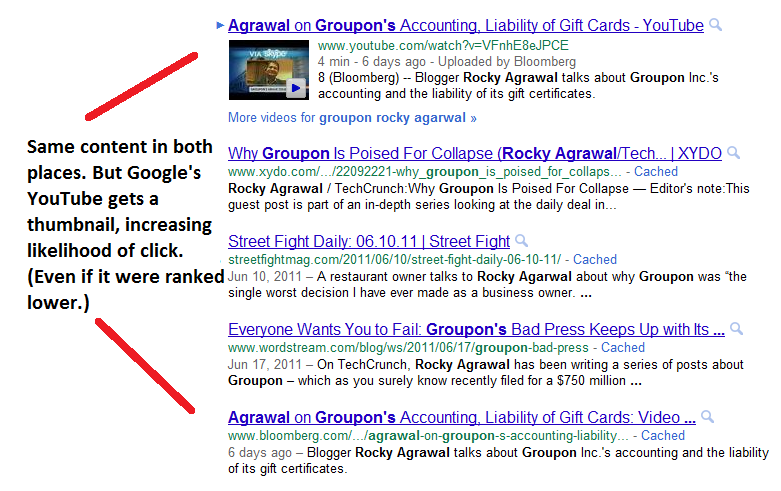
Even when Google presents its own content in the algorithmic order, it can give it special presentation that other sites don’t get. Consider this screenshot:

Comparison of organic results in Google search

Comparison of organic results in Google search

For the sake of argument, assume that YouTube had ranked lower than the original content on Bloomberg. The enhanced presentation of the YouTube video, with a thumbnail, duration and time stamp would drive more traffic.

Tying of other products (like social)

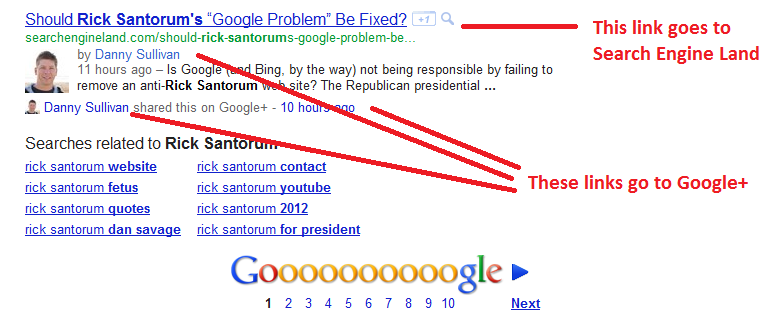
Google also integrates new products into Google’s Web search. If you happen to follow an account on Google+ and that person posts content that matches your search term, it will move up in the rankings for you. In this example, I did a search for “Rick Santorum” and the 10th result is a story by Danny Sullivan. It showed up there because I follow Danny on Google+.

Google+ gets preferential treatment in search results

Google+ gets preferential treatment in search results. Three of the four links in this result go to Google+.

When I do that search while logged out, the same result appears on page 2 in position 16. That’s a significant disadvantage as many searchers don’t go past the first page.

This creates an incentive for a) people to create an account on Google+ and b) people to share articles on Google+. The annotation also increases the likelihood of a click. Three of the four links in that result above go not to Danny’s article on Search Engine Land, but to Google+.

These incentives are especially critical right now when Google+ is struggling to gain meaningful adoption. On its own merits, I would not currently recommend that clients spend time on Google+. But because of the potential effect on Google Web search results, I think it makes sense for many businesses.

Google provides similar treatment for some links shared on Twitter, but this seems to be reduced now that Google is no longer licensing Twitter’s firehose. Even when it does appear, there is one link to Twitter compared with the three links Google gives to Google+.

In addition to the explicit incentives that Google creates, there are the implicit incentives created by Google’s black-box ranking algorithms. Legions of SEOs with no inside knowledge Make Shit Up. They advise clients how they can please Google’s algorithm Gods, often by making more use of other Google properties. (Which, of course, said SEOs can assist them with.)

Advertiser products

Google bundles several discrete ad products together. In some cases, it is impossible for advertisers to opt out of certain properties that they might not want to buy.

In other cases, Google offers a wide range of other ad products that can be easily purchased with the primary Web search advertising buy. Advertisers can easily buy into the contextual ad network, mobile ads, etc. From an efficiency standpoint, this makes things much easier for advertisers. But the net effect is that Google can take more share of limited advertising dollars.

Ben Edelman, an assistant professor at Harvard Business School, wrote a great analysis of how Google’s practices affect advertisers. That was a topic that didn’t get much consideration in the Senate’s hearings.

Next in this series, I’ll look at good and bad aspects of monopolies.

Posted in google, search | 6 Comments

Google and antitrust: competing in Web search against Google would be extremely hard

This is the first in a multi-part series on Google and antitrust. 

Part 1: Competing in Web search against Google would be extremely hard

Part 2: How Google favors its own products

Part 3: Looking at the good and bad effects of monopolies

Disclosures: I worked on AOL Search from 2004-2007, where Google was our algorithmic search partner. Any assessments of financial models are based on publicly released information and not any specific information I had access to regarding the terms of the AOL-Google deal or our negotiations with Google and Microsoft. My brother is currently employed by Google and I have many friends there. I went to high school with Google CEO Larry Page.

In today’s hearings before the Senate Judiciary Subcommitte on Antitrust, Competition Policy and Consumer Rights, Google tried to dissuade the committee from the notion that Google is a monopolist.

In space after space, Google has used the dominance of its search engine to promote its own products. A few examples: local, finance, product search, images, YouTube, Google Offers. I expect we’ll see tighter integration of Google Offers and Flights into the core search experience within the next year.

Competing against Google in Web search is extremely difficult

Eric Schmidt made the claim several times that competition is one click away. That’s absolutely wrong. Search on the scale of Web search is an incredibly hard problem that requires several thousand engineers, significant capital investment to crawl the entire Web and return results at blazing speed and global reach. You can’t solve Web search today with 2 engineers in a garage.

And that’s just Web search. To have a competitive product, you’d need maps, stock quotes, news, weather and all of the other things that Google has incorporated into its results over the years.

For the sake of argument, let’s say you could. The next step would be getting people to try your search engine. That’s hard for two reasons: brand and distribution.

I’ve done A/B testing with search results. If you took a set of results and changed nothing but the logo, the results with the Google logo were perceived by users to be better. That’s how powerful Google’s brand is.

Google got its initial breaks in terms of distribution when search was a nascent space and companies like AOL and Yahoo! didn’t know how incredibly lucrative the space would turn out to be. With ingredient branding on search on AOL and Yahoo!, Google was able to develop its own brand as the place to go for high quality search. Deliberately or not, Google used the quarterly revenue focus of its distribution partners to its advantage, letting them clutter their own experiences with lots of irrelevant ads while keeping Google.com relatively sparse.

Let’s assume somehow you’ve built the best search engine, solved the brand problem and convinced distribution partners that you had a better product. The next challenge is paying them enough to displace Google.

Search advertising is a network-effects business. Because it relies on an auction model, generally the greater the number of participants, the higher the price. Search advertising is time consuming for the advertiser — many advertisers can accomplish their business needs just using Google AdWords. There’s no need for them to also buy on bing. As a result, Google can afford to offer more revenue to distribution partners. Even if you were willing to take a loss and give distribution partners more money than you take in, Google’s higher take means they would still offer partners more money.

Solved that problem? Next, there’s the challenge that many of your potential distribution partners have lost a lot of their share. Among the distribution partners that helped build Google: AOL is hardly worth talking to as AOL Search traffic continues to plummet. MySpace? Um, OK.

I’ve always viewed Google’s YouTube acquisition as more of an insurance policy on the rest of Google’s search business, not as a video service acquisition. What Google was doing in 2005-2006 with the AOL Search renewal, YouTube acquisition and the $900 million search deal with MySpace was locking up eyeballs. If any of those distribution deals had gone to Microsoft, search might be very different today.

Facebook is the only company I can think of that has a real shot of challenging Google at search.

What consumers want

Schmidt also made the claim that Google is delivering what consumers want. There’s a lot of truth to that. If I enter “HPQ” in the search box, the most likely thing that I’ll want is the stock price for HP. If I enter an address, I probably want a map of it. If I enter “weather,” I probably want the weather where I am right now. It is a benefit to the consumer to have that answer right on the search results page.

Google’s innovation in maps has been phenomenal. I was working at AOL (Mapquest’s parent company) when Google Maps came out. I remember the emails from the head of Mapquest telling AOLers not to worry about Google Maps because no one would ever want such features.

In the case of Maps, Google delivered a much better product than Mapquest. The fact that Mapquest continues to exist at all is a testament to the power of consumer inertia. It’s also a testament to the power of brand.

And Schmidt is right in saying that trying to gather such results in real time from various sites would be technically extremely challenging.

But there are also many cases where what Google delivers is not what consumers want. I recently returned from SMX East, a search engine conference. Every time I searched for it and clicked the agenda link, I got the 2010 agenda, not the 2011 agenda. Searches for my own name return inexplicably return my Google+ profile instead of my blog, Twitter, Quora or many other presences that I actually tend to.

Is it possible to create a search engine that addresses these things? Sure. But these are not easy challenges. And although Google continually evolves its algorithms, it seems that big changes to solve such issues aren’t a priority. The recent big changes in Google’s algorithms to reduce the prominence of low-quality content written primarily to rank on Google, known as Panda, came about only after Google was practically shamed into addressing the content farm issue.

Part 2 will look at how Google favors its own products and ties new products into existing products.

Posted in google, search | 8 Comments

Why Netflix’s split won’t help with its real problems

Today’s announcement by Netflix of changes to its longrunning service will do little to solve the very significant challenge in front of Netflix streaming: content licensing.

In his blog post, Netflix CEO Reed Hastings compared his company’s challenges to those of AOL and Borders:

Most companies that are great at something – like AOL dialup or Borders bookstores – do not become great at new things people want (streaming for us) because they are afraid to hurt their initial business. Eventually these companies realize their error of not focusing enough on the new thing, and then the company fights desperately and hopelessly to recover. Companies rarely die from moving too fast, and they frequently die from moving too slowly.

While all of that is true, Netflix is nothing like these companies. AOL and Borders died largely because of internal conflicts and lackluster attention to emerging technologies (broadband in AOL’s case, e-readers for Borders). Those are not the real challenges that Netflix faces.

Hastings and Netflix have always been forward thinkers. The company was launched at a time when DVD players were just starting to take off — but it wasn’t named DVDFlix. They experimented with creating their own digital media players before spinning out Roku. They have gotten Netflix streaming into virtually every device out there.

I have great respect for Netflix and Hastings. Not long ago, I heavily praised Netflix for making many right moves to be as successful as they are.

Netflix’s biggest problem is not internal conflict between the DVD side of the business and the streaming side. Every battle in that realm has clearly gone toward the streaming side. Netflix management has made it very clear that it wants the DVD to go away.

But they need the content owners to cooperate for that to happen — and so far, there has been limited cooperation.

Content providers are more than happy to sell Netflix old library content that they have no meaningful way to monetize. (Some of which is of such low value that it’s not even worth pressing DVDs.)

Content providers are much less willing to give access to new release movies, HBO Original content like The Sopranos and other high-value content for which there are many other more lucrative markets.

On the DVD side, Netflix doesn’t need to seek permission from the content owners. Under the first sale doctrine, they can rent anything they can get their hands on. Even there, Netflix has voluntarily agreed to delay when it begins renting new-release DVDs in exchange for access to other content from the studios. (Presumably, if Qwikster were truly separate, then it would rent all new-release DVDs as soon as they came out. I bet that doesn’t happen.)

As much as content owners want the revenues that can be generated by Netflix’s 20+ million subscribers, they are worried about Netflix devaluing their content. At $7.99 a month for unlimited access, Netflix is cheaper than the price of a single movie ticket in many cities. Premium content providers don’t like that.

Even if Netflix were willing to pay more for the content than it charges subscribers, content providers wouldn’t play along. Let’s say for the sake of argument that Netflix were willing to pay $14.99 a month for content and could only charge subscribers $7.99 a month. This would generate a loss of $7 a month but the studios would get a lot more money. The studios are unlikely to participate because they want consumers to associate a higher price for their product than $7.99 a month.

This is similar to the Minimum Advertised Price concept in retail, where manufacturers set a minimum price that must be shown whenever their product is advertised. They want consumers to associate a certain value with their product and retailers advertising a lower price undercuts that. (If you’ve ever wondered why Amazon sometimes asks you to put an item in your cart before showing you the price, this is why.)

A similar thing happened with e-books. Amazon used to sell many Kindle books for a loss to promote the adoption of Kindle. With recent changes in the marketplace, the publishers are setting the price and Amazon gets a commission.

A related issue that content providers face is channel conflict. They sell essentially the same product to multiple channels: first-run theaters, second-run theaters, cable video-on-demand, hotel pay channel distributors, premium networks like HBO and Showtime, DVD, basic networks like AMC, Bravo and USA. This “windowing” strategy allows them to maximize revenues for a single piece of content.

In order to keep getting the high prices they get from cable VOD, they can’t sell new release rights to Netflix at low prices. If Netflix goes for $7.99 a month, HBO at $20 a month looks expensive. TimeWarner, which owns both studios and distribution, wants to protect HBOs price point. There are two ways to do that: get Netflix to raise its price or only sell mediocre or dated content to Netflix.

Netflix will have to raise the price of its streaming service in order to get high quality content. Apparently this was a sticking point in the recent re-negotiation with Starz. According to the Los Angeles Times, “Starz didn’t just want Netflix to pay more money for its content. It wanted Netflix consumers to pay more too.”

As much as many consumers hate the tiered model and expense of cable and satellite channels, that model has worked for decades and the entrenched players don’t feel the need to change that. Unless copyright law changes to force compulsory licensing of movies and television content (the odds of a truly entertaining Oscars broadcast are much higher), Netflix will have to play by the rules created by the content owners.

Splitting the DVD and streaming businesses does little to address any of these concerns. While other companies merge for synergies that rarely materialize, the DVD and streaming sides of Netflix are entirely complementary. The DVD side provides a fresh and deep library, while the streaming side provides instant access for when you just need something to watch right away. Recommendations take into account taste preferences regardless of the silly division between physical and digital media. Customer care, Web site development and other operations also have shared value.

I’m as big an advocate of the all-digital living room as anybody. I bought a DVR when they were selling for $1,000. I owned the first-generation Apple TV. If I had to pick between DVD and Netflix streaming today, it’d be no contest: DVD.

Posted in movies, netflix, television, video | 1 Comment

Google Offers merchant agreement

Note: Page 1 is the term sheet. The only substantive item on the term sheet is the revenue share. In this case, the merchant received between 50 and 60 percent.

GOOGLE PREPAID OFFERS BETA PROGRAM ADDENDUM
Google Prepaid Offers Beta Program Addendum Confidential Page 2 of 4
Google Inc. v042611
Terms and Conditions

This Google Prepaid Offers Beta Program Addendum (“Addendum”) is entered into by Google Inc. (“Google”) and the entity executing this Addendum (“Merchant”) and is an addendum to and is governed by the Google Advertising Program Terms previously executed by Merchant and Google or, if not previously executed, as available at http://www.google.com/ads/terms (the “Terms”), which are incorporated here by reference. This Addendum and the Terms govern Merchant’s participation in the Google Prepaid Offers Beta Program (the “Program”). Capitalized terms not defined in this Addendum have the meanings assigned to them in the Terms. The Program is a “Beta Feature” under the Terms and subject to the confidentiality obligations outlined therein. Merchant is a “Customer” under the Terms. This addendum is effective as of the date of Merchant’s signature above (the “Effective Date”).

1. Definitions
 “Brand Features” means trade names, trademarks, service marks, logos, domain names, and other designators of source or origin.
 “Buyer” means a purchaser of a Merchant Offer.
 “Creative Content” means advertising materials and related technology, including without limitation data, APIs, written text, logos, flash, images and computer code (e.g., XML, HTML, JavaScript).
 “Creative Services” means (a) Google’s design, production or development of any creative assets on Merchant’s behalf using Creative Content for use in ad campaigns (“Campaigns”; collectively, the “Creative Work Product”) and (b) Google’s selection and/or placement of any Creative Work Product or Creative Content on Merchant’s behalf for Campaigns (“Creative Placement”).
 “Google Creative Content” means Creative Content created by Google.
 “Merchant Offer” means a gift certificate, discount, coupon and/or voucher offered to Buyers through the Program that the Buyer may redeem for Merchant’s products and/or services. For clarity, Merchant Offers are “ads” under the Terms.
 “Offer Purchase Period” means the period during which a Merchant Offer is available for purchase via the Program.
 “Pending Merchant Offer” means a Merchant Offer that has not yet been released to potential Buyers through this Program.

2. Google’s Role. Merchant authorizes and consents to Google’s selling any Merchant Offer under the terms listed in the IO (“Offer Terms”). Google may, but is not obligated to, sell Merchant Offers to Buyers and act as the merchant of record under the card brands’ rules for the sale of Merchant Offers. Google will remit revenue share (as specified in the IO) from the sales of Merchant Offers to Merchant as specified in Section 8 of this Addendum. Google is not offering or selling Merchant’s products or services listed in the Merchant Offers. Google is not obligated in any manner to (a) honor or redeem a purchased Merchant Offer; (b) provide refunds to Buyers, except as provided herein or otherwise by law; (c) determine, charge, retain or pay sales tax on its sale of any Merchant Offer. Notwithstanding anything to the contrary, modifications to the Offer Terms to any Pending Merchant Offer by Merchant may be provided orally or in writing by Merchant to its sales contact at Google at least 3 business days before the date on which the Pending Merchant Offer is scheduled to run.

3. Merchant Responsibilities. Merchant will: (a) be responsible for ensuring that the Offer Terms are complete, correct and current before it approves Creative Work Product for the Merchant Offer; (b) honor a purchased Merchant Offer under the Offer Terms; (c) not ask a Buyer to provide any personal information in order for Buyer to redeem a purchased Merchant Offer, except for information Merchant legally collects on all of its customers; (d) be responsible for all funds that it receives from the sale of the Merchant Offers and is responsible for maintaining, reporting and using those funds in compliance with any legal requirements; (e) comply with all laws applicable to promoting, honoring and redeeming a Merchant Offer, including, without limitation, any laws relating to (i) required refunds, (ii) disclosures or (iii) expiration dates for gift certificates, coupons, discounts or vouchers, (iv) tax determination, registration, collection and payment and (v) state abandoned property laws; and (f) not permit a Merchant Offer to be used in a manner that would violate any applicable law. Merchant represents and warrants that it has the financial and operational capability and appropriate inventory, staff and the supply of the relevant goods and services to meet Merchant’s obligations to Buyers for the anticipated number of Merchant Offers that may be purchased and subsequently redeemed by Buyers, as described to Google.

4. Merchant Offers. Merchant Offers will satisfy the following requirements: (a) each purchased Merchant Offer may be redeemed only once unless otherwise stated in the Offer Terms; (b) no fee or charge will be imposed by Merchant on Buyer for redemption of the Merchant Offer, other than applicable tax Merchant may charge; (c) the Merchant Offer may only be transferred by the Buyer in accordance with applicable law; (d) subject to restrictions under applicable law, Merchant may determine whether to permit Merchant Offers to be redeemed for products that are subject to purchase or other legal restrictions, such as alcohol and tobacco products; (e) unless expressly permitted by the Offer Terms, Merchant Offers cannot be applied toward the payment of shipping fees, tips or gratuities, taxes, or outstanding balances owed by Buyer to Merchant; (f) unless expressly permitted by the Offer Terms, Merchant Offers cannot be combined with other coupons, special offers or special discounts offered by Merchant or a third party. Google may use Merchant’s Brand Features for marketing or advertising the Program.

5. Content. Subject to the terms and conditions of this Addendum, Google will provide Merchant Creative Services for Campaigns submitted to Google for the Program. Merchant is solely responsible for (a) Creative Content (other than Google Creative Content) and (b) approval of all Creative Work Product. Merchant warrants that it has and will have all necessary rights and authority to use and to have Google use on Merchant’s behalf the Creative Work Product (including without limitation any Creative Content therein) as contemplated by this Addendum (“Merchant’s Warranty”). Google will own any Google Creative Content but will not claim ownership over any other Creative Content. Google will not use the Creative Work Product (except for the Google Creative Content therein) except for purposes of the Campaigns and inclusion in Google’s marketing and promotional materials. For Creative Work Product that uses any Google API (e.g., Google Gadgets API), such Creative Work Product is subject to the policies applicable to that API. For Creative Work Product that uses Google Maps, any such Creative Work Product will be coded in compliance with the Google Maps API Terms of Service available at http://code.google.com/apis/maps/terms.html (“Maps API TOS”). Merchant may not (i) modify such Creative Work Product in any way that impacts the Google Maps API or (ii) use the Maps API for any purpose other than use in the Creative Work Product, unless in each case Merchant has read and consented to the Maps API TOS. For Creative Work Product that use Merchant’s APIs, Merchant is responsible for confirming that the use of Merchant’s API in the Creative Work Product complies with Merchant’s API terms of service. Google may not (i) modify such Creative Work Product in any way that impacts Merchant’s API or (ii) use Merchant’s API for any purpose other than creating the Creative Work Product, unless in each case Merchant’s permission is received. Google is providing the Creative Services at no additional cost to Merchant.

6. Content Liability. Google will perform the Creative Services with reasonable care (“Limited Warranty”). Except for the previous sentence, Google makes no representations, warranties or covenants about the Creative Services, any Creative Work Product (including the Creative Content therein) or any Creative Placements. Without limiting the generality of the foregoing, Google has no liability for any Creative Content, Creative Work Product or Creative Placements. Merchant’s sole remedy for any breach of the Limited Warranty or any of Google’s other obligations in this Section 6 is to require Google to re-perform the applicable Creative Services free of cost. Merchant will indemnify, defend and hold harmless Google, its Partners, agents, affiliates, and licensors from any third party claim or liability arising out of any Creative Work Product, Creative Placement and any breach of Merchant’s Warranty. Partners are deemed third party beneficiaries of the above Partner indemnity.

7. Refund Policy. Google may refund Buyers for purchased Merchant Offers for any reason at any time. Within 90 days after the Offer Purchase Period of a Merchant Offer, any refund by Google to a Buyer for the Merchant Offer will cause Merchant to immediately forfeit or otherwise provide to Google any revenue share it received or would have received for the Merchant Offer.

8. Payment. Google Payment Corporation will act as the paying agent for Google and will transfer funds owed by Google to Merchant via electronic funds transfers to a bank account Merchant registers with the Program. Merchant authorizes and consents to Google’s deducting, from the revenue share from the sale of Merchant Offers, the amount of funds that Google is entitled to hold as reserves and other amounts due and owing to Google or its affiliates. The sales price and the revenue share percentage specified in the IO or through a Google user interface for this Program, as well as any refunds made under Section 7, will determine the amount of payment Merchant will receive for purchases of its Merchant Offers. Google will retain the remainder of the proceeds from the sale of Merchant Offers. Except as stated herein, each party is responsible for its own costs under this Addendum. Google will initiate payment to Merchant representing 80 percent of the amount due to Merchant based on purchased Merchant Offers, adjusted for refunds, reversals, and chargebacks, within 4 business days after the close of the Offer Purchase Period. Google will initiate payment to Merchant for the remaining 20 percent of the amount due to Merchant based on purchased Merchant Offers, adjusted for refunds, reversals, and chargebacks, within 90 days after the close of the Offer Purchase Period. Merchant authorizes and consents to Google holding this remaining 20 percent for 90 days as a reserve for the payment of refunds,reversals, and chargebacks, and any other amounts due and owing to Google or its affiliates. Google reserves the right to withhold any payment to Merchant if Merchant does not comply with the Merchant Offer terms as provided to Google. Google will not be liable for any payment (a) based on any purchase of any Merchant Offer through any fraudulent or invalid means, as determined by Google in its sole and absolute discretion, including but not limited to the fraudulent use of credit cards or other means of payment, (b) based on purchases of Merchant Offers that are refunded or (c) subject to a credit card charge back by a Buyer. Google reserves the right to withhold payment, offset amounts owed to Merchant or debit Merchant’s designated bank account because of any of the foregoing. Merchant agrees to cooperate with Google in its investigation of any of the foregoing. Merchant is responsible for immediately refunding and/or repaying to Google any payment made by Google under this Addendum that is later subject to a return, chargeback, reversal, refund, adjustment or rejection whether by a bank, Buyer action or otherwise, or that was paid in error or paid as a result of miscalculation by either Google or Merchant (“Merchant Repayments”). Merchant authorizes Google to offset and net current amounts owed by Google to Merchant against the amount of any Merchant Repayments owed by Merchant to Google. All payments and refunds contemplated hereunder will be made in U.S. dollars.

9. Term/Termination. This Addendum begins on the Effective Date and continues for a period of 6 months thereafter(the “Initial Term”). After the Initial Term, this Addendum will automatically renew on these same terms and conditions for successive one-year periods (each a “Renewal Term”). The Initial Term and any Renewal Terms are collectively referred to herein as the “Term.” Notwithstanding anything in the Terms to the contrary except for Google’s rights to cancel under the Terms, either party may terminate this Addendum (and the Terms solely as they relate to this Addendum) at any time (a) with 30 days prior written notice with or without cause or (b) with prior notice and the other party’s consent. Sections 3, 4, 6, 7 and, only with respect to revenue received by Google but not distributed to Merchant by the termination date, 8 will survive any expiration or termination of this Addendum. Merchant may cancel a Pending Merchant Offer online if online cancellation functionality is available to Merchant, or, if not available to Merchant, with prior written notice to the Merchant’s Account Manager at Google, including without limitation by electronic mail, at least 3 business days before the date on which the Pending Merchant Offer is scheduled to run. Merchant may not cancel a Merchant Offer thereafter.

Posted in daily deals, google | 4 Comments

The economics of LivingSocial/Whole Foods-like deals


As expected, today’s LivingSocial offer of $20 Whole Foods gift card vouchers sold out at 1 million vouchers sold.

This is a great marketing move that created buzz around the Internet, for a while was the top term on U.S. Google trends, generated news stories by Reuters, The Washington Post, Mashable and others. They even got your resident daily deals curmudgeon to say nice things about the deal.

But many people fail to understand the economics behind such deals. If the deal is structured like other such deals, it’s a customer acquisition tool. As a grocery store (even a high-priced one often referred to as Whole Paycheck) Whole Foods doesn’t have the margins for deep discounts. It’s operating margin is 5.5%. A more mainstream chain like Kroger has operating margins of 2.7%.

LivingSocial is likely spending $20 for each $10 paid by consumers. In a best case scenario, they were able to negotiate a bulk purchase discount and get the gift certificates for $18 or $19 each. That’s a net loss of $8-$10 per customer. (LivingSocial spokesman Andrew Weinstein declined to discuss the deal terms.)

This loss is increased by:

  • Customers who are already LivingSocial customers. If you’re already a customer, there’s no reason for you not to buy one. It’s essentially free money! Every existing customer who buys one should be subtracted from the total customers when you’re calculating customer acquisition costs. The Amazon gift certificate promotion was more cost effective — there was a smaller base of users who were already LivingSocial customers.
  • Customers who get free vouchers under LivingSocial’s 3 and free program. If you get 3 of your friends to buy, yours is free. Given how much tweeting and Facebook activity was going on, I estimate that 5-15% were given out for free.
  • Customers who fraudulently purchase multiple vouchers. (Groupon and LivingSocial merchants face this all the time. Customers will set up multiple accounts to exceed stated limits.)

This loss is decreased by:

  • The number of vouchers that are unredeemed. From the legalese: “Whole Foods Market code shall not be deemed purchased by the purchaser until claimed • Whole Foods Market codes will be available for purchasers to claim for ninety days following the offer period. If code is not claimed within 90 days following offer period, code will be deemed forfeited, and purchasers will be refunded the full paid value ($10) of the Whole Foods Market code in Deal Bucks to be used on livingsocial.com” Effectively, you’re buying a special gift card for LivingSocial that can be turned into a Whole Foods git card. If you don’t convert it, it’s a zero acquisition cost. In that case, you would either not use it or buy another deal on which LivingSocial would have margin.

Running deals like this puts LivingSocial in the same boat as merchants who run LivingSocial deals: customers will come in for the almost-too-good-to-be-true offer, but won’t return for the normal offer. I would buy the Whole Foods deal every single day. I also bought the Amazon and Fandango deals — all of which were likely sold at a loss. But I rarely buy anything else.

Groupon CEO Andrew Mason called out LivingSocial’s tactic of buying revenue in his controversial email to employees:

Living Social’s U.S. local business is about 1/3rd our size in revenue (and smaller in GP [gross profit]) and has shrunk relative to us in the last several months. This, in part, appears to be driving them toward short-sighted tactics to buy revenue, like buying gift certificates from national retailers at full price and then paying out of their own pocket to give the appearance of a 50% off deal. Our marketing team has tested this tactic enough to know that it’s generally a bad idea, and not a profitable form of customer acquisition.

Asked to comment on that, Weinstein responded, “we haven’t commented on Mr. Mason’s memo, except to say that any claims about our financial metrics should be treated with skepticism, as no other companies have access to our internal numbers.”

Is it worth it?

By my estimates, Groupon spent $24.08 for each new customer acquired in the second quarter. Between giving money to Google for advertising and giving money to consumers, I’d rather give money to consumers. Then there’s the value of all of the press LivingSocial received today, much of it from reporters who don’t understand the economics.

Given the timing, the bigger reason to do it is to put lipstick on the LivingSocial hog. As a company that is rumored to be on the IPO path, the Whole Foods gift card giveaway improves these metrics:

  • Total number of customers. (If you bought the deal you’re a customer.)
  • Conversion rate of list subscribers to customers. (Again, every one who buys this is a customer. This increases the percentage of list subscribers who have bought something.)
  • Repeat customers. One of the things I knock Groupon for is more than half their customers have never purchased again. But if you bought both the Amazon deal and the Whole Foods deal, you’re a repeat customer!
  • Gross revenue. If LivingSocial books revenue like Groupon does, they just generated $10 million in revenue! They just grew revenue for the quarter by $10 million. Magic.
  • Total vouchers sold.

Investors should be smart enough to look past such shenanigans, but most don’t look at such details when evaluating financials.

I look forward to reading and analyzing LivingSocial’s S-1, if there is one.

Posted in daily deals, groupon, livingsocial | 10 Comments

Groupon deal performance: down and to the right

This is another graph that caught my eye from the study posted by Harvard and Boston University researchers:

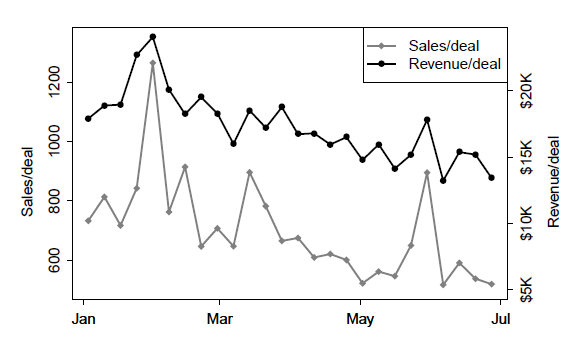
Groupon sales and revenue per dealThis bears out what I’ve been hearing from Groupon insiders.

In the latest amendment to the S-1, Groupon also reported that its revenue per sales rep declined from $172,000 in 1Q2011 to $138,000 in 2Q2011.

Groupon’s model is heavily dependent on its salesforce. To the extent that each deal brings in less revenue, selling expenses alone will become an even bigger problem for the company.

Posted in daily deals, groupon | Comments Off on Groupon deal performance: down and to the right

Why running a Groupon can destroy your Yelp ratings

A recent study by researchers at Harvard and Boston University confirm statistically something that I’ve long suspected: Running a Groupon can destroy your Yelp ratings. I generally recommend that restaurants and service businesses avoid running Groupons because the short-term economics are terrible. This study suggests that the long-term economics may be just as bad.

Groupon's effect on Yelp ratings

Some quotes from the report, which looked at 6 months of Groupon deals in 20 markets:

Our analysis shows that while the number of reviews increases signi cantly due to daily deals, average rating scores from reviewers who mention daily deals are 10% lower than scores of their peers on average.

We find that reviewers mentioning daily deals are signi cantly more negative than their peers on average, and the volume of their reviews materially lowers Yelp scores in the months after a daily deal off ering.

An average drop of 0.12 suggests a signifi cant number of merchants may lose a half-star due to rounding. This could have a potentially important e ffect on a business; a recent study reports that for independent restaurants a one-star increase in Yelp rating leads to a 9% increase in revenue.

Although the analysis doesn’t go deep into the reasons for lower ratings, based on numerous conversations with merchants and consumers the lower ratings are a result of a number of factors:

  • Persnicketiness of Groupon customers. Some Groupon customers haven’t tried services or these price levels before. They have higher expectations than consumers who normally frequent a business. The owner of a spa in Germany told me that his Groupon customers were much more demanding than his full-price clientele.
  • A crush of demand that is hard to service. Groupon and LivingSocial generate a crush of demand that can vastly exceed the service capabilities of restaurants and small businesses. In extreme cases, 2-3 years worth of business will be sold in a 24 hour period. More commonly, 6 to 12 months of business will be sold. Many of these customers want to use the service right away. One consumer told me he bought a house cleaning deal on LivingSocial to use the next weekend. When he called to schedule the cleaning, he was told the next slot was in 4 months. Restaurants will find that they are slammed for the first 2-3 weeks of a Groupon run and toward the end of the run. Under such circumstances, it’s hard for any business to perform up to its normal service levels. This has another side effect: many consumers tell me that they now avoid their regular places right after a Groupon run because they don’t want to deal with the crowds. The restaurant ends up turning away full-price customers to serve customers at deep discounts.
  • Breakdown in communications between Groupon, the merchant and staff. Many merchants don’t understand the rules of accepting Groupons, such as the fact the mobile app is valid and a paper voucher isn’t required. Staff aren’t adequately trained on acceptance procedures. They also are unaware of the legal requirements related to gift cards and expiration dates.
  • A negative feedback loop. This is a very common one that I hear from both sides. Merchants complain that Groupon customers don’t tip well, are picky, etc. After a few weeks of this, they treat Groupon customers like second-class citizens. Groupon customers then complain because of the way they are treated and this reinforces lack of tipping.
  • Confusing terms and conditions. As merchants wake up to the economics of daily deals, many are adding terms and conditions to balance demand or in hope of generating some profit from a deal. Customers either don’t read these terms or deliberately choose to ignore them, figuring they can browbeat the merchant in to accepting the voucher. I’ve heard from merchants that they’ve been threatened by Groupon customers with bad reviews if they didn’t accept a voucher that the customer wan’t entitled to use.

All of this is exacerbated by the fact that Groupon has great customer service. Even if you have the flimsiest reason, Groupon will give you a refund for the price you paid for a deal. (I had a terrible experience with Groupon Getaways, but they immediately offered me a full refund.)

Although this is definitely great for consumers, this makes the merchant look like the bad guy and the merchant gets slammed in Yelp. I’ve even heard of cases where Groupon customer service made disparaging remarks about the business, apologizing for not adequately vetting the business.

Yelp has become the de facto standard for restaurant ratings in the United States. Dropping from a 4-star rating to a 3.5-rating can have a negative long-term impact on businesses. I, for example, won’t eat at places rate less that 4-stars on Yelp; there are just too many other options out there. As mobile Yelp usage continues to explode, I expect this effect to become more pronounced as people will rely even more on the average rating than reading individual reviews.

Once your rating is damaged, it can be very hard to recover. Groupon delivers so many customers at once that the sheer volume of ratings they submit will take time to overcome.

Although I recommend against running Groupon for service businesses and restaurants, if you choose to run one, here’s my advice: treat Groupon customers as if they were your best customers.

Posted in daily deals, groupon | 8 Comments

Groupon’s newest class action and what’s going on in Groupon sales org

A purported class-action lawsuit filed last month by former Groupon employee Ranita Dailey accuses the couponing giant of underpaying overtime for sales employees.

The suit alleges that Groupon required non-exempt sales employees to work overtime and then incorrectly calculated the base rate on which overtime payments were to be made. According to the suit, overtime pay should be calculated based on the salary and commission paid to the employee, but Groupon was paying overtime only on the base salary. During some periods, Groupon stopped paying sales employees overtime altogether.

The suit seeks class action status and back pay plus punitive damages and attorney’s fees. Given that 40% of Groupon’s more than 9,600 employees are in sales, if the suit is successful, the damages could be significant.

I met with a likely class member in Chicago over the weekend. He told me that once the plaintiff started raising the issues around how overtime pay was calculated, Groupon stopped paying sales employees overtime entirely.

Several sources described the Groupon sales team as demoralized, with significantly less emphasis on working long hours to close deals. After the elimination of overtime pay, instead of working long hours, some Groupon sales employees are beginning to look for other opportunities.

In addition to the elimination of overtime pay, sources described a change to the commission structure that they believe will significantly lower sales commissions.

One thing that struck me in my conversations was that my sources still believed in the core Groupon concept of merchants using deals to attract new customers; they believed that a properly structured deal can create strong benefits for merchants, consumers and Groupon. They described a number of scenarios in which Groupon provided merchants with great results. They just think that Groupon has done terribly at executing on its own concept.

Sources described a focus on “GP” or gross profit — what Groupon gets from a given deal. New salespeople start in a small market and have to work their way to a bigger (and more lucrative) market. As a result, there is incentive to burn merchants with poorly structured deals to hit a big GP number. One source, a former salesperson, said “You had to fuck over businesses to get promoted.”

Sources said that in smaller markets, the much vaunted Groupon pipeline of merchants is small. Deals are often being sold only 7-14 days out.

By and large, Groupon salespeople do not have equity in the company. Any IPO (even in its weakened state) would not result in a financial windfall for them.

Former salespeople aren’t the only ones suing Groupon. The latest amendment to Groupon’s S-1 says that there are 16 purported class action lawsuits against the company. (This would make 17.) Merchants are suing Groupon alleging false advertising and consumers are suing alleging that Groupon violates gift card laws. In other legal trouble, Oregon’s chiropractors have banned Groupon as a disallowed fee-splitting agreement.

Note: Groupon has yet to reply to a request for comment. I will update if I hear from them.

If you are a Groupon employee and want to share your experience (good or bad), please email dailydeals@agrawals.org.

Posted in daily deals, groupon | 3 Comments

Why Google’s acquisition of Zagat matters

Today, Google announced its acquisition of Zagat, the company that publishes the venerable restaurant and hotel review guides. It’s a terrific acquisition. If Google executes correctly, this deal could be as significant as the YouTube deal has been. (I was also a big fan of that deal.)

Although Zagat is primarily known for its maroon pocket-sized guidebooks, it has long been working with innovators to get its data in the hands of mobile users. I first used Zagat on a mobile device on my Newton MessagePad 110 in the mid-90s. I later used it on a Palm V and Palm VII as part of the Vindigo service. (Vindigo eventually switched to Gayot and other data sources because they didn’t want to pay Zagat’s licensing fees.) There are aspects of those services that still haven’t been replicated by the leading mobile products.

Competition with Yelp

The most direct competitor to be affected by this deal is Yelp.

I love Yelp and use it all the time. But it’s way too much work. Half of each review seems to be about the personal life of the reviewers. Sorry, but I couldn’t care less that your girlfriend dumped you; I just want to know how the food and service was. Yelp has made great strides over the years in making sense of the reviews but its five-point scale that homogenizes food, service, ambiance and cost isn’t very helpful. Add to that the fact that a lot of restaurants are rated 4 stars and quickly discriminating among places is hard.

When it comes to restaurant reviews, comprehensiveness is less important than conciseness. There isn’t a “correct” answer — I’m just looking for a good-enough answer quickly. I don’t want to engage in a 30-minute research project and read 20 reviews to choose where to go to dinner. That’s where Zagat has excelled. Just glancing at the ratings, I can quickly pick a place. (I think my food threshold was 24.)

All that said, I stopped using Zagat when Yelp took off. The primary reason: I didn’t want to pay the fees and Yelp provided a good-enough solution for free. I fully expect that Google will take down the Zagat paywall and offer the ratings for free. (I’m surprised that hasn’t happened already.) I also expect that Zagat ratings will be syndicated across various Google properties, including mobile properties.

Zagat’s team is good at synthesizing information into actionable data. If Google can translate that knowledge into algorithms acting on data collected by Google Places, that could be really powerful.

Mobile

Mobile has been a godsend to companies like Yelp, Fandango and others that have strong brands. Unlike the Web, they’re not held hostage by Google’s search algorithm for traffic. Google has continually expanded the presence of its own local products on the main search results pages to the detriment of sites like Yelp.

The app-centric nature of mobile devices to data means that companies with strong brands can intercept that traffic before Google gets a chance. Zagat is a brand that carries its own affinity and a free Zagat app would instantly become a strong competitor to Yelp.

Brand

One of the biggest assets that Google gets with Zagat is the power of the Zagat brand, which in many circles is synonymous with fine dining.

As powerful as Zagat is with consumers, it’s also incredibly powerful with restaurateurs. Here is my subjective assessment of various local brands, as perceived by restaurateurs:

  • Zagat. Highly positive.
  • Facebook. Positive.
  • Google. Neutral to positive.
  • Groupon. Slightly negative, but heading downhill rapidly.
  • Yelp. Strongly negative.

Where Zagat is viewed as a friend of restaurants, Yelp is often viewed as an enemy. Part of the problem is that Yelp has sold advertising to restaurants and many restaurateurs view Yelp ad sales people as extortionists. (I believe Yelp management’s claims that they separate editorial from advertising, but that doesn’t change the widely held perception.)

If Google can use the Zagat brand as an in-roads to better engage with restaurateurs, that alone would be the price of the acquisition.

Facebook — and why all this might not matter

The biggest problem I have with local reviews as they’ve been done to date is that they largely ignore the social layer that has been built up over the last four years. When it comes to matters of taste, I’d rather get recommendations from people I know than random strangers.

It bugs my friends at Yelp and foursquare that every time I go on a trip, I post a Facebook status message asking for restaurant recommendations. Bill at Yelp will tell me to check Yelp. Tristan will tell me to check out foursquare Explore.

Yelp has its own social layer, but the people in my Yelp friend graph aren’t my real friends. The few that are rarely write reviews. Foursquare has my real friends, but for the most part doesn’t have enough data density to suit my needs. (A recent trip to Chicago was an exception.)

Even without any optimization, Facebook has both. Most of my status updates generate 3-4 restaurants, which is all I need. There’s another important benefit: I know how my tastes compare with the tastes of my friends. There are some friends that I know have a positive affinity with; if Dariusz offers a restaurant recommendation, I’ll go there without thinking about it. There are others with whom I have a negative taste affinity; if they recommend it, I won’t go.

A lot of people have looked at Facebook’s recent public announcements in local — killing its Deals product and removing the Places product from mobile — as a sign that Facebook doesn’t care about local. That couldn’t be further from the truth.

I’ve seen Facebook testing product concepts that point at its future direction in local. One test asks you to compare recent places you’ve visited. Another feature lets users contribute data on restaurants and other venues. Facebook realizes that most average people won’t go to the trouble of writing long reviews like those on Yelp. It’s better to collect small nuggets of data from massive audiences. See my post, Heading toward the Facebook recommendation engine.

Ironically, Ted Zagat, son of Tim and Nina Zagat, works at Facebook. That should make for some interesting dinner conversations. The question is how they’ll decide where to eat.

See also:

Posted in facebook, foursquare, google, groupon, yelp | 1 Comment

My policy on anonymous sources

I’m wrapping up a successful trip to Chicago where I had the opportunity to meet with Groupon PR and several Groupon insiders, talk with merchants and experiment with Groupon Now in a market where the product has sufficient density for it to be useful. I also had the chance to visit the first business ever to run a Groupon.

I didn’t, however, have the opportunity to enter Groupon’s offices. An offer to meet with employees and management in Groupon’s offices was rescinded because I refused to agree to Groupon’s condition that I identify confidential sources I was meeting with. No journalist worth his salt would ever agree to such a condition; I wouldn’t have agreed to such a condition when I was a reporter for my high school paper.

Like any journalist, I prefer to have sources on the record and fully identified in stories. Unfortunately, it’s impossible to talk about the inner workings of corporate America without the use of anonymous sources. When companies are under the microscope as Groupon currently is, anyone talking to the media without approval is putting his or job at jeopardy. Anonymity is often the only outlet that such employees have to share their insights.

I’m not about to put someone’s job or career at risk in exchange for access.

The risk of using anonymous sources is that people will use anonymity to take out grudges. I work to balance that by talking to numerous sources and verifying information that is provided anonymously.

I will continue to provide the best reporting and analysis of the daily deals space I can.

Posted in daily deals, groupon | 1 Comment