A note about my Groupon coverage and accountability

I’m sometimes asked if I ghost write under other names or post comments anonymously about Groupon. I do not. Everything I’ve written about Groupon and the daily deals space has been posted under my name.

I do, however, answer a lot of calls from other reporters about Groupon and the daily deals space. I help them to understand how the space operates and to interpret financial statements. I also help make introductions to other sources they might want to contact or businesses they might want to interview. I sometimes advise reporters on what questions they should ask.

In many cases, I’m quoted by name. But in a lot of cases, my comments are paraphrased, summarized or woven into the structure or theme of the story. This is at the discretion of the reporter; I do not ask for my comments to be on background.

Posted in daily deals, groupon | 1 Comment

Like many Groupons, Groupon is no bargain — even at 50% off

Groupon finally announced the details of its much awaited IPO. The company seeks a valuation that is between 1/3 and 1/2 of what was rumored when its first S-1 was published in June.

Although the numbers are on the surface much better than we’ve seen before, this was primarily the result of Groupon significantly reducing its marketing expenses. The structure of the company’s business is that marketing expenses can be ramped up or down to achieve company objectives: if the company desires hypergrowth, it can achieve it by spending aggressively on marketing. If it desires to veer toward profitability, it can cut marketing expenses. It seems to have done exactly that. Groupon has done a great job of dressing up the pig for the State Fair. But it’s still a pig.

That does not change the fundamentals of Groupon’s business. Cutting marketing substantially hurt Groupon’s growth. Among the key numbers that trouble me:

  • Sequential growth in merchants featured dropped from 38.2% in 2Q to 0.2% in 3Q. A drop of 38 percentage points.
  • Sequential growth in Groupons sold dropped from 15.8% to 1.5%. A drop of 14.3 percentage points.
  • Average revenue per subscriber dropped from $3.90 to $3.30, a drop of 15.4%

Groupon’s revenue share declining
The percentage of revenue that Groupon gets to keep from a deal also dropped substantially — from 42% in Q2 to 37% in Q3. Long term, I expect this number to be in the 10-20% range.

Groupon explains part of this with:

We launched several new channels including travel (Groupon Getaways), event tickets (Groupon Live) and consumer products (Groupon Goods). These new channels had lower deal margins than our standard featured daily deals. Over time, we expect our deal margins in these new channels to improve.

Groupon does not provide any reasoning for why it expects margins on these deals to improve. Unless Groupon is currently subsidizing these deals, this is the equivalent of saying that the margin fairy will arrive to help them out. Travel, ticketing and consumer goods are well established categories. Merchants in these categories have a lot of experience in online commerce. They know the margins they will accept and how much they will pay for advertising. To them, Groupon is just another channel that needs to compete with SEO, SEM, display and their other established advertising channels.

Declines in established markets

In more established markets, the number of Groupons sold in the quarter dropped on a sequential basis. In Chicago the drop was 11%, Boston 10% and Berlin 4%. That’s not a drop in growth, it’s an actual drop. Groupon does not provide details on revenue in each market, so it’s unclear what the revenue impact of these declines is. But it’s not a good sign for investors that long established markets are buying fewer and fewer Groupons.

Groupon’s merchant pool in North America declined for the second consecutive quarter. This is the pipeline of potential merchants for Groupon to feature. As word spreads of the terrible economics of running Groupons for merchants, I would expect this number to continue to decline.

Accounting changes

Following Groupon’s accounting is like playing whack-a-mole. Every time you think you’ve got the mole, it shows up in another hole. In yet another change to its accounting practices, Groupon substantially redefined what it includes in cost of revenue. I had previously pointed out that Groupon’s cost of revenue was soaring. From the first half of 2010 to the first half of 2011, it increased 40% on a percentage basis. I also said that this would be an important metric to follow to judge the risk inherent in the “Groupon Promise.” (I had asked Groupon PR to comment on that.) I believe that the Groupon Promise still represents a significant risk to investors. But under the new definition, that number is obfuscated.

An important related issue is that Groupon’s auditors, Ernst & Young, keep going along with such changes. There’s no reason that such significant changes to the company’s financials should be made weeks before the IPO. It reflects poorly on both Groupon’s CFO and Ernst & Young.

Other bad signs

  • The proportion of subscribers who have ever purchased anything from Groupon remains stuck near 20%.
  • The cost of a new subscriber in 3Q was $6.67.
  • The cost of a new customer in 3Q was $28.15.
  • Only 54% of Groupon customers have purchased more than one Groupon. Based on the company’s financials, I’m one of Groupon’s best customers.

The only good sign that I see in this offering is that the money raised will actually go to the company, instead of into the pockets of Groupon insiders. Groupon will raise roughly half of what it has raised in previous rounds, but the company will get nearly 4 times what it got before.

That cash infusion may give the company enough time to find a real business model.

Posted in daily deals, groupon | 4 Comments

Groupon and LivingSocial get half off deals they won’t like: their traffic

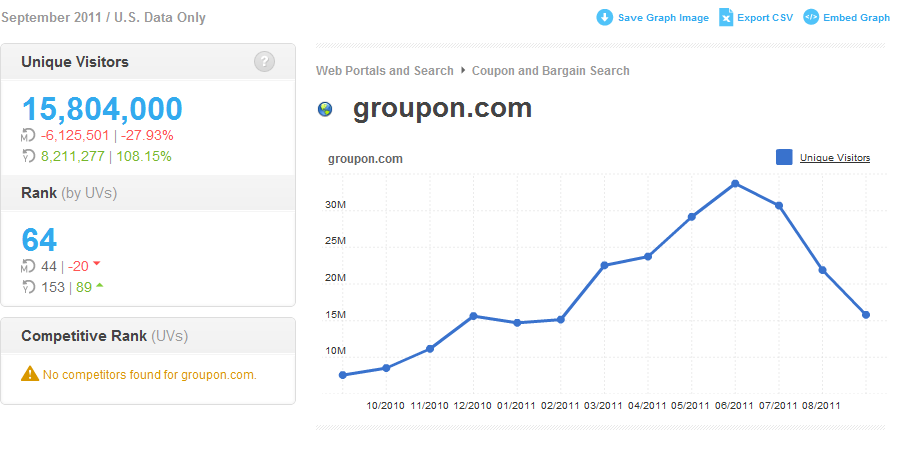
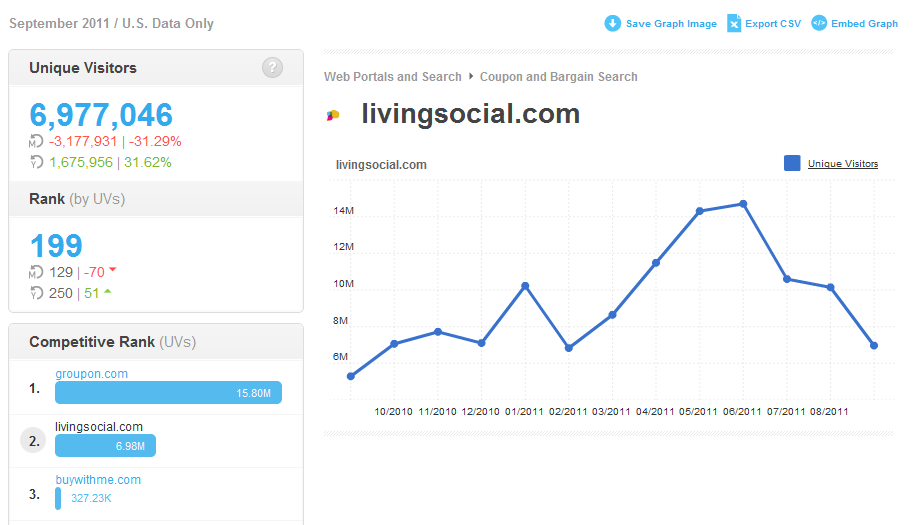
Traffic to leading daily deal sites Groupon and LivingSocial has fallen often a cliff in the last few months, according to data from Compete.

Groupon visitors have plummeted more than 50% since June.

Since June, unique visitors to Groupon have fallen more than 50% from 33.7 million to 15.8 million. In the same period, LivingSocial’s unique visitors have fallen from 14.7 million to 7 million. Just in the last month, Groupon visitors are down 28%. LivingSocial’s visitors were down 32% in the last month.

LivingSocial traffic has also fallen more than 50% since June.

LivingSocial spokesman Andrew Weinstein responded, “There are a lot of competing and contradictory estimates out there, but they should all be treated with deep skepticism, as none are based on our actual numbers.” Groupon did not respond to a request for comment.

Although Web metrics generally vary depending on the source of the data, I’m comfortable using comparisons from within the same data source for relative changes. The magnitude of the drops indicate that this isn’t a statistical anomaly. This also comes during a period when LivingSocial ran an expensive publicity stunt with Whole Foods to drum up user interest.

I asked Compete about any methodology changes during that time that could have resulted in the large drop. I have not yet received a response. However, during the same period,  Amazon was up 4%, eBay was up 3% and Google was up 5%.

Compete’s data are based on a panel of 2 million people in the United States. According to Groupon’s S-1, its North America segment accounted for 42% of revenue for the six months ending in June.

Groupon’s management has repeatedly claimed that prospective investors should ignore the company’s high customer acquisition costs because once they acquire a customer, that customer will keep coming back and can be marketed to again at no cost.

These data suggest otherwise.

I’ve argued repeatedly that Groupon should disclose email open rates in its S-1. The Compete data says that traffic is falling rapidly.

Given that email is a core part of Groupon’s business, if Groupon knows that people aren’t opening its messages, that is material information that investors deserve to know.

Posted in daily deals, groupon, livingsocial | 3 Comments

Why I agree 100% with Groupon on obfuscating its Deal Counter numbers

Groupon announced on its blog yesterday that it’s going to obfuscate the numbers shown in its Deal Counter, which shows how many of each deal sold. It’s the right move for Groupon.

I noticed this in action several weeks ago when I looked at a few deals. I didn’t write about it because it didn’t seem like a big deal to me. Groupon is just preventing competitors from getting competitive intelligence on its business and the media from jumping to inaccurate conclusions based on faulty interpretation of data collected by third parties like Yipit.

A tipping point for this likely was all of the crappy coverage around Yipit’s revenue data claiming that LivingSocial’s revenue grew five times faster than Groupon’s in September.

That makes for a great headline and it’s technically true. But in every meaningful way, it’s not true.

Unfortunately, too many journalists don’t know the nuances of statistics and the intricacies of the business models behind the companies. TechCrunch got it mostly right in the details of its story, but the headline was largely linkbait.

There are two fundamental problems with the 5X number:

  • LivingSocial’s September revenue growth was largely driven by the Whole Foods deal, a deal in which I believe LivingSocial sold Whole Foods gift cards for about half what they paid for them. Of course people  bought it! It doesn’t reflect the fundamental value of the LivingSocial product. If you back that out, LivingSocial’s growth rate drops from 32% to less than 10%.
  • It’s harder to grow percentage wise when you’re a lot bigger to begin with. Groupon’s August revenues were 3x that of LivingSocial’s. In actual dollar terms, a 1% growth in Groupon’s revenue is equivalent to a 3% growth in LivingSocial’s revenue. If you believe in the Daily Deals space*, Groupon is unquestionably the better company.

Beyond the problems with the number itself, there is the fact that Gross Revenue Numbers Don’t Matter.

This is a problem that I’ve been harping on for more than four months. I even cited selling cash equivalents for half of cost as a potential problem. Reporting gross revenue encourages the kind of stupid revenue buying that LivingSocial has engaged in. The fact that media keep playing along with such tactics makes it even more worthwhile.

Groupon was recently forced by the SEC to restate its financials based on the amount of revenue it gets to keep, not what it charges consumers. That’s what really matters.

If LivingSocial booked revenue according to those same rules, it would have shown a reduction in revenue of $10 million due to the Whole Foods deal instead of an increase in revenue of $10 million. (More likely, they would have called it a marketing expense, booked $0 as revenue and $10 million towards marketing.)

Unfortunately, the media gravitate toward the Yipit numbers because they are the only numbers that are available. Groupon reports numbers only quarterly (or whenever CEO Andrew Mason feels like writing an email with unaudited numbers). As a private company, LivingSocial hasn’t reported any numbers other than vanity statistics.

Tying back to my piece on Groupon and incentives yesterday:

  • Media outlets have an incentive to write stories with big but bogus numbers because they generate clicks. LivingSocial sells 1 million in one day! LivingSocial growing 5x faster than Groupon! Groupon is the fastest growing company in history! etc.
  • Yipit has an incentive to publish data because it gets it name out there. I wasn’t privy to the conversations they had with journalists. I’ve met Yipit COO Jim Moran and I suspect that Yipit provided all of the right caveats, they just fell by the wayside as the story circulated. Unfortunately, Yipit isn’t in a position to provide better data — just to explain the constraints of their methodology.
  • Groupon has an incentive to stop putting out data that will be misused by people to make its business look worse than it is. Unfortunately for them, I suspect that people will just use the lower numbers because that’s what’s available and make the asterisk on the data’s validity slightly larger.
  • I have an incentive to not write about the other data I wouldn’t publish if I were in charge of Groupon because that data is helpful in my reporting and analysis.

*On the off chance that you haven’t read any of my previous analysis, this is by no means an endorsement.

Posted in daily deals, groupon, livingsocial | 2 Comments

Groupon, IPOs and incentives

When I first started writing about Groupon more than four months ago, my friend Semil asked me “Why are you the only one saying these things?”

I explained that it call came down to incentives.

Consider the various people involved and what their incentives are:

Groupon insiders and investors. They own a substantial amount of Groupon stock. Obviously they have incentives to say good things about the company. In Groupon’s case, they’ve said substantially more than they should have. This includes Eric Lefkosky telling Bloomberg West’s Cory Johnson that the company would be “wildly profitable,” in violation of SEC quiet period rules. (A statement that was later retracted.) It also includes Andrew Mason’s extremely rosy email to employees that was “leaked” to the media.

Other startups looking to benefit from a frothy market. If Groupon were to have gone public with a valuation of $20 billion to $30 billion, it would have benefited other terrible companies looking to go public. This sentiment has shifted lately; I’ve heard more from VCs hoping that Groupon tanks because there are good companies out there and they don’t want a post-IPO disaster in Groupon to affect their strong companies.

Short sellers. Even if you think a company is the worst pile of shit ever known to man, your incentive is to keep your mouth shout. It’s better financially to wait for the company to go public and then either short the stock or buy puts against it. I’ve had shorts ask me to stop writing and talking about Groupon because I am reducing the maximum profit they can make betting against the company when it goes public. At a $30 billion valuation, Groupon is the short of a lifetime. At a $3 billion valuation, it’s probably still a good short, but there’s a lot less profit. Investor and analyst Paul Kedrosky says that institutional shorts are among the people most eager to see Groupon get out. He has also had people ask him to stop talking about Groupon. (See the video below.)

Partners. Groupon is still a big company with a lot of influence over the startup ecosystem. Partners and potential partners of Groupon have to say positive things about the company. But what they tell me in private is very different from what they say for attribution.

With all of that, you had a lot of people with incentives to say good things about Groupon.

The group that has the most incentive to accurately write about Groupon is the media. Unfortunately too many journalists (including business journalists) don’t understand the complexity of Groupon’s business model and the basics of economics and statistics. I’ve read a lot of really awful and inaccurate analysis by journalists.

Too many just blindly report what Groupon insiders tell them. My writing started after I read an incredibly glowing piece by a supposedly expert journalist. At the time, I knew that the company was worse than the picture he was painting; I didn’t know how bad it was. Only now are you starting to see the mainstream media tide turn against Groupon.

There is some great analysis out there, but by and large it hasn’t been in the mainstream media. Some of the best is on a blog called Grumpy Old Accountants.

In the print media, by far the best coverage on Groupon and the deals space has been by Doug MacMillan at Bloomberg Businessweek. On the TV side, Emily Chang and Cory Johnson have done a terrific job covering the story on Bloomberg West.

In terms of my own incentives, I have to admit that I sometimes question whether I did the wrong thing. I’ve invested a significant amount of time and money covering Groupon. Unlike professional reporters, I don’t get paid for what I write. My expenses (such as my trip to visit Groupon in Chicago) come out of my pocket. Financially, I would have been much better off waiting for Groupon to go public and shorting it.

There are times when I’m up at 3 a.m. doing analysis and I think “Why do I keep doing this?” The best answer I can come up with is I don’t want more small businesses to get fleeced. And that as much as I study the incentives of others, I suck at responding to my own incentives.

Posted in daily deals, groupon | 3 Comments

What every small business should do. Today.

I’ve written quite a bit about how bad a deal running Groupons is for many businesses, including the extremely lopsided merchant agreement and the potential for Groupon to damage businesses in the long term by destroying Yelp ratings. It occurred to me that I haven’t written about what small businesses should do.

It’s quite simple:

  1. Claim your Facebook business page.
  2. Sign up for Twitter.
  3. Get business cards printed up with your Facebook and Twitter IDs. Online, these can be had for under $20.
  4. Build relationships with your existing customers and get them to connect with you online.
  5. Update your status once or twice a day.

This is really the easiest way to get started in online marketing.

If you use Facebook for personal reasons, you can do it for your business. If you don’t have the time to update both Facebook and Twitter, you can just update Facebook and use a tool to publish it to Twitter. (or vice versa.) You can do this in less than a minute each day and you can do it from your cell phone. (Even if it’s not a smartphone!)

Some of the things I like about this approach:

  1. It’s really simple.
  2. It’s almost free. (Just the cost of your business cards.)
  3. You own the list that you build, unlike with daily deals where the provider owns the list.
  4. Unlike Groupon, there’s no potential for it to cost you tens of thousands of dollars.
  5. It doesn’t rely on deep discounting and doesn’t damage your price point long term.

It may seem intimidating to have a blank slate. Or you may be discouraged about having to tweet every day. Don’t sweat it; just start. You’ll get into the groove. And if you don’t tweet for a day or two, don’t worry about it. Here are some ideas for what to share with your subscribers:

  • Any specials you may be running. These needn’t be deep discounts, it could just a special entree you’re running for the night (at full price).
  • Pictures of your business and what you’re offering.
  • Notices of special events, such as guest artists, musicians, etc.
  • Interesting stories about your industry.
  • In advance of holidays, tweet if you’ll be open. (If you’ll be closed, share that along with a holiday greeting.)
  • For extra credit, put videos on YouTube and share those.

Here are a few businesses that I think are doing it right: Posies Cafe, Radio Room, milk + honey spa, Humphy Slocombe Ice Cream. Watch what they do and you might be inspired.

A few questions you may have:

Will this get me hundreds of new customers?

No. But most small businesses don’t need hundreds or thousands of new customers. In fact, that’s the worse thing for many businesses. The crush of demand created by Groupon and LivingSocial can wreak havoc on your staff and turn away your regular customers.

For many businesses, getting a few extra customers each day can make a big difference. That’s what this approach can do for you.

What about the dozens of other sites that offer local presences?

Like starting a new exercise regimen, it’s important to start with something you know you can manage so that you actually do it. Facebook and Twitter will provide the most bang for the effort.

Why don’t other people talk about this approach?

Because it doesn’t make them any money. Groupon’s biggest innovation was to take online advertising and make it less targeted and more expensive. That made it possible for them to pay sales people to tell businesses what a great deal Groupon is and why they should be honored to be selected to run one.

Think about the last time you were at a visitor’s center. Remember the glossy brochures? You could learn about guided rafting, hot air balloon rides, horseback riding tours, ziplining etc. But you probably didn’t see brochures for nearby hikes, beautiful beaches or waterfalls. That’s because those things are free.

Sometimes the best things in life are free — and for small businesses, Facebook and Twitter are the best things.

Posted in daily deals, groupon | 7 Comments

My batshit crazy challenge

Newt Gingrich

Newt Gingrich

In order to motivate myself to exercise more, I’ve decided to donate to Newt Gingrich Rick SantorumMichele Bachmann every day I don’t meet my exercise goals until a Republican candidate is selected for President.

The rules of the challenge:

  • For every day I don’t hit 10,000 steps on the fitbit, I’ll donate $1. Update: Based on doctor’s orders, I have to cut back on the daily step count.
  • On days I don’t hit 5,000 steps, I’ll donate $5.
  • No rollovers. If I do 20,000 steps one day, it doesn’t offset future dates.
  • I will publicly shame myself by tweeting and Facebooking when I donate.
  • When GingrichSantorumBachmann drops out, she’ll be replaced by the next most repugnant candidate. (Currently Paul.) (Currently Perry Santorum.)

If you want to keep me honest, check my progress on fitbit.

Contributions to date:

$10 in total contributions to Rick Santorum.

  • 4/5/2012: $5. Was exhausted due to many late nights working on Groupon stories. I napped from 4p.m. to 11p.m. When I woke up, I started watching the 11 p.m. repeat of Bloomberg West. Totally forgot about fitbit. At 11:50, I raced out and got in as many steps as I could. Sadly, not enough. 4,286.
  • 1/27/2012: $5. Forgot that I was a little shy of the mark when I got home. 4,964.

$29 in total contributions to Michele Bachmann.

  • 12/29/2011: $5. Dead battery. 2,372.
  • 12/26/2011: $5. Redeye, family time. 2,527.
  • 12/5/2011: $1. Sick. 5,348.
  • 11/28/2011: $1. Sick. 5,204.
  • 11/22/2011: $5. Sick. 627.
  • 11/19/2011: $1. Sick. 7,332.
  • 11/8/2011: $5. Yuck. First $5 day. Was exhausted when I came home and couldn’t do it.
  • 11/7/2011: $1. Technicality. Forgot to wear fitbit while working out.
  • 11/6/2011: $1. Technicality. For some reason, end of DST screwed up fitbit’s tracking.
  • 11/1/2011: $1. Was a long day.
  • 10/19/2011: $1. Missed target by 57 steps because workout finished after midnight.
  • 10/17/2011: $1. Missed target because workout finished after midnight. If you count the part after midnight, I did hit the 10k.
  • 10/5/2011: Missed target after Steve Jobs’ death. Due to special circumstances, $99 will be donated to LiveStrong instead.
  • 10/2/2011: Test donation of $1.

Some reminders of why Michele Bachmann:

Feel free to help motivate me by sending your Michele Bachmann quotes: batshitcrazy@agrawals.org. There have to be at least many Michele Bachmann gaffes as there are disgruntled Groupon merchants.

Posted in personal | 6 Comments

Up In The Air

Winglet of the now non-existent Mokulele Airlines.

Winglet of the now non-existent Mokulele Airlines.

The airline industry is one of the most volatile out there. I’ve had a chance to experience many of the ups and downs of the industry on a variety of U.S. and foreign carriers.

U.S. carriers (10)

  • Alaska
  • American
  • Avelo
  • Cape Air
  • Delta
  • Frontier
  • jetBlue
  • Southwest
  • Spirit
  • United

International carriers (35)

  • Aer Lingus
  • Aerolineas Argentina
  • Air Asia
  • Air Canada
  • Air France
  • Air New Zealand
  • Asiana
  • Avianca
  • British Airways
  • Brussels Airlines
  • Cathay Pacific
  • Cayman Airways
  • Emirates
  • EVA Air
  • Fiji Airways
  • Flair
  • Iberia
  • Icelandair
  • IndiGo
  • Japan Airlines
  • KLM
  • LAN
  • Latam
  • Kuwait Airways
  • Lufthansa
  • SAS
  • Singapore Airlines
  • Tarom
  • Trans Maldivian Airways
  • Turkish Airlines
  • Vietnam Airlines
  • Virgin Atlantic
  • Virgin Australia
  • Vueling
  • WestJet

Defunct airlines (21)

  • Aloha
  • Alitalia
  • AmericaWest (brand is gone, acquired US Airways and took US name)
  • bmi
  • Comair (South Africa)
  • Continental (last flight landed on 3/3/2012)
  • go! (the Hawaiian airlines, not to be confused with still operating Indian carrier Go)
  • Hawaiian Airlines
  • Independence Air
  • Indian Airlines
  • Island Air
  • Kiwi International
  • Mahalo
  • Mark Air
  • Mokulele
  • Northwest Airlines (acquired by Delta)
  • Pan Am
  • Taca
  • US Airways (acquired by American)
  • Vanguard Airlines
  • Virgin America (acquired by Alaska)

Defunct aircraft (3)

  • Concorde
  • MD-80
  • DC-10
  • Boeing 727
Northwest Airline
Posted in travel | Comments Off on Up In The Air

Groupon’s cost of revenue is soaring

The third amendment to Groupon’s S-1 shows significant changes. Although the prospectus is cleaner and better reflects the company’s financial position, it brings to light more bad news about an already troubled offering.

The most significant new issue I see is that Groupon’s cost of revenue is soaring.

Cost of revenue

Groupon changed the way it reports revenue from gross to net. This change from gross to net reporting also provides us with insight into Groupon’s operational costs. Groupon revised the cost of revenue metric dramatically. Before cost of revenue was defined as the merchant’s share of total Groupon revenue. Now it reads:

Cost of revenue is primarily comprised of direct costs incurred to generate revenue, including costs related to credit card processing fees, refunds provided to customers under the Groupon Promise and other processing costs.

Cost of revenue increased more than 40% from 6.8% of revenues in the first half of 2010 to 9.6% in the first half of 2011.

I believe this is an incredibly important number to watch for Groupon. It is a bad sign that as the company gets larger this number is increasing as much as it is. An increase in absolute terms is to be expected; a dramatic increase in percentage terms is dangerous. If anything, the cost of revenue as percentage of revenue should decline with scale. (For example, Groupon should be able to negotiate better rates for credit card processing due to much higher volume.) I will write about this in more detail.

Change to revenue reporting

The latest S-1 shows a reduction in revenue by more than 50% as the result of a change in how Groupon books revenue. Groupon had been reporting the entire price that a customer paid for a Groupon as revenue, including the significant portion that was paid out to the merchant. Groupon is now only reporting the portion that it receives.

This is an issue that I’ve talked about extensively during the last 3 months. Although all of the same numbers were available in the previous S-1s, they were much less prominent.

It’s a positive change for many reasons:

  • Given how most media outlets report the headline revenue numbers, it’s an important change in shaping the public perception of the company. Breathless headlines calling Groupon the fastest growing company in history were largely driven by relying on misleading metrics like gross revenue. (I’ve done all of my analysis based on net revenue numbers.)
  • Net revenue reporting is also less susceptible to gaming by the company. Tricks like buying gift cards at full price and selling them for half off won’t help a company’s revenue numbers.
  • A focus on the net revenue numbers means that collapsing economics of the business model will be harder to hide. In 2Q2011, Groupon retained approximately 39% of a Groupon’s price. I expect that to fall to 15%-20%.
  • It makes for a more meaningful comparison against subscriber acquisition costs. For Groupon to be a meaningful company in the long term, it must generate more revenue from each subscriber than in costs to acquire her. The change had the effect of reducing revenue per subscriber from $18.00 to $8.30. I estimate that Groupon spent $24.08 per subscriber in 2Q2011.

A departing COO

Groupon announced that COO Margo Georgiadis is leaving the company to return to Google after about 5 months with the company. That is the third significant executive departure for the company in the last 6 months. Her predecessor as COO, Rob Solomon, left earlier this year.

Groupon’s head of PR left after about two months. Shortly after he left, Andrew Mason’s email to the team was “leaked” to the media during Groupon’s quiet period.

Andrew Mason’s email to employees

The revised S-1 advises potential investors that Mason’s email to employees “should not be considered in isolation.”

It also provides clarification on the gross revenue numbers provided in Mason’s email, which stated that “gross billings” increased 12% over July.

Travel revenue was  a significant portion of August’s numbers. I believe Groupon Getaways has significant problems and is one of the riskier offerings in Groupon’s portfolio.

Marketing

Groupon wants you to look at marketing expenses as a percentage of gross billings. I think the better way to look at marketing expenses is as a percentage of revenues. By that metrics, marketing expenses were 67.6% of revenue in the first half of 2010 and 62.8% of revenue in the first half of 2011.

Cumulative repeat customers

Groupon added a new metric, presumably to make itself look good called “cumulative repeat customers.” My take is that the numbers are actually quite bad given the value that Groupon executives repeatedly tout – that once a subscriber has signed up, Groupon won’t have to spend any more money market to that subscriber.

Instead of looking at the absolute number, it’s better to look at percentages. This is the percentage of Groupon customers who have ever purchased more than 1 Groupon.

2009 – 43.2%

2010 – 49.6%

1H2011 – 52.2%

For a company whose premise is repeat buying will offset marketing costs, it’s a bad sign when nearly half of customers don’t buy again. Also keep in mind that 80% of Groupon email subscribers have never purchased anything.

By these metrics, at 15 Groupons purchased, I’m actually one of Groupons better customers.  (Most were purchased before I knew how terrible the economics of Groupons are for merchants; I now only purchase Groupon for testing purposes.)

Free cash flow

Groupon continues to report “free cash flow”.

A key aspect to Groupon’s cash flow that investors should be aware of is that float from credit card companies is essentially providing the company’s working capital. Groupon charges a consumer’s credit card and then pays merchants in installments over a period of about 60 days in the U.S. and Canada.

By the time the payment is due, Groupon has already spent the money it received from the credit card companies. If merchants stop signing up for Groupon, there will be no money to pay merchants.  The same is true if payment terms have to improve for merchants to be competitive (LivingSocial pays out in about 15 days).

Lawsuits and regulations

Groupon added a purported class action lawsuit in the province of Ontario related to gift card handling.

There is no mention of a recent filing of a purported class action by Groupon’s sales employees who allege violations of overtime rules.

There is also no mention of recent moves by Oregon chiropractors and dentists to bar practitioners from issuing Groupons. The chiropractors have already banned Groupon; the dentists have advised against Groupons while the issue is being reviewed. Given that an increasing number of Groupons seems to be for such services, a state-by-state review and battle on these fronts would be problematic for Groupon.

Facebook

Groupon deleted Facebook as a competitor. Although Facebook recently killed its directly competitive deals product, I believe it’s a mistake to count Facebook out as a competitor in the local space. The space is not really daily deals, it’s local marketing.

See also:

Posted in daily deals, groupon | 10 Comments

Google and antitrust: looking at the good and bad effects of monopolies

This is the last in a multi-part series on Google and antitrust.

Part 1: Competing in Web search against Google would be extremely hard

Part 2: How Google favors its own products

Part 3: Looking at the good and bad effects of monopolies

Disclosures: I worked on AOL Search from 2004-2007, where Google was our algorithmic search partner. Any assessments of financial models are based on publicly released information and not any specific information I had access to regarding the terms of the AOL-Google deal or our negotiations with Google and Microsoft. My brother is currently employed by Google and I have many friends there. I went to high school with Google CEO Larry Page.

Benefits of monopoly

I don’t believe Google is an evil company. I use Google products every day, including search, Maps, Places, Gmail, Docs and Android.

Google’s monopoly profits from AdWords support a lot of potential for the improvement of society.

Google is one of the few companies that does active research on things that have no short-term value and that many investors would object to. At a time when “science” and “intellectual” have become dirty words in our political discourse and NASA budgets are being slashed, it’s good to see a company investing in research that will move the human race forward. Google’s research into self-driving cars and alternative energy are risky bets that most publicly traded companies wouldn’t make and few private companies can raise the capital to pursue.

We’ve seen this before. Bell Labs used monopoly profits from the phone system to fundamentally change communications. This video on YouTube chronicles some of the highlights from Bell Labs:

Note how much of that video is in black and white. After AT&T’s breakup, a lot of the monopoly profits went away. I don’t know many people that would consider today’s AT&T innovative. (Bell Labs itself is a shadow of its former self and is now part of the French Alcatel Lucent.)

My first reaction when I saw the video was “What will the Google song include?”

Dangers of monopoly

Google’s monopoly profits also allow it to nurture products and provide them at a loss. From a consumer standpoint, I love Google Maps and the free navigation that I get on an Android phone. But Google has largely destroyed the market for portable navigation devices and paid navigation apps on mobile phones.

The core business of Skyhook Wireless, a company that pioneered WiFi-based geolocation, is drying up because Google and Apple have developed their own mechanisms.

Although the “What if Google gets into your space?” question hasn’t dried up venture capital investment in companies, it does seem that many companies are being built specifically to be sold, not to thrive into large businesses. Better to position yourself as something that plugs nicely into Google and sell early than to take the risk of building something audacious that could be the next Google. (Facebook is the obvious exception here.) In that way, Google’s dominance extends influence beyond its own capital investments.

As innovative as Bell Labs was, we’ve also seen huge innovations in communications from companies after AT&T’s breakup, including Skype, Apple and Google.

Would we be better off if investors were swinging for the fences and solving Really Big Problems rather than funding features disguised as companies that could be sold for $50 million-$200 million to one of the bigger internet players? Probably.

Does antitrust law matter?

As much as some enjoyed seeing Schmidt being called in front of Congress, the Senate hearing was largely for show.

Antitrust law when it comes to technology is largely irrelevant. By the time the wheels of policymakers produce an outcome, it’s too late. (Ask Netscape or Real how their antitrust “victories” worked out for them.)

Even when regulators make changes or stipulate conditions on deals for approval, they can often be worked around. For example, even lthough the agreement with the Justice Department requires Google to continue to license ITA’s travel software to competitors until 2016, it doesn’t require Google to license enhancements that Google makes:

Nothing in this Final Judgment shall require Defendants [Google and ITA] to provide to any third party any product, service, or technology (or feature thereof) that Defendants develop exclusively for use in the Google Services, nor shall any such product, service, or technology, or the relative functionality of one or more Google Services (including, but not limited to, the Google Consumer Flight Search Service) when compared to third-party websites using QPX, be considered in determining Defendants’ compliance with any provision of this Final Judgment.

Google’s new Flights product likely falls into that bucket. And although the initial version is rough around the edges, it’s so blazing fast that it will likely displace my use of Kayak as a flight search tool. Kayak, which depends on ITA for its search engine, likely won’t have access to the enhancements that make the speed possible.

Posted in google, search | 3 Comments