Bet with Paul Kedrosky

I have this bet with Paul Kedrosky:

  • If Groupon’s market cap falls below $6 billion on any day on or before June 3, I win.
  • If Groupon’s market cap stays above $6 billion until after June 3, Paul wins.

Market cap is measured as the market cap at the end of trading on any day, as reported by Google Finance. Intraday dips don’t count.

$6 billion is the price that Google reportedly offered for Groupon.

Stakes: loser buys dinner at restaurant of winner’s choice when we’re in the same city.

Update: A day late and $200 million short! Groupon closed above $6 billion on June 1, but below $6 billion on June 4. The markets weren’t open on June 3. (I didn’t check the calendar before proposing the bet.) On the plus side, I’m now in the win column on my bets with Semil Shah and Felix Salmon.

Posted in Uncategorized | 2 Comments

Another open letter to Andrew Mason

Dear Andrew:

As you may have heard, I am coming back to Chicago in the next couple of weeks for another round of Groupon research. Although you didn’t take me up on my invitation the last time I visited Chicago, I’d like to encourage you to re-consider this time.

Since I started writing about Groupon last June, I’ve been right about most things. Here are some of my predictions that have come true:

  • Groupon would have to abandon ACSOI.
  • Groupon would have to use net accounting instead of gross accounting.
  • Groupon Getaways wouldn’t be meaningful.
  • Groupon Now wouldn’t be meaningful.
  • Consumers would fatigue of daily deals.
  • The deal quality would go down as better merchants figured out that running Groupons is a  bad idea.
  • The Groupon Promise would turn out to be too expensive. During my last visit, I very explicitly told your PR team that they were underestimating the refund rate. This, as we know, was the cause of your restatement that has sent the stock into freefall.

I’m happy to chat with you about the current state of Groupon and the steps that management is taking to fix these problems.

There are a few other reasons you should consider meeting with me:

  • I will be meeting with current and former Groupon employees during my trip. I can only spend so much time in Chicago, so any time I spend with you is time that I’m not talking to employees.
  • I talk to most reporters who cover Groupon. Because I have spent more time than nearly anyone studying the space, I give background information to many others who are looking to learn and write about it.
  • I talk to money managers about Groupon and the local space. Before the IPO, I talked to many money managers about the offering. Most everyone I talked to listened to what I had to say and didn’t buy at the offering. (And they’re now very thankful — considering that the stock is down 35% in less than 6 months.) If there’s a better story to tell for the future, I’m sure they’d love to know.

And, who knows, after meeting, we may decide that my April Fool’s joke isn’t such a bad idea.

Posted in daily deals, groupon | 4 Comments

In Chicago April 21-25

I’m due for a trip to the Windy City for some Giordano’s, my pilgrimage to Wrigley, and of course to visit my friends at 600 W. Chicago and the Motel Bar.

While I’m in Chicago I would love to speak with current and former Groupon employees. Anonymity assured, if you’d like it. Email me at redesign@agrawals.org.

Yes, I’m always interested in positive stories, too.

I also want to talk with interesting startups in Chicago. Interesting is subjective, of course. But take a look at my recent coverage. If you do something in space that I might want to cover, shoot me an email.

Posted in Uncategorized | Comments Off on In Chicago April 21-25

Proposed stakes for a new bet with Felix Salmon

Bet is based on Groupon’s market cap as a percentage of Priceline’s market cap at the close of trading on April 9, 2013. Wolfram Alpha numbers will be used.

If the ratio is below 15%: Felix will buy Rocky dinner at a place of Rocky’s choosing in New York.

If the ratio is above 15%: Rocky will buy Felix dinner at a place of Felix’s choosing in San Francisco.

If Groupon goes bankrupt or is delisted before April 9, 2013, Rocky can claim his dinner in New York at any time after the bankruptcy or delisting.

Posted in Uncategorized | Comments Off on Proposed stakes for a new bet with Felix Salmon

Look at the logo Google News puts next to Groupon

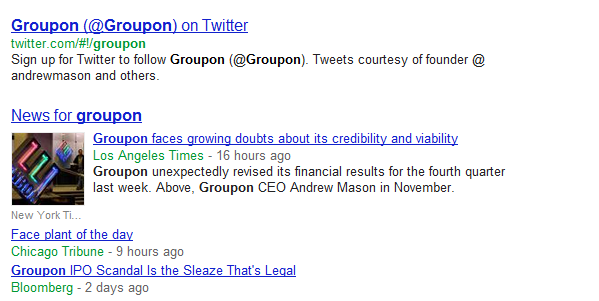
From this morning, a search on Groupon returned these results:

Google News algorithms put the Enron logo next to a story about Groupon

Google News algorithms put the Enron logo next to a story about Groupon

I think I’ve made the Groupon and Enron comparison myself. In both cases, you had high-flying companies that focused on short-term growth while ignoring the underlying risks of what they were creating.

One of the challenges of negative press like this is that Groupon is dependent on cash flow from selling new deals to pay off merchants from old deals.

The right way to think about Groupon is as a currency. Such constant bad press could create a confidence crisis in the Groupon currency. Small businesses who do the most basic due diligence (Google “Groupon”) will see the negative news and refuse to run new deals. It will exacerbate Groupon’s adverse selection problem, meaning only shakier and shakier businesses will run Groupons, increasing Groupon’s refund liabilities. (If you were on the bubble about running a Groupon, the bad press will sway you toward not running one.)

Consumers will also stop buying deals. It could also lead payment processors like Chase Paymentech and American Express to terminate their merchant relationships, which would also lead to cash-flow issues for Groupon.

If the Groupon currency market were as efficient as bond markets, this news would cause Groupon to collapse overnight like Lehman Brothers. Fortunately for Groupon, the market is not that efficient.

Groupon customers outside of the United States and Canada will also be hurt because Groupon generally holds on to their money until a Groupon is redeemed.

When Groupon collapses, it will cause some serious pain for Chase Paymentech and possibly American Express. I estimate that Chase has at least $500 million in chargeback liabilities if Groupon goes under. But because Groupon doesn’t accurately track which Groupons were redeemed, this liability could be much higher. Any consumer who had purchased a Groupon could claim they didn’t get what they paid for. I called on credit card companies to take a look at their exposure from Groupon months ago in a Bloomberg West appearance.

The biggest losers in a Groupon collapse would be the small businesses who run Groupons. As of the end of the 4th quarter, Groupon owed small businesses $520 million. This number is likely at least $100 million higher. These are people who can hardly afford to take a hit of several thousand dollars.

The other potential loser is Ernst & Young, the auditor that signed off on revision after revision of Groupon’s bogus financial statements. (Though I don’t expect Groupon to take down Ernst & Young like Enron took down Arthur Andersen.) I’m not ordinarily one to call for Congressional hearings, but E&Y deserves to be raked over the coals for sanctioning Groupon’s financials.

Oh, and a note to the Los Angeles Times: I fully expected this.

See my worst-case scenario of what happens if Groupon collapses. Also see my collection of Groupon stories following the restatement.

Disclosure: I have investments and several ongoing bets related to Groupon.

Posted in daily deals, groupon | 2 Comments

Why I like the American Express approach to offers

I am in Las Vegas and went out to dinner last night a the Public House, a fantastic restaurant at the Venetian.

We were having a great meal when several of us decided to check in on foursquare. (Hey, we’re from San Francisco, we do dorky things!) We noticed a check-in special for a free house beer with purchase of an entree. All of us had entrees, so two of us decided to get beer.

I asked the waiter for the house beers. He pointed to the beer list and we ordered.

When the check came, we showed our phones with the offer. He then told us that the offer was only good on a specific beer, not the beers we ordered. (There was no mention of this on the offer.)

This added some friction to an otherwise pleasant meal. He also went to check with the manager who refused to do anything. (It would have been $15-20 on a $210 tab.) He also told us that we should have showed our phones when order the beers so that he could direct us to the discount. At a fancy restaurant where I’m out with friends, I don’t want to have to show a phone for a discount, especially during the meal.

While I understand the need to have restrictions, there is the tradeoff with the consumer experience. One of the things I love about the American Express approach to offers is that I don’t have to worry about whether I get the deal I was promised. It’s automatic as soon as I swipe the card. There’s no presenting anything, there’s no arguing. From a business owner’s perspective, this adds a number of benefits: no staff training, no POS integration and a better guest experience.

And I get a confirmation within seconds of completing my transaction.

Posted in Uncategorized | 1 Comment

RockyDeals: Chance to win a pitch meeting

Earlier this week, I interviewed Albert Wenger of Union Square Ventures.

I really love what Albert had to share and want to get as money people as possible to listen to it.

If you listen to the interview and send me a summary of your startup’s pitch, I will select at least 3 for a meeting.

After you’ve listened, email me at redesign@agrawals.org.

Posted in Uncategorized | 1 Comment

Are LivingSocial, Google Offers and the rest as bad as Groupon?

IMPORTANT: Please see this page to see my current interests in Groupon.

Whenever I get into Groupon mode, people ask me about how LivingSocial and Google Offers are different from Groupon.

In many ways, they are the same. Any model that gives businesses cash early on in exchange for a promise of service to be delivered later is a financing business, not a marketing business. I use the analogy of receivables factoring or payday lending to describe the core U.S. Groupon business model. That also applies to LivingSocial’s and Google Offers’ daily deals product. Whenever you do that, you have a risk management issue. And I believe that no one in the space is handling the risk appropriately.

As a point of comparison, I tried one of my fraud tests against Square. About $11 in transactions that fit a pattern of potential fraud were enough to get my account shut down. Yet Groupon and LivingSocial are writing checks for tens of thousands with very little fraud prevention.

But there are some very significant differences among the players in the space:

  • Scale. Groupon has the most scale by far. On a revenue basis, they are roughly 4x as large as LivingSocial, the #2 player.
  • Management team. Groupon co-founder and executive chairman Eric Lefkofsky has a checkered past with his previous companies. The pattern is the same: he gets rich and investors lose. This CNN article is a must read for anyone interested in Groupon. Lefkofsky and his affiliated entities took nearly $400 million out of Groupon before the company went public. I worked with LivingSocial CEO Tim O’Shaughnessy during my time at Aol (although not closely). There was nothing in my interactions with him that suggested anything sketchy. He just struck me as an ambitious and energetic guy. It’s hard for me to believe that a $10 billion public company has a PR team as grossly incompetent as Groupon’s. LivingSocial’s is among the best I’ve ever worked with. (Disclosure: I worked with LivingSocial’s head of PR at Aol. He was the PR lead on one project I worked on. Groupon refuses to talk to me.)
  • Company structure. Groupon is an independent public company, which means its moves are analyzed differently than LivingSocial’s (which is private) and Google Offers (which is too small to be material in Google’s results). This means they have to act very differently. Even if Andrew Mason agreed 100% with everything I’ve written, he might not be able to take corrective action because most of the necessary steps would require short-term revenue declines. LivingSocial, on the other hand, can do away with underperforming products like LivingSocial Instant. Because Offers is a tiny part of Google’s business, they can afford to build for the long term and do the right thing for small businesses as opposed to trying to extract as much money as possible now to satisfy Wall Street.
  • Innovation. Although LivingSocial essentially ripped off Groupon’s business model, it has been much more innovative since. As a smaller company that is not subject to Wall Street pressures yet, it is able to try a lot of new businesses and see what works. This flexibility may be what saves LivingSocial while Groupon has to double down on a stupid business model to show revenue growth.
  • A different focus. Groupon has set its brand to be all about price, which attracts the wrong set of customers for small businesses. Businesses want high-value customers, not cheapskates who will never return at full price. Just the brand names make a difference: Groupon sounds cheap; LivingSocial almost sounds classy. This may sound like a cheap shot, but I believe it makes a meaningful difference.
  • Risk mitigation. LivingSocial has sales people on the ground in most of its markets. They actually visit the businesses and talk with business owners. Groupon has a lot of people in call centers in Chicago. Although LivingSocial has had its share of deals that go bad, having feet on the street is an important risk mitigation function. In theory, LivingSocial sales people can see if a business is shoddy or has gaping flaws that would turn off customers. I’m sure they’re not trained to evaluate risk as someone who knew they were in the receivables financing business would be, but it’s better than nothing. There are also structural differences: by being in market, LivingSocial salespeople don’t have as much incentive to screw over small businesses because they may have to revisit them. Groupon, with its call centers, creates bad incentives because sales people screw over businesses in smaller markets in order to get promoted into bigger markets where they get promoted.
  • Groupon Promise. The Groupon Promise is the proximate cause of Groupon’s earnings re-statement on Friday. (There are others, but I’m simplifying.) LivingSocial and other players have not had anything like it. This creates a lot of overhang for Groupon in that they’re unconditionally backing the performance of small businesses over whom they have little control. It also opens Groupon up to refund abuse by consumers who just take advantage of the promise. As a consumer value proposition, it sounds great. But it creates a lot of risk for the business financially. It also creates legal and regulatory risk if they don’t live up to that promise.
Posted in daily deals, google, groupon, livingsocial | 1 Comment

USV’s Albert Wegner talks about the state of Internet investing

I had a chance to sit down with Albert Wegner of Union Square Ventures yesterday as part of a book I’m working on.

Wegner is a gracious and brilliant man. He offered his insights on a wide range of topics. It’s a must listen for any entrepreneur or investor. If you’re not already a reader of his blog, Continuations, you should be. It’s fantastic.

I will be using this content for a book as well as blog posts. But in the spirit of the Internet, I’m making the audio available in advance.

Among the topics we covered:

  • Current valuations in private markets.
  • The rise of mobile.
  • Network effects businesses.
  • Advice for public market investors thinking about Internet companies.
  • Decline of newspaper industry.
  • Groupon.
  • JOBS Act.
  • Kozmo vs. Postmates.
  • How the IPO process can be improved.
  • Agency problems between GPs and LPs.

I don’t have the time right now to transcribe this. So I’m going to start an experiment: I’ve created a Google Doc. Anyone is welcome to edit it.


Posted in Uncategorized | Comments Off on USV’s Albert Wegner talks about the state of Internet investing

Best practices for April Fool’s Day

My April Fool’s Day went much better than I expected with a lot of people believing that I joined Groupon. As you probably know by now, I didn’t actually join Groupon. In fact, I was on CNBC this afternoon talking about how I believe it will go to zero without significants changes in its model.

One of the things that struck me was how powerful social media have become. I got a number of inquiries from reporters about the move. Clearly, something like this was material news that might move Groupon’s stock.

Based on my experience, here are some best practices on April Fool’s:

For pranksters

  • Make it believable. Don’t make your jokes so ridiculous that no one would think it was possible. In my post, I criticized Groupon and didn’t talk about what a great company it was because no one would believe those words coming from me. Some people told me that “forward looking statements” footnote made it seem more authentic. I actually cut and pasted that from a Groupon press release. But I also added in a sentence: “The SEC particularly advises investors to be skeptical of announcements posted on April 1 of any year.” (This is why you should read footnotes in financial statements!)
  • Go all in. My prank spanned my blog, Twitter, Facebook, Quora, LinkedIn and foursquare. If you checked out my other presences, you would have seen a consistent story.
  • But know your limits. There are some lines you shouldn’t cross. Even though I could’ve played the prank out on TV or in other media outlets, that would have been wrong. I would not agree to do TV or interviews where I was spreading false information. I also would not have done this on a day that the market was open.
  • Be self-deprecating. Throughout the day, I retweeted tweets that called me a sellout or worse.

For prankees

  • Read the comments. Inevitably, someone will spoil the prank in the comments. I tried to remove some of the most obvious comments throughout the day. (But I was offline a lot of the day, so some slipped through.)
  • Respect the game. It may be tempting to show how smart you are by commenting that it’s a prank. Instead, privately let the person know that you got it. (I had quite a few people IM, SMS and email me.) If you must comment, make it oblique.
  • Spread the joy. Special thanks to Kevin Nakao, Arnie Gullov-Singh and Marc Bodnick for moving the prank forward.

As to whether I would actually join Groupon if they offered me a job… that’s a post for another day!

Posted in groupon | 3 Comments