There are many things I hate about Facebook’s Photos application:
- It doesn’t support high resolution photos.
- I get a Java cache error every time I try to upload pictures.
- You can’t search the pictures.
- It doesn’t use commonly provided EXIF data, including timestamps and orientation.
- It won’t read tags and captions embedded in pictures.
- I can’t see my pictures on a map.
Flickr doesn’t have any of these problems. But flickr lacks one thing that makes Facebook’s Photos truly compelling: the social graph. People tagging is the basis of an incredibly powerful distribution and recirculation engine.
I uploaded the same set of pictures to flickr and to Facebook last night.
When I added the people tags, each of the people I tagged received a message that there was a new picture of them online. Who wouldn’t want to log in to see what kind of potentially embarrassing pictures might be up there? When they logged in to view the pictures, some of them also left comments. Which triggered a message to me saying people left comments. And then I logged in to see the comments.
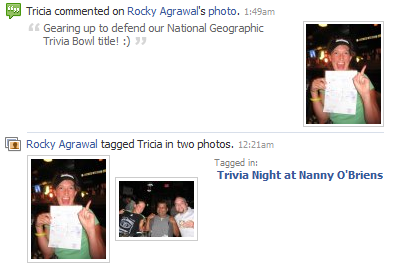
I didn’t know all of the people in my pictures. One of my friends tagged a few other people in my pictures. Which triggered notifications to those people.
You can also tag people who aren’t on Facebook by providing their email address. Yet another way for Facebook to grow their user base.
People who weren’t in the pictures — my friends or friends of people I tagged — saw messages in their news feeds, furthering the distribution.
In less than 24 hours, the pictures received four comments. The same pictures on flickr didn’t receive any.
 Rakesh Agrawal's blog
11 responses
[…] It’s surprisingly addictive and it forms the basis of the real power of Facebook photos. More on that later. […]
[…] almost-connection was facilitated by Facebook’s social graph and status updates. Next time I’m in Boston, I know to look Chike up. Twitter, Jaiku […]
[…] a lofty $15 billion valuation. People clearly want to share their information with their friends. Facebook Photos significantly reduces the friction in viewing photos; as a result it has quickly become the number one photo sharing site on the […]
[…] When it comes to restaurant reviews and recommendations, most people are looking for “good enough”. While you could spend hours reading every Yelp review of several restaurants and possibly get a better answer, a recommendation based on your friends’ activity is probably nearly as good. Facebook has done really well with good enough; Facebook Photos dominates online photo sharing, despite many functional weaknesses when compared wit…. […]
Is Facebook Photo tagging the most viral social mechanic ever invented?…
It’s pretty high up there, right next to Hotmail’s tag line appended to sent messages when it launched. Think about the impact: you tag someone, they log into the site, maybe leave a comment, that comment spurs more interaction. The fact that you can…
What factors led to Twitter’s growth?…
The three things I’ve found about people in designing products are that people are lazy, selfish and vain. Twitter hits the trifecta: * Lazy. No worrying about writing thoughtful blog posts that are coherent. You can tap out a tweet in less than 30 se…
Where does Google get the data and confidence that playing catch-up with Yelp and Foursquare with checkins and Facebook with social profiles is the right thing to do and that they will eventually catch up?…
I would put Yelp and foursquare into a different bucket than Facebook. Yelp/foursquare are still very small relative to Google. Google can get more users to its sites almost by accident as people trip into it from other Google properties. Many casual u…
[…] I’ve deliberately avoided doing a feature-by-feature checklist. Having the most features rarely matters. Flickr has been trounced in the photo sharing space by Facebook, despite having many more features for photo lovers. The sheer size of Facebook’s distribution system was enough to overcome its feature gaps. […]
[…] The power of the social graph […]
The experience is the product — thoughts on holistic product design…
Apple retail stores celebrated their 10th anniversary last week. The stores have defied all analyst expectations and have become the highest grossing retailers in the world. The company’s market cap exceeds all of the other players in tech. Its $5,000 …
[…] of the company’s growth is the people-tagging feature in Facebook. Even though Flickr was a better product than Facebook Photos for many years, the virality of people-tagging rocketed Facebook to the top of the photo-sharing […]